

Most aches during marathon training are normal adaptation: broad muscle soreness that is worst the day after a long run, eases once you warm up, and settles within a couple of days. Pain that sits in one spot, builds as the run goes on, changes the way you run, or hangs around at rest is more likely to be an injury, and it needs a different plan.
Marathon training asks you to put up with some discomfort on purpose, which is what makes this hard. The skill is telling apart the soreness that means your legs are adapting from the pain that means one tissue is falling behind the load you are putting through it.
The short version
- Diffuse soreness that eases as you warm up is usually normal adaptation.
- Pain in one spot that worsens during a run usually means injury.
- Shin, Achilles and heel problems are the most common running injuries.
- Big jumps in weekly mileage are linked to more overuse injuries.
- Bone that is tender to press, or a hot swollen calf, needs checking.
What normal training soreness feels like
Long runs damage muscle in small amounts, and that is part of how the legs adapt. In a study of runners who finished a full marathon, soreness peaked immediately after the race while blood markers of muscle damage peaked the following day. Another small study found soreness peaked on the night after the race, calf and hamstring tightness peaked on day two, and tightness had still not returned to normal by day five. A training long run is a smaller dose than a race, but the pattern is the same.
The typical picture of normal soreness is both legs, spread across big muscle groups like the thighs and calves, stiff for the first few minutes, loosening as you get going, and a little better each day. It does not make you limp and it does not change your stride.
The signs that point to injury rather than adaptation
These are the patterns that make an injury more likely than ordinary soreness:
- You can point to the pain with one finger.
- It is on one side only.
- It gets worse as the run goes on instead of easing.
- It makes you shorten your stride, limp or run differently.
- It is there at rest or at night, or it is worse each week.
- There is swelling, or a patch of bone is tender when you press it.
Some pain during training can be managed without stopping. In a randomised trial of 38 people with Achilles tendinopathy, those allowed to keep running and jumping under a pain-monitoring model did as well over 12 months as those told to stop for six weeks, with both groups improving substantially. A rule of thumb many clinicians use is that pain during a run should stay mild, settle by the next morning, and not creep up from one week to the next. If it breaks any of those three, the load is too high for now.
The injuries marathon runners get most often
A systematic review covering 3,500 runners found the most common running injuries were medial tibial stress syndrome (shin splints, incidence 13.6% to 20%), Achilles tendinopathy (9.1% to 10.9%) and plantar fasciitis (4.5% to 10%). In ultra-marathon runners, Achilles tendinopathy and patellofemoral pain at the front of the knee led the list.
The NHS describes shin splints as pain and tenderness along the front of the lower leg that usually gets better within a few weeks, with advice not to keep doing the exercise that caused it and to build back up slowly. We have separate guides on Achilles tendinopathy, plantar fasciitis, front-of-knee pain and ITB syndrome.
Bone stress injuries are the ones to take most seriously. A review in Current Osteoporosis Reports describes every bone stress injury in runners as a workload error, where the number and size of loading cycles exceeds what the bone can resist. Guidance on returning to running after a shin bone stress injury puts resolution of bony tenderness and pain-free walking ahead of any running at all. So a small patch of shin bone that hurts to press is the pattern that should be assessed, never run through.
Why pain often turns up around peak mileage
Injury risk tracks how much and how fast you add. A meta-analysis found 17.8 injuries per 1,000 hours of running in novice runners against 7.7 in recreational runners, so a first marathon block carries more risk than a fifth one.
The speed of progression matters too, though the evidence is softer than the old 10% rule suggests. In a cohort of 874 novice runners tracked by GPS, overall injury rates did not differ by how quickly people added distance. Runners who increased weekly distance by more than 30% over two weeks did have a higher rate of distance-related injuries such as shin splints, ITB syndrome and patellofemoral pain, with a hazard ratio of 1.59, although that result fell just short of statistical significance. The authors' advice was to keep weekly increases under 30%.
In practice, the weeks where the long run jumps, a hilly route comes in, and speed sessions start at the same time are the weeks where something tends to give.
What to do when something starts to hurt
Stopping everything is rarely necessary, and carrying on unchanged is rarely wise. The middle ground usually looks like this:
- Drop or shorten the session that provokes the pain first.
- Cut the long run back for a week or two rather than missing it entirely.
- Swap some runs for cycling or swimming to keep fitness ticking over.
- Keep a short note of pain during the run and the next morning.
- Reintroduce volume before speed once things settle.
If the pain is not improving after a week or two of reduced load, or it is getting worse, get it assessed. Two lost weeks in a 16-week block is recoverable. A stress fracture six weeks out from race day usually is not.
When a runner comes in mid-block, our osteopaths look at the training log as closely as the sore spot: what changed in the weeks before it started, how the long run has progressed, and what the race date allows. Treatment usually pairs hands-on work with a modified plan and specific strength work through our exercise rehabilitation service, so you keep training where it is safe to.
When to get help urgently
Most training pain can wait for a routine appointment. Some cannot. The NHS advises asking for an urgent GP appointment or calling 111 if you have throbbing pain and swelling in one calf, red or darkened skin, or swollen veins, which can be a blood clot. Call 999 if those symptoms come with breathlessness or chest pain.
After an injury, contact NHS 111 if you cannot put weight on the leg or walk more than a few steps, the swelling or pain is getting worse, or you also have a high temperature or feel hot, cold or shivery. Leg pain that comes with numbness, pins and needles or weakness is a different problem from a training ache and should be checked by a GP.
If this sounds like what you're dealing with, an assessment is the next step. Book online here.
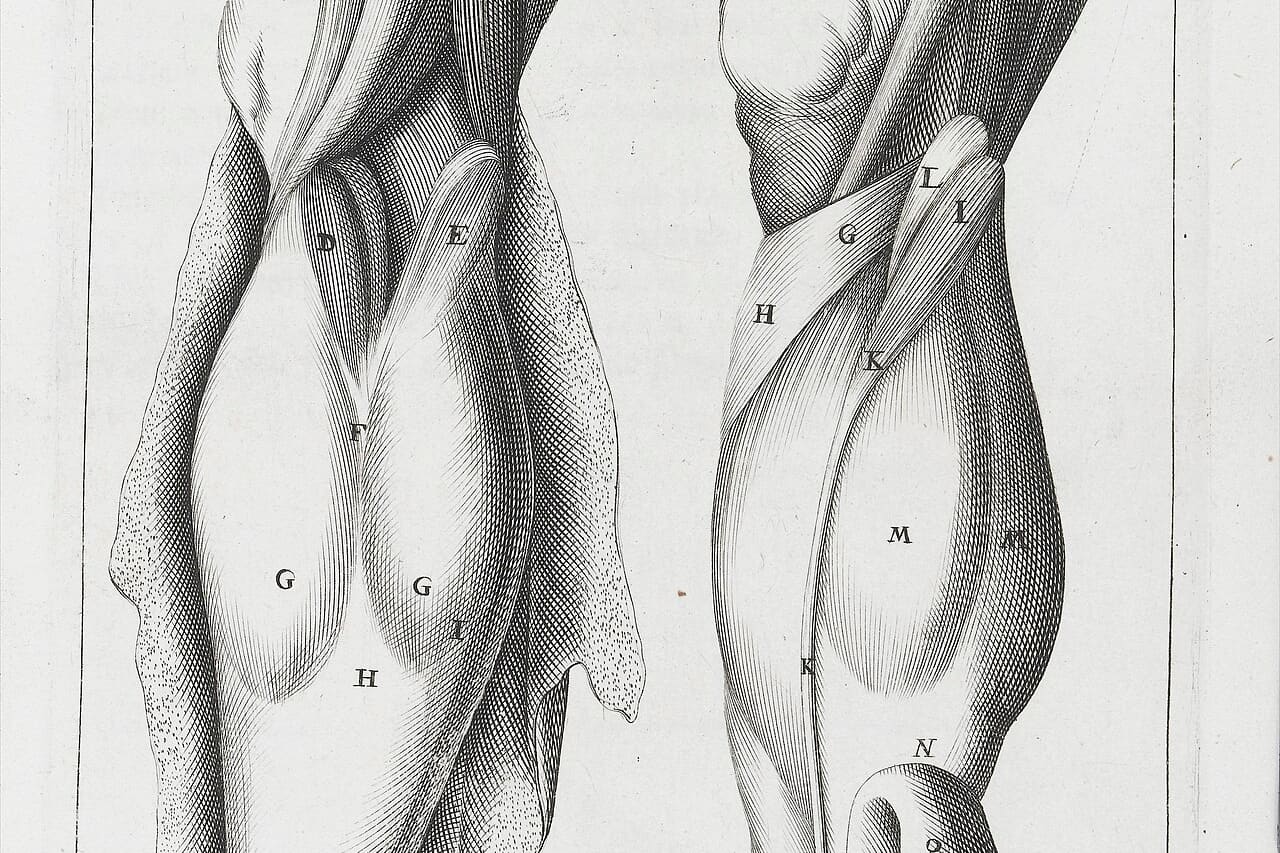
Illustration: muscles of the lower leg, Wellcome Collection, CC BY 4.0, via Wikimedia Commons.