

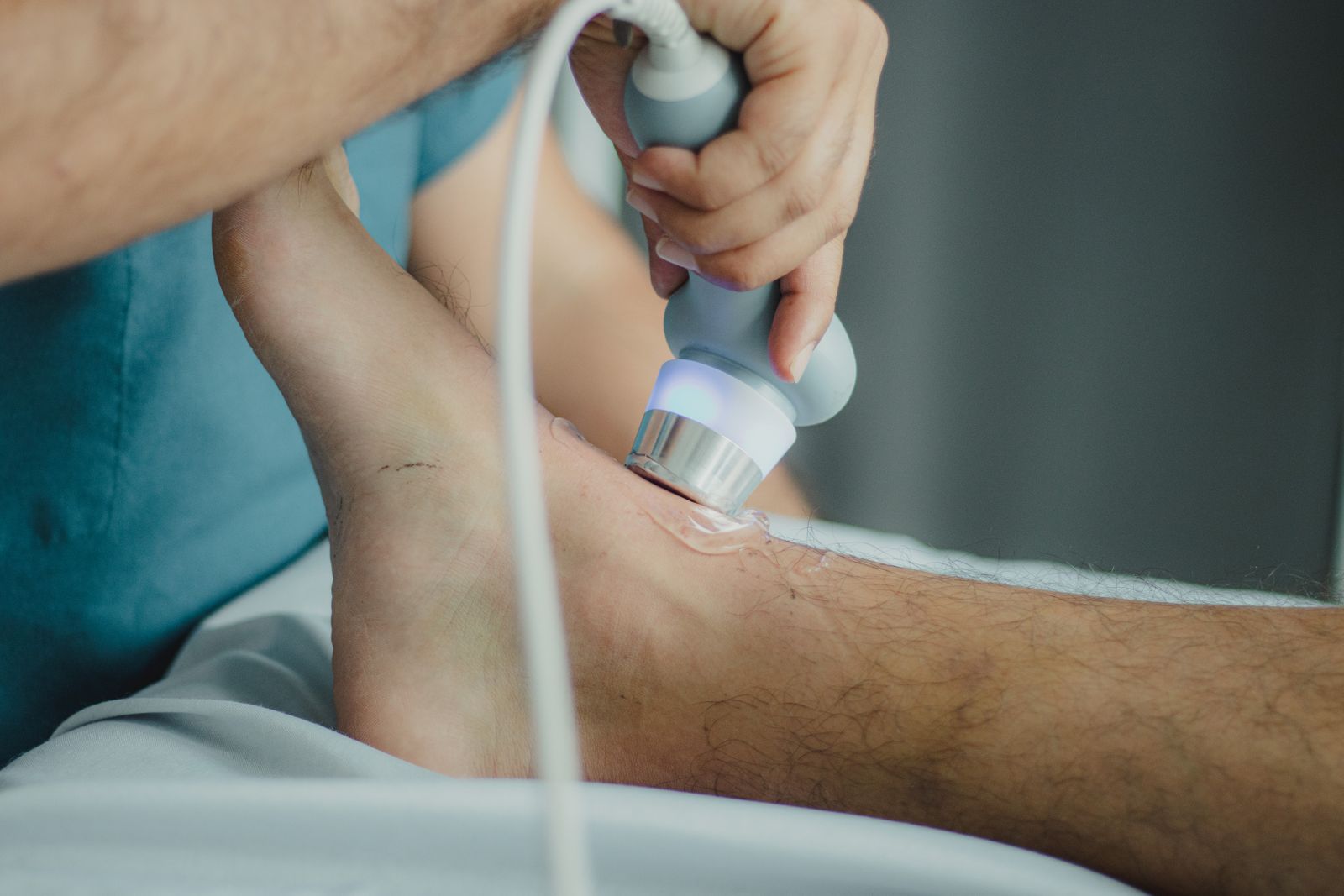
Pain and stiffness in the back of the ankle, either right at the heel or a few centimetres above it, is most often Achilles tendinopathy: a tendon that has been overloaded and irritated rather than torn. It is a loading problem at heart, which is exactly why the two things people try first, complete rest and stretching, so often leave them stuck.
The Achilles is the thick cord that runs from your calf muscles down to your heel bone. It takes several times your body weight every time you push off to walk or run, so when it starts to complain it needs managing, not ignoring. Here is what is actually going on and what tends to shift it.
The short version
- Achilles tendinopathy is an overloaded, irritated tendon, not usually a tear.
- Complete rest and stretching alone rarely settle it for good.
- Progressive calf strengthening is the best-supported treatment.
- Recovery takes months, and can take a year or longer.
- Sudden severe pain with loss of push-off needs urgent assessment.
What Achilles tendinopathy actually is
Achilles tendinopathy is defined by NICE as pain and loss of function in the tendon related to mechanical loading. In plain terms, the tendon has been asked to do more than it was ready for, too often, and its structure has started to change. For a long time it was called tendinitis, implying inflammation, but the tissue changes seen in long-standing cases look more like disorganised repair than classic inflammation.
It shows up in two main places. Non-insertional tendinopathy affects a section two to six centimetres above the heel and is the more common of the two. Insertional tendinopathy sits right where the tendon meets the heel bone. The distinction matters, because insertional problems tend to dislike being stretched or compressed against the bone, which changes how you load them.
The typical pattern is pain and stiffness first thing in the morning or when you start moving after sitting, easing as you warm up, then grumbling again afterwards. In the clinic team's experience, runners, walkers returning to activity after a break, and people who have suddenly ramped up hills or speed are the most common presentations.
Why rest and stretching so often disappoint
Rest feels like the obvious answer, and in the first few days of a very angry tendon, easing off genuinely helps. The trouble is that a tendon left completely unloaded gets weaker, not stronger. So the pain settles while you rest, then returns the moment you go back to your old activity, because nothing has changed the tendon's capacity to handle load. This is the loop that keeps people stuck for months.
Stretching has the same problem and sometimes a worse one. Pulling hard on an already-irritated tendon does not rebuild it, and for insertional cases, pressing the tendon against the heel bone at the end of a stretch can flare things up. The NHS advice on tendon problems leans on managing load and a gradual return to activity rather than aggressive stretching, and that matches what tends to work in practice.
None of this means you should never rest or never stretch. It means neither one, on its own, is the treatment. The tendon needs a reason to get stronger.
What actually helps: progressive loading
The best-supported treatment for Achilles tendinopathy is progressively loading the calf and tendon with strength work. The landmark study here is Alfredson's, which showed that a programme of heavy calf-loading exercises produced good results in people with long-standing Achilles pain who had otherwise been heading for surgery. The principle is simple: load the tendon in a controlled, graded way, and it adapts by getting stronger and more tolerant.
You do not have to do it one exact way. A later trial found that heavy slow resistance training worked about as well as the classic eccentric heel-drop programme, with patients often finding the slower, gym-style version easier to stick with. What matters is the load and the progression, not the exact protocol. A common approach is calf raises done slowly, with the load increased over weeks as the tendon copes, working to a level of discomfort that settles quickly rather than to sharp pain.
The detail is where people go wrong, which is where a structured plan earns its place. If you are not sure how much to load, how fast to progress, or whether yours is insertional or non-insertional, a tailored exercise rehabilitation programme built around your leg tends to beat guessing from a video online.
How long it takes to recover
This is the part patients least want to hear. Achilles tendinopathy is slow. NICE notes that full recovery can take a year or longer, and re-injury is common. Most people feel a change within a few weeks of loading properly, but resolving it fully is a matter of months, not days.
That slowness is not a sign the treatment is failing. Tendons adapt at their own pace, and the people who do best are usually the ones who keep loading consistently and resist the urge to test the tendon with a hard run every time it feels better. In my years of practice, the ones who recovered cleanly treated it like strength training with a long horizon, not a niggle to be rushed.
When to get it checked
Most Achilles pain is a loading problem you can work with, but a few signs mean you should get seen rather than push on. If you feel a sudden, severe pain at the back of the ankle, as if you had been struck or kicked there, sometimes with an audible sound as it happens, and you then struggle to walk or to push off and stand on tiptoe, treat it as a possible tendon rupture and get urgent advice from NHS 111 the same day.
See a GP if the pain has not started to improve within a few weeks of sensible self-care, or if it is severe enough to stop you doing normal daily activities. And if your calf becomes hot, swollen, red and painful without a clear injury, that needs urgent medical attention, since it can point to a blood clot rather than a tendon problem.
If this sounds like what you're dealing with, an assessment is the next step. Book online here.