

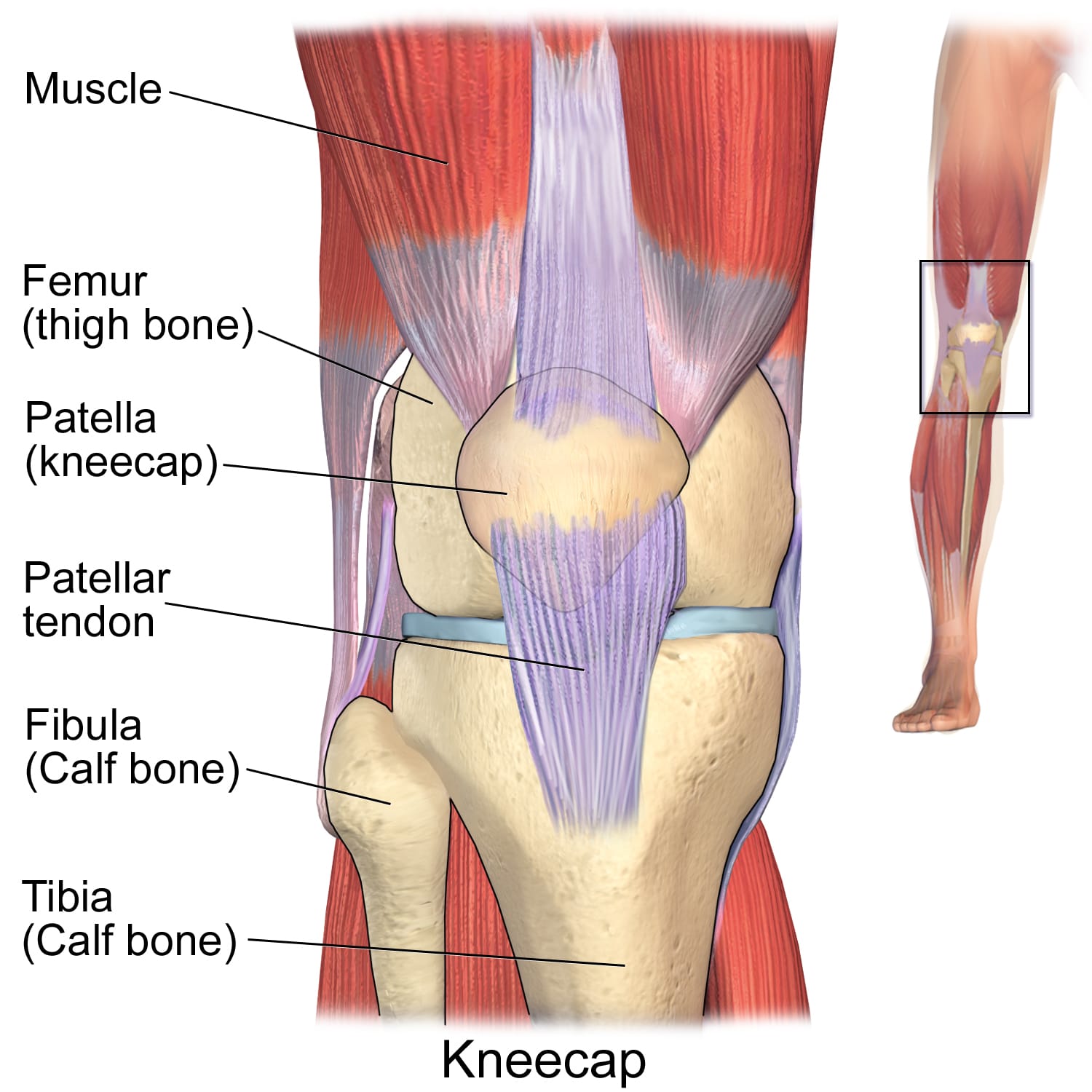
If the pain is at the front of your knee, around or behind the kneecap, and it built up gradually rather than starting with one obvious injury, patellofemoral pain is the most likely explanation. It hurts most on stairs, on squatting, and after sitting still for a long stretch. It is not arthritis and it is not a torn cartilage.
The short version
- Patellofemoral pain is pain around or behind the kneecap, not in the joint line.
- It builds gradually. Stairs, squatting and long sitting make it worse.
- Hip-focused and knee-focused exercise work about equally well.
- Manipulation on its own and electrical treatments are not recommended for it.
- See a GP if the knee locks, gives way or swells badly.
What patellofemoral pain actually is
Your kneecap sits in a shallow groove at the bottom of the thigh bone and slides through that groove every time you bend and straighten the knee. It is not a loose bone floating over the joint. It is set into the quadriceps tendon and works as a lever, which is why it gets pressed back against the thigh bone whenever the knee bends under load.
The deeper the bend and the heavier the load, the harder that contact gets. Stairs, hills, squats, lunges and kneeling all raise it. Patellofemoral pain is what happens when the tissue in and around that joint becomes sensitive to loads it used to handle without complaint.
The name matters, because the old ones were misleading. An international consensus group settled on patellofemoral pain as the umbrella term, moving away from labels like chondromalacia patellae, which implied damaged cartilage that is often not there, and runner's knee, which implies you have to be a runner (2016 consensus statement, part 1). It is not a niche sports problem. It affects a large proportion of the population, from adolescents to older adults.
The pattern the clinic team sees most
Onset is gradual. Most people cannot name the day it started, only a few weeks in which it got steadily more annoying. Ask someone to point at the pain and they tend to cup the whole kneecap with a hand rather than put one finger on a spot.
Going down stairs is often worse than going up. Squatting, lunging and getting out of a low car seat provoke it. So does sitting for a long stretch with the knee bent, which is why it turns up on the Thameslink into St Pancras and in the cinema more than it does at a desk.
It usually follows a change in load rather than an injury. A new running plan, a return to the gym after a lay-off, a house move with a lot of stairs, a job that suddenly involves ladders. The knee was coping with the old dose and has not caught up with the new one.
What else front-of-knee pain can be
Patellofemoral pain is the most likely answer, not the only one. The NHS lists the common causes of knee pain, and a few are worth separating out:
- Patellar tendinopathy. The pain sits between the kneecap and the shin, and you can usually put one finger on it. Jumping and landing are the giveaway.
- Knee osteoarthritis. More likely over 50, often in both knees, with stiffness after rest and some mild swelling. Osteoarthritis can involve the kneecap joint itself, so the two overlap more than people expect.
- Meniscal or cartilage damage. There was usually a twist or a specific incident. The knee catches, gives way, or will not straighten fully.
- Bursitis. Warm and red, and kneeling makes it clearly worse.
- Osgood-Schlatter disease. Teenagers and young adults, with pain and swelling on the bony bump below the kneecap.
One more thing our osteopaths always check: the hip can refer pain to the knee, particularly in children and teenagers. If the knee examines clean and the pain is still there, the hip gets assessed properly.
What actually helps
Exercise. That is the short answer, and the evidence behind it is reasonably consistent. The 2018 international consensus statement recommends exercise therapy, particularly combining hip-focused and knee-focused work, along with combined interventions and foot orthoses, to improve pain and function.
What it does not tell you is which exercises. A 2023 trial in the British Journal of Sports Medicine took 200 people with patellofemoral pain and put half on a 12-week quadriceps programme and half on a 12-week hip programme. The two came out equivalent, with 0.6 points between them on a 100-point knee score.
Read the rest of that trial and it gets more honest. Neither group's average improvement crossed the threshold the researchers had set in advance for a change a patient would actually notice. Twelve weeks of exercise produced modest average results. Some people did considerably better than average, some worse.
Two practical things come out of that. First, if hip work and quadriceps work perform the same, pick the one you will keep doing and load it properly. Second, 12 weeks is a starting point rather than a finish line. In our clinical experience the people who do well are the ones who carry on progressing the load after the pain settles, instead of stopping the moment it stops hurting.
For the first few days of a bad flare, the NHS self-care advice is sensible: keep weight off it where you can, use an ice pack for up to 20 minutes every two to three hours, and take paracetamol or ibuprofen if you need to. Reduce the aggravating dose rather than stopping everything. Complete rest tends to leave you with the same knee and less capacity to use it.
What does not help, and what we still do not know
The 2018 consensus is equally clear about what to leave out. Mobilisation of the kneecap, the knee or the lower back, used on its own, is not recommended for patellofemoral pain. Neither are electrophysical agents, the ultrasound and electrical stimulation machines still found in some clinics.
Genuinely uncertain, in the panel's own words: taping and bracing, acupuncture and dry needling, manual soft tissue techniques, blood flow restriction training and gait retraining. Uncertain is not the same as useless. It means the trials are not yet good enough to tell you either way.
Some of that covers what we do here, and it is worth saying plainly. Hands-on treatment can make a sore knee more comfortable and easier to load in the short term, which matters when someone cannot get started on the exercise at all. It is not a treatment for patellofemoral pain on its own, and a clinic telling you otherwise is overselling.
One myth worth putting down while we are here. Your kneecap is not sitting in the wrong place and does not need putting back. It is where it belongs.
When to see a GP or call 111
Most front-of-knee pain is not sinister, but a few features need attention the same day. NHS guidance is to get advice from 111 straight away if:
- the knee is very painful
- you cannot move it or put any weight on it
- it is badly swollen or has changed shape
- it locks or gives way
- you have a very high temperature, or feel hot, cold or shivery, with redness or heat around the knee, which can signal infection
See a GP if knee pain has not improved within a few weeks. In many areas you can also refer yourself to an NHS community musculoskeletal service without going through a GP, which is worth knowing before you pay anyone privately.
What an assessment looks like here
An initial assessment is 45 minutes and costs £75. Follow-ups are 30 minutes at £60. Most of that first appointment goes on working out what changed, because patellofemoral pain nearly always has a load story behind it, and then on watching you move: a squat, a step down, single-leg control, and what the hip and ankle are contributing above and below.
After that you get hands-on work where it earns its place, and a programme you can realistically run and progress over the following weeks. Our knee pain treatment page covers how we work, and exercise rehabilitation is the part that does the heavy lifting for this particular problem.
If this sounds like what you're dealing with, an assessment is the next step. Book online here.
Image: "Kneecap" by BruceBlaus, used under CC BY 3.0, via Wikimedia Commons.