

If your child plays sport around Luton and has heel or knee pain on one side that gets worse during training, it is usually not growing pains. The likelier cause is a load injury at a growth plate: Sever's disease at the heel, Osgood-Schlatter at the knee. Both are common in school-age athletes, and both tend to settle with managed load rather than a total break from sport.
The short version
- Growing pains affect both legs, come at night, and settle by morning.
- One sided pain that worsens with training points to a growth plate injury.
- Sever's disease is the most common cause of heel pain in children.
- Osgood-Schlatter affects up to 10% of adolescents and hits the knee.
- Most cases improve with managed load rather than complete rest from sport.
Growing pains are real, but they look different
The NHS describes growing pains as leg pain in children aged 3 to 12: aching or throbbing in the muscles or joints of both legs, in the evening or at night, and gone by morning. It is harmless and gets better on its own. The NHS is also clear it is not caused by growing, and that it is more common in active children.
That description is the test. A twelve year old with a sore right heel after Sunday league, worse in the second half and fine by Wednesday, does not fit it. Nor does a fourteen year old with a tender lump below one kneecap that bites when they sprint. Those are load injuries with a location and a mechanism.
Sever's disease: heel pain in the 8 to 15 age group
Sever's disease, properly called calcaneal apophysitis, is the most common cause of heel pain in children, and it is associated with running and jumping sports such as football and basketball. The mechanism is repetitive stress on the growth plate at the back of the heel bone, where the Achilles tendon attaches. It is usually seen between the ages of 8 and 15, and a squeeze test across the back of the heel is normally enough to identify it.
A German youth football academy logged 4,326 injuries in 612 players over ten years, of which 22 were calcaneal apophysitis, an incidence of 0.36 cases per 100 athletes per year. Mean age at diagnosis was 11.8 and mean time back to playing was 60.7 days, with a wide spread around that. Roughly one in seven cases came back a second time.
On treatment, a 2024 review of eight randomised trials found conservative care helps symptoms, using insoles, exercise, taping and foot orthoses, though an earlier review found only limited evidence for heel raises and orthoses. The direction of travel is clear. The certainty is not.
Osgood-Schlatter: the sore lump below the kneecap
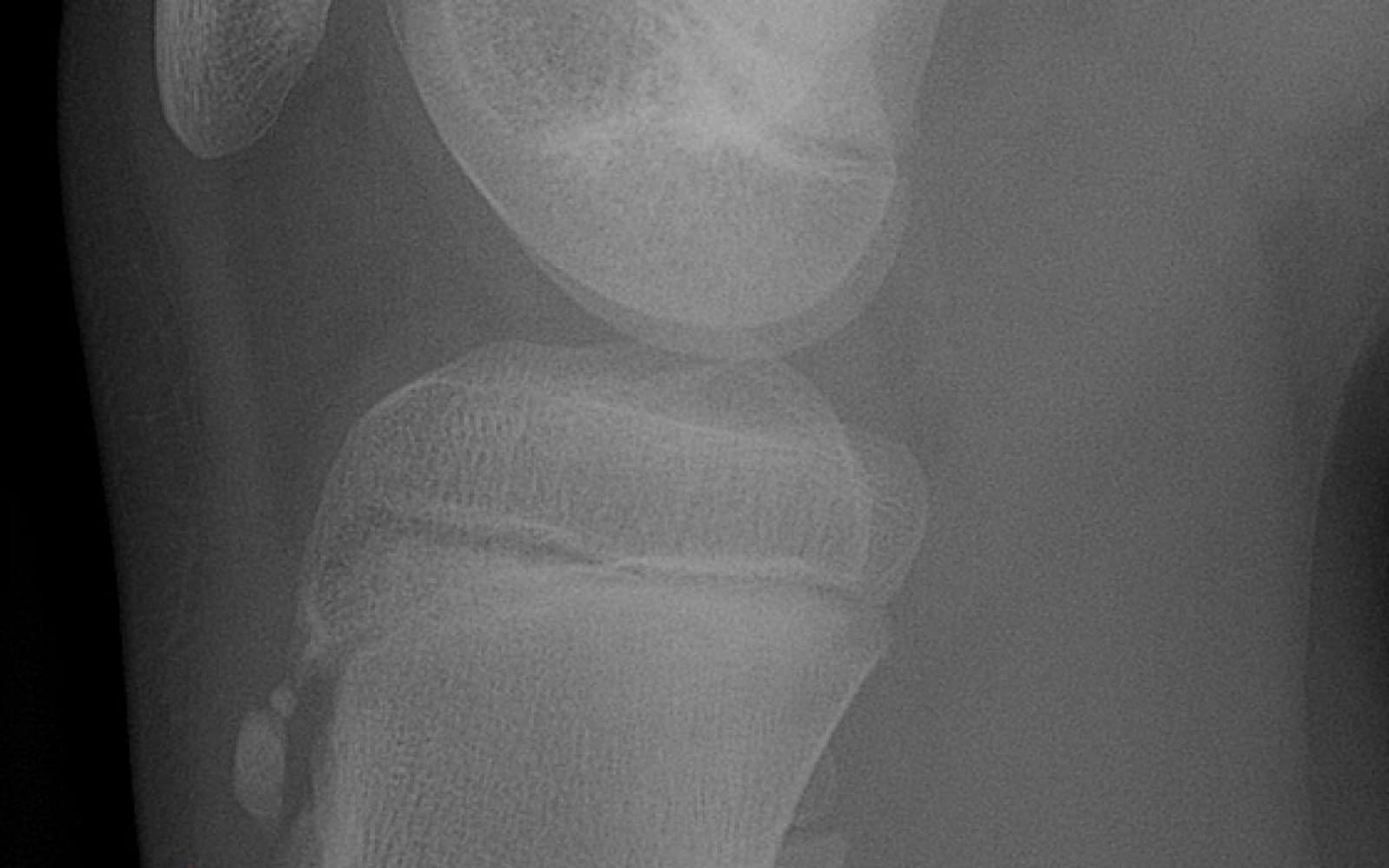
Osgood-Schlatter is a traction apophysitis of the tibial tubercle, the bony bump below the kneecap where the quadriceps tendon pulls into the shin. The NHS lists it under knee pain as the likely cause in teenagers and young adults with pain and swelling in that spot, and a systematic review puts it at up to 10% of adolescents. In adults, pain at the front of the knee is a different problem with a different cause.
It used to be called a boys' condition peaking at 12 to 15. A 2020 clinical review reports no clear difference in sex distribution now, attributed to more girls playing high impact sport, and puts conservative management as successful in over 90% of cases.
In a study of 280 young professional footballers aged 11 to 15, 10% were diagnosed with it, and treatment without immobilisation and without stopping sport had them back in around 27 days on average. The "they will grow out of it" line is less reliable than parents are told, though. A Danish follow up found 60.5% of respondents still reporting knee pain at a median of nearly four years, and over half of those had cut back their sport. It was small, retrospective, and only about half of those contacted replied, which probably tilts it towards people still in pain. It is still a reason to deal with it rather than wait.
Why the local fixture list matters
Stopsley sits in the middle of a busy youth sport catchment, and the clinic team treats young athletes from local football, rugby, running and combat sports clubs. The pattern behind most of these presentations is the same: a child playing school sport, a Sunday league club and an extra midweek session trains on more days than most adults manage, on a skeleton still laying bone down at the ends of the long bones. Volume climbs faster than the body adapts to it.
So look at what changed in the four to six weeks before the pain started. A step up in training days, a new position, a change of surface, new boots. That is where the answer usually sits, and it is the first thing we go through at our sports injury clinic in Luton. None of this argues for less sport. The NHS guideline for 5 to 18 year olds is an average of at least 60 minutes a day of moderate or vigorous activity, and the aim is managing how quickly load goes up, not cutting it.
What actually helps, and what the evidence will not support
In my years of practice, what changed the outcome in these cases was rarely a single stretch or an insole. It was the conversation about the training week. That is a clinical observation rather than a trial result, but it lines up with what the studies above did to get players back.
- Reduce the running and jumping load rather than stopping sport. The footballers above returned to training without immobilisation or a full break.
- Find the spare session. A child doing school sport, club sport and a midweek session is often carrying one too many.
- Load the muscles above the sore point. Quadriceps and hamstring work for the knee, calf work for the heel. The Osgood-Schlatter review names both as prevention measures.
- Keep pain relief simple. Ice, soft soled footwear and paracetamol or ibuprofen sit on the NHS self care lists for heel and knee pain.
- Expect weeks rather than days. Mean return to play in the heel study was two months.
What the evidence will not support is a confident claim about any one treatment. The Osgood-Schlatter review found only two randomised trials in the entire literature, of poor to moderate quality, and none comparing specific exercises against sham or usual care. Anyone offering a definitive protocol is going past what has been tested. Our exercise rehabilitation for these cases starts with load management, with the exercises chosen around the child's sport.
When to see a GP instead
Not all leg pain in a child is a sport injury. The NHS says to see a GP if your child has pain in one leg, leg pain in the morning or when walking or taking part in activities, pain bad enough to stop them walking or to make them limp, pain in a single joint such as the knee or ankle, a rash or swelling or unusual bruising on the legs, leg pain with a high temperature, unusual tiredness, or a loss of appetite or weight.
Several of those overlap with what I described earlier, and that overlap is the point. One sided leg pain in a child is a reason to have it examined rather than assumed. For the knee, the NHS advises getting advice from 111 straight away if the knee cannot take weight, is badly swollen or has changed shape, locks or gives way, or if there is a high temperature with redness and heat around the joint. A hot, swollen, painful joint in a child with a fever is a hospital problem, not one for a manual therapist.
Getting it assessed in Luton
An assessment here is mostly a conversation and an examination: the history of the pain, what the training week actually looks like, and a hands on check of the sore point plus the joints above and below it. Imaging rules other things out rather than making the diagnosis. Most of these children leave with a plan for their next month of training rather than an instruction to stop, and if it points to something outside our scope we say so and write to the GP.
The clinic is on Hitchin Road in Stopsley and sees around 100 patients a week, with families travelling in from Luton, Dunstable, Hitchin, Harpenden and Leighton Buzzard. An initial assessment is £75 and takes 45 minutes, and you do not need a GP referral. Adults arriving with knee pain from a different cause are assessed the same way.
If this sounds like what you're dealing with, an assessment is the next step. Book online here.
Image: lateral knee radiograph showing Osgood-Schlatter changes, by Lucien Monfils, used under CC BY-SA 3.0, via Wikimedia Commons.