

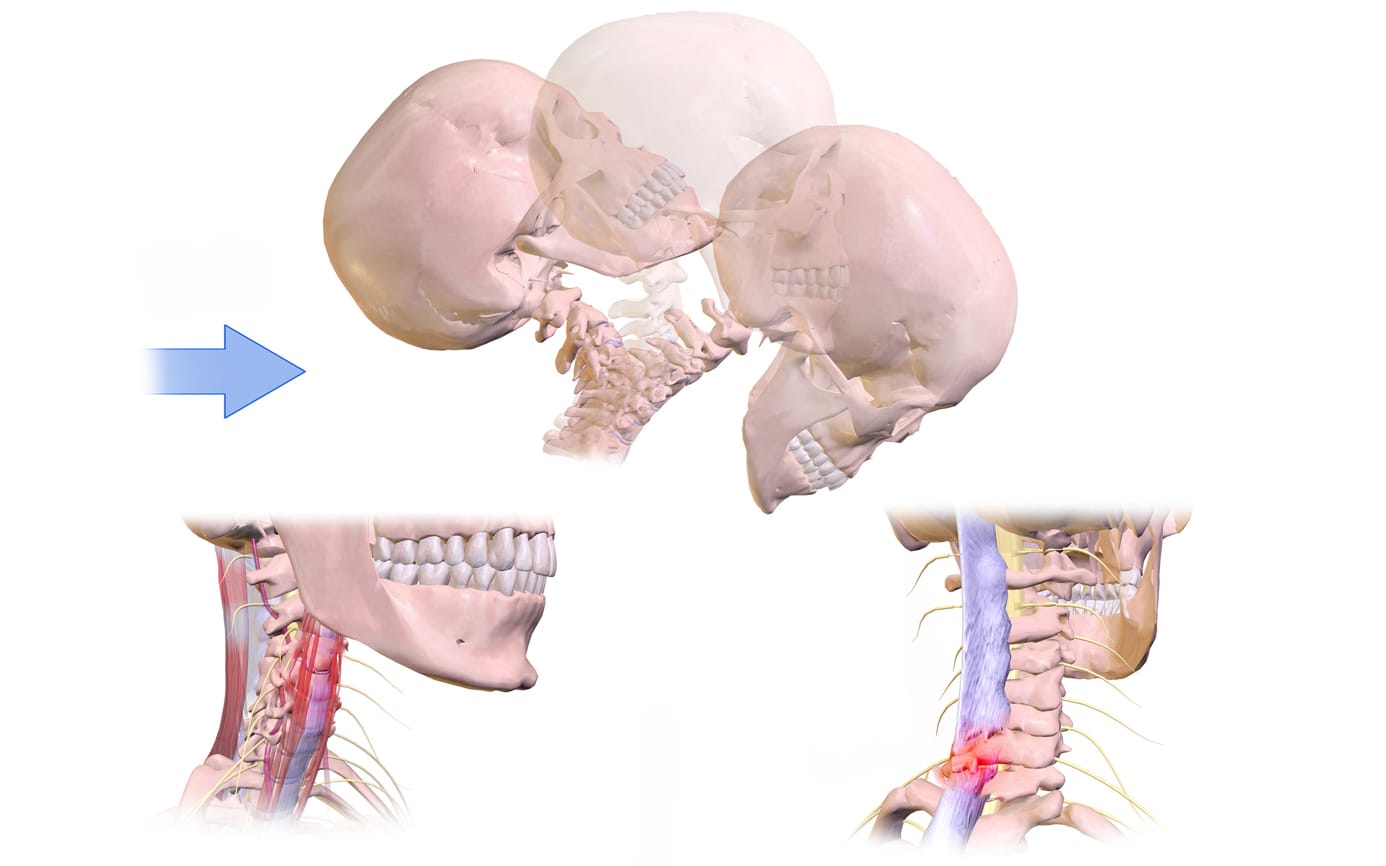
Most whiplash gets better within two to three months. The NHS puts it exactly that way, and the research agrees: the bulk of recovery happens in the first three months after the injury, then the curve flattens. Some people keep symptoms for longer, and the things that predict who does are mostly about how much it hurt early on and how the first few weeks are handled.
This post covers what whiplash is, what the recovery curve looks like, what slows it down, what tends to help, and when to get checked urgently.
The short version
- Whiplash is a neck injury caused by sudden movement of the head.
- Most recovery happens in the first three months, then levels off.
- Higher early pain and disability predict slower recovery.
- Collars and long rest do not help. Gentle everyday movement does.
- Tingling, weakness or electric-shock feelings after a neck injury need urgent advice.
What whiplash is
Whiplash is what happens when the head is thrown forwards and backwards faster than the neck muscles can control. It most often follows a road traffic collision, but a slip, a fall or a tackle in sport can do the same. The NHS lists the common symptoms as neck pain, neck stiffness and difficulty moving your head, headaches, and pain or muscle spasm in the shoulders and arms.
One detail catches people out. Symptoms can take several hours to start, so feeling fine at the roadside and stiff the next morning is a normal pattern rather than a sign that something new has gone wrong.
Whiplash is graded by severity, from grade 0 (no complaints or physical signs) to grade 4 (a fracture or dislocation). This post is about grades 1 and 2, where the problem is neck and musculoskeletal pain and stiffness.
The recovery curve
A 2008 systematic review in the journal Pain pooled 38 separate groups of people followed after car accidents. Recovery happened for a substantial proportion in the first three months, then recovery rates levelled off. Pain and disability dropped quickly in the early months and showed little further improvement after three months.
That shape matters. The first twelve weeks are when most of the change happens, so they are the weeks worth getting right.
It also means a sizeable minority do not fully settle. The Bone and Joint Decade Neck Pain Task Force, which reviewed the research up to 2006, concluded that around 50% of people with whiplash still report some neck pain a year after the injury. Some neck pain is not the same as being disabled by it, and many in that group are managing normal life. Still, it is a more honest figure than the "it will be gone in a fortnight" line people are often given.
What makes whiplash recovery slower
The best summary of who struggles comes from a 2013 meta-analysis of prognostic factors. The factors linked with a poorer outcome included:
- High pain early on (above 5.5 out of 10)
- High disability scores at the start
- Headache at the time of the injury
- Low back pain at the time of the injury
- Neck pain before the accident
- A higher grade of whiplash
- High catastrophising, meaning a strong tendency to expect the worst from the pain
- Female sex, less than post-secondary education, and not wearing a seatbelt
What did not predict a poor outcome is just as interesting. In that review, collision severity, rear-end collisions and older age showed no significant predictive value. The Task Force reached a similar view: few factors about the collision itself, such as the direction of impact or the type of headrest, made much difference, while passive coping, low mood and fear of movement were linked with slower or less complete recovery.
Put simply, how the crash happened tells you less than how the person is doing in the weeks after it. Several of those factors, such as fear of moving and passive coping, are things that good early advice can influence.
What tends to help
The NHS advice is to take paracetamol or ibuprofen for the pain, keep doing everyday activities even if it hurts a little, avoid a neck brace or collar, and avoid resting the neck for long periods.
The research backs the movement part. A Swedish randomised trial of 97 patients compared early active movement, mainly frequent gentle neck rotation done at home, against the older approach of rest, a soft collar and gradual self-mobilisation. At three years the active group had less pain and less sick leave. It was a small trial, but it points the same way as the NHS guidance.
What the research does not show is that more treatment is always better. The UK MINT trial in The Lancet followed 3,851 patients from NHS emergency departments. For people whose symptoms persisted, a package of up to six physiotherapy sessions gave a modest benefit at four months compared with a single advice session, but no difference at eight or twelve months. For whiplash that had already lasted more than three months, the PROMISE trial found a 20-session exercise programme was no better for pain than advice with telephone support at any point up to a year.
A 2007 Cochrane review of 23 trials concluded that the evidence neither supports nor refutes either passive or active treatments for grade 1 and 2 whiplash, largely because the studies were of poor quality and too varied to combine.
Where osteopathy fits
Given that evidence, no hands-on treatment should be sold as the thing that speeds whiplash up. Where an assessment earns its place is in checking the grade, ruling out the warning signs below, explaining what is happening, and setting a graded plan to get the neck moving and you back to normal activity. Some people find hands-on work makes movement more comfortable in the short term, which can help them keep going with the exercises. That is a reasonable use of it, and our post on where manual therapy earns its keep goes into the evidence in more detail.
In my years of practice, the whiplash patients who struggled most were often the ones who had been told to keep their neck still and wait. That is a clinical observation rather than a trial result, but it lines up with everything above.
When to get urgent help
According to the NHS, ask for an urgent GP appointment or contact NHS 111 if you have injured your neck and:
- you have severe pain despite taking paracetamol or ibuprofen
- you have tingling or pins and needles on one or both sides of your body
- you have problems walking or sitting upright
- you have a sudden electric-shock feeling in your neck and back, which may go into your arms and legs
- your hands, arms or legs feel weak
These can be signs of damage to the nerves in the neck or back. Do not drive or cycle until you have spoken to a GP or NHS 111. For less urgent cases, the NHS suggests seeing a GP if symptoms have not improved after a week or painkillers have not worked.
If your neck is still sore weeks after a collision and you want a clear plan, our neck pain treatment in Luton page explains how the clinic team approaches it. If this sounds like what you're dealing with, an assessment is the next step. Book online here.
Illustration: BruceBlaus, CC BY-SA 4.0, via Wikimedia Commons.