

Manual therapy earns its keep as a short-term way to ease pain and get someone moving again, and it works best as one part of a plan built around exercise. As the whole treatment, carried on for months, it rarely earns its fee. That is my opinion after years of practice, and it sits close to where the best current evidence lands.
By manual therapy I mean the hands-on part of what osteopaths, physiotherapists and chiropractors do: spinal manipulation, mobilisation of joints, and soft tissue work such as massage. I'm an osteopath and I run a clinic built around hands-on treatment, so I have every reason to oversell it. I'd rather tell you what I think it is good for.
The short version
- Hands-on treatment gives modest, short-term relief for many back and neck problems.
- Compared with other active treatments, it performs about the same for pain.
- NICE recommends it only alongside exercise, never on its own.
- Serious side effects are rare. Short-lived soreness is common.
- If you only ever lie on the couch, ask what the plan is.
Does manual therapy work? What the evidence says
The biggest body of research is on low back pain. The 2026 Cochrane review of spinal manipulation for chronic low back pain pooled 76 trials and 11,866 people. Against a sham treatment, manipulation reduced pain by about 7 points on a 100-point scale at one month, which is small, and the certainty of that evidence was rated very low. Against other conservative treatments such as exercise, it made little or no difference to pain and a small difference to function.
Several of that review's authors work as chiropractors in their own clinics. Nobody can call it a hatchet job on hands-on care, which is part of why I take it seriously.
For recent back pain the picture is a little better. A 2017 JAMA review of acute low back pain found manipulation was linked to an improvement of about 10 points on a 100-point pain scale, and a modest gain in function, at up to six weeks. That was moderate-quality evidence from 15 trials, with large differences between them.
Neck pain looks similar. A 2025 Cochrane review of manual therapy combined with exercise for neck pain found it improved function compared with a placebo, but made little or no difference to pain. Against no treatment at all it looked much better. My reading of that is that doing something active beats waiting, which is a lower bar than it sounds.
Where manual therapy earns its keep
In my view, the clearest value of hands-on treatment is early on, when pain is high and someone is wary of moving. A session that eases pain enough to walk, sleep or get through a working week buys time for the things that change the long-term picture: movement, gradually rebuilt load and confidence.
That is how NICE guideline NG59 frames it for low back pain, with or without sciatica: consider manipulation, mobilisation or massage, but only as part of a treatment package that includes exercise. The NICE osteoarthritis guideline says the same for hip and knee arthritis: only consider manual therapy alongside therapeutic exercise.
It also has a place in assessment. Moving a joint by hand and finding what reproduces the pain tells the practitioner a lot. And I think a patient who has felt a stiff area ease is more likely to give the home exercises a fair go.
Where it doesn't
Manual therapy on its own, week after week, with no exercise and no end point, is where I think the value runs out. NICE tells clinicians to explain to people with osteoarthritis that there is not enough evidence to support manual therapy alone. A 2022 review of 19 trials in hip and knee osteoarthritis found some short-term benefit from adding manual therapy to exercise, but high-certainty evidence of no added benefit in the long term.
There is also no good evidence that common back or neck pain comes from a bone being out of place, or that hands put one back. If a practitioner tells you your pelvis is out, or that you need monthly maintenance sessions to stay straight, ask what that is based on. I went through the reliability problem with those hands-on tests in the post on sacroiliac joint pain.
Why it helps when it does
The best current explanation is neurological rather than mechanical. A widely cited model of how manual therapy works proposes that the force of the technique sets off a chain of responses in the peripheral and central nervous system, and those responses drive the change in pain.
A good share of the effect also comes from the context: the explanation, the reassurance, the expectation of feeling better, and time with someone who listens. A 2024 review of placebo-controlled physiotherapy trials estimated that 88% of the immediate pain relief from joint mobilisation could not be put down to the technique itself. For exercise therapy the figure was 46%.
I don't see that as a con. Those effects are real and the patient feels them. I wrote more about it in the post on placebo and nocebo in pain treatment. It is a good reason, though, to be wary of anyone who claims their particular technique is special, and to judge treatment by whether you are moving and coping better over weeks.
Is manual therapy safe?
For most people, yes, with some short-lived soreness. The JAMA review found no serious adverse events in its trials, but minor ones such as increased pain, stiffness and headache were reported 50% to 67% of the time in large case series. In the Cochrane review, side effects were limited to muscle soreness, stiffness or a temporary increase in pain. For neck manipulation, a 2024 review of 14 trials found no higher rate of mild or moderate side effects than control treatments, though its authors point out that trials cannot detect rare serious events.
That last point matters. Rare events exist, which is why a proper history and screening come before any hands-on treatment.
Some symptoms need urgent medical care first. The NHS advises calling 999 or going to A&E if back pain comes with pain, tingling, weakness or numbness in both legs, loss of feeling around the genitals or anus, or changes in your bladder or bowels. Call 111 if you feel hot, cold, shivery or generally unwell with it, or if severe pain starts suddenly. See a GP if the pain is worse at night, you have lost weight without trying, or there is a lump or swelling in your back.
What to expect from any osteopath, including ours
Hands-on treatment should come with a reason, a plan and an end point. By the end of a first appointment you should know what the practitioner thinks is going on, what they are doing with their hands and why, and what you are doing between sessions. If the plan is only ever more sessions, ask how you will both know when to stop. I covered how long a course usually runs in how many osteopathy sessions you might need.
That is the standard I hold the clinic to. The clinic offers exercise rehabilitation alongside hands-on treatment so the hands-on part has something to hand over to.
If this sounds like what you're dealing with, an assessment is the next step. Book online here.
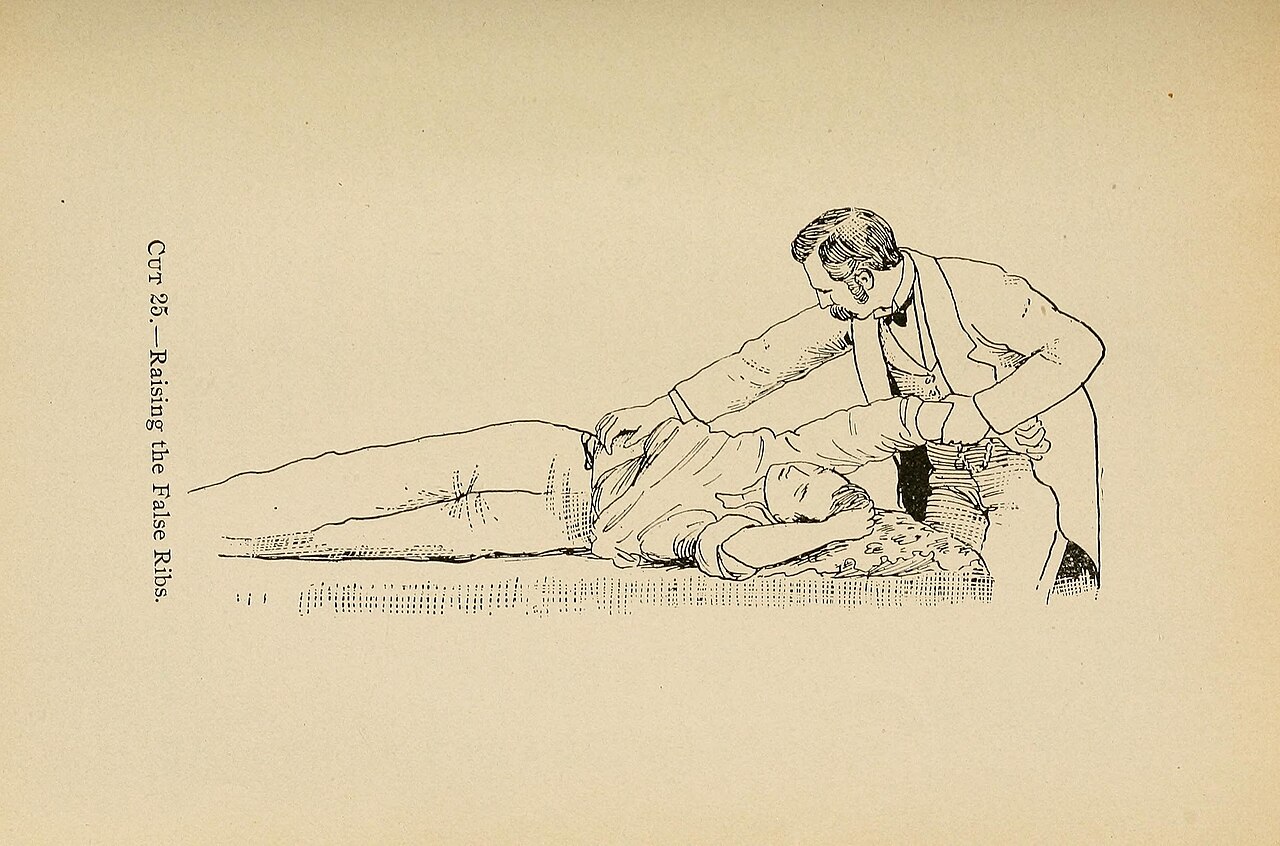
Illustration: "Raising the False Ribs", from Osteopathy Complete (1898), Internet Archive Book Images via Wikimedia Commons, no known copyright restrictions.