

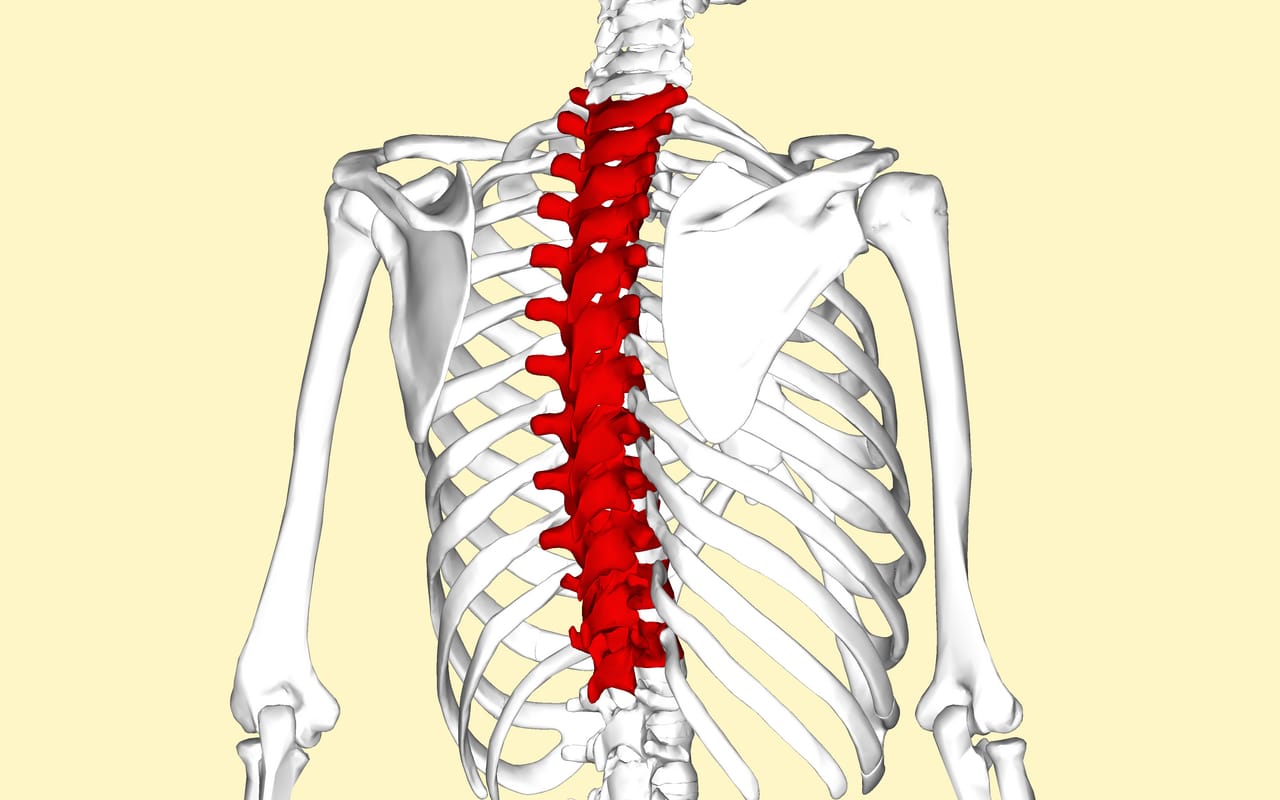
Most upper back stiffness in desk workers comes from the middle section of the spine and the muscles around the shoulder blades holding one forward-leaning position for hours. It is a load and tolerance problem in a part of the spine that is naturally less mobile than the neck or lower back, and it usually eases with regular movement and some targeted strength work.
The upper back is also the one area where the NHS asks you to be a bit more careful than usual, so this post covers both: the common desk pattern, and the short list of signs that mean it needs checking.
The short version
- Desk-related upper back stiffness is common and usually mechanical.
- Sustained forward posture loads the mid-back and shoulder blade muscles.
- Frequent short breaks shortened recovery from desk-related pain in a trial.
- Shoulder and upper back strength work reduced pain in office-worker trials.
- Upper back pain with chest pain or feeling unwell needs urgent checking.
Why the upper back stiffens at a desk
Your upper and middle back is the thoracic spine: twelve vertebrae, each one joined to a pair of ribs. That rib attachment is what makes this section stiffer than the neck above it or the lower back below it. It is built to protect the heart and lungs and to rotate, and it does less bending than people expect.
A desk asks it to do very little of what it is good at. Your arms reach forward to a keyboard and mouse, your head drifts towards the screen, and the mid-back rounds slightly to follow. The muscles between and around the shoulder blades then work at a low level for hours to hold your arms in front of you. Low, constant effort without breaks is tiring for muscle tissue, and the result is the familiar ache or band of tightness between the shoulder blades that builds through the afternoon and eases when you move.
In my years of practice this was a presentation I commonly saw in office workers: a patient who described their upper back as feeling locked or knotted, worse by the end of the working day, better at the weekend. The clinic team still sees this pattern regularly.
It is a well-recognised problem in the research too, if less studied than neck and low back pain. A systematic review of 33 studies found one-year prevalence of any thoracic spine pain ranged from 15.0% to 27.5%, and noted that the area is far less well documented than the neck and lower back. A French workforce study of 3,710 people found 17% of women and 9% of men reported thoracic spine pain in the previous week, with higher rates in several white-collar groups.
What your scan will and will not tell you
Some people with long-standing upper back stiffness are sent for an MRI and come back with words like disc degeneration on the report. That finding means much less than it sounds. A 2025 systematic review of thoracic MRI findings reported thoracic disc degeneration in anywhere from 0.2% to 89% of people depending on how it was defined and who was scanned, and concluded that no definitive link to pain or disability could be drawn.
For a typical desk-pattern upper back, the useful information comes from your history and how the area moves, which is why most people do not need a scan at all. We cover the same issue for the lower back in our post on what an MRI actually means.
What tends to help
Three things carry most of the weight, and none of them is a perfect posture.
Break the position up. In a cluster-randomised trial of 193 office workers, people given prompts and equipment for active breaks or regular posture shifts recovered from neck and low back pain in a median of one month against two months for the control group. Recurrence was 21% and 18% in the two intervention groups against 44% in the control group. That trial measured neck and low back pain, not the thoracic spine specifically, but the mechanism is the same: the tissue tolerates variety far better than one held position.
Move the mid-back in the direction it is built for. The NHS sitting exercises include an upper-body twist, which it describes as a way to develop and maintain flexibility in the upper back, and a chest stretch for posture. Both can be done at a desk in under a minute. They are a short-term relief tool, useful for the late-afternoon ache.
Build strength in the shoulders and upper back. This is the part most people skip. In a randomised trial of 447 office workers published in the British Journal of Sports Medicine, one hour a week of specific strength training for the neck and shoulder muscles over 20 weeks reduced neck and shoulder pain compared with no training. How that hour was split, whether one long session or several short ones, made little difference to neck pain. The trial looked at neck and shoulder pain rather than the thoracic spine alone, but the muscles trained, the ones that hold the shoulder blades and arms, are the same ones working all day at a desk. Rowing movements, band pull-aparts and controlled reaching overhead are typical starting points, with load built gradually.
Where hands-on treatment fits
Manual therapy for the thoracic spine is well established, and many patients find it eases stiffness and makes movement more comfortable in the short term. The evidence suggests it is not the only way to get there. In a small randomised trial of 26 office workers with chronic neck pain, thoracic manipulation and thoracic mobility exercises produced similar improvements in pain and disability. With only 13 people per group, that result is a pointer, not proof.
The honest position is that hands-on work is a useful way to settle symptoms and get someone moving, and the exercise and break habits are what tend to keep the problem from coming back. At the clinic, osteopathic treatment for this pattern is usually paired with a short home programme for that reason. Upper back stiffness often travels with neck symptoms, so our post on neck pain from screens is worth reading alongside this one.
When upper back pain needs checking first
This is where the upper back differs from the lower back. The NHS back pain guidance lists pain coming from the top of your back, between your shoulders, as a reason to see a GP, along with pain that does not improve after resting or is worse at night, unexplained weight loss, a lump or change in the shape of your back, or pain that is not easing after a few weeks of looking after it at home.
Most upper back pain is still mechanical. The area sits next to the heart, lungs and other organs, though, and a GP is the right person to rule those out when the pattern is unusual. Stiffness that clearly varies with your working day and eases with movement is the reassuring pattern. Constant pain that does not change with position is the less reassuring one.
The NHS says to ask for an urgent GP appointment or call 111 if you have back pain and feel hot, cold, shivery or generally unwell, or if severe pain starts suddenly or gets worse quickly. Call 999 or go to A and E if back pain comes with chest pain, with weakness, numbness or tingling in both legs, with changes in bladder or bowel control, or after a serious accident.
One more group to mention: older adults, particularly women after the menopause, or anyone on long-term steroid tablets. The NHS osteoporosis page notes that in people with weak bones, even a cough or sneeze can cause the partial collapse of one of the bones of the spine. New mid-back pain after a minor strain in that group should be assessed, not assumed to be muscular.
Getting it assessed
If your upper back has been stiff for weeks and the breaks and exercises above have not shifted it, an assessment can sort out which structures are involved and what to load first. That is how we approach back pain at the clinic: settle the symptoms, then build tolerance through structured rehabilitation so the end of the working day stops being the worst part. An initial assessment is £75 for 45 minutes and includes a home exercise plan to take away.
If this sounds like what you're dealing with, an assessment is the next step. Book online here.
Illustration: Anatomography, CC BY-SA 2.1 JP, via Wikimedia Commons.