

Tennis elbow is pain on the outside of the elbow. Golfer's elbow is pain on the inside. Both are tendon problems where the forearm muscles anchor to the bone, both are more often driven by everyday gripping and twisting than by sport, and the treatment that helps them is close to identical.
The short version
- Tennis elbow hurts on the outside of the elbow. Golfer's elbow hurts on the inside.
- Tennis elbow is just over three times as common as golfer's elbow.
- Both are tendon degeneration rather than inflammation, despite the medical names.
- Steroid injections work fast, then perform worse than doing nothing.
- Loading the tendon beats resting it, though the gains are modest.
Where it hurts, and how to check in ten seconds
Run your thumb along the sides of your elbow and you will find a bony bump on each side. The outer one is the lateral epicondyle, the inner one the medial epicondyle. Roughly a dozen forearm muscles converge onto those two small anchor points.
The muscles that lift your wrist and fingers backwards attach to the outer bump. The muscles that curl your wrist forwards and turn your palm downwards attach to the inner bump. Tennis elbow is a problem at the outer anchor. Golfer's elbow is the same problem at the inner one.
Two checks separate them. First, press each bump firmly: tenderness right on the bone points at that side. Second, straighten the arm and resist a movement with your other hand. Palm facing down, push the back of your hand upwards against resistance, and pain on the outside suggests tennis elbow. Palm facing up, curl the wrist against resistance, and pain on the inside suggests golfer's elbow.
The NHS describes the tennis elbow pattern as pain that is worse when lifting or bending the arm, gripping objects or moving the wrist, often with tenderness at the elbow, pain into the forearm and difficulty fully straightening it. Golfer's elbow follows the same rules on the opposite side. These checks narrow it down rather than settle it.
Neither one is really an "itis"
The formal names, lateral epicondylitis and medial epicondylitis, both end in a suffix meaning inflammation. The tissue does not agree. A review of the histopathology of symptomatic Achilles, patellar, rotator cuff and extensor carpi radialis brevis tendons, that last one the main tennis elbow tendon, found disorganised collagen, increased mucoid ground substance, plump cells where slim ones belong and new capillaries growing into the tissue. The authors singled out one finding as the most significant: the absence of inflammatory cells.
Their conclusion was that these are degenerative changes, that overuse tendon conditions are rarely if ever caused by inflammation, and that the word tendinopathy should replace the older labels. The NHS patient page still describes tennis elbow as the tendons becoming inflamed, which is the simple version of a more awkward truth.
This matters for what you do next. Anti-inflammatory tablets and gels can take the edge off, and the NHS lists both as reasonable self-care, but in this context they are painkillers rather than repair. The tissue change responds to load.
Which is more common, and who actually gets it
The best population figures come from a Finnish study of 4,783 people aged 30 to 64, drawn from a representative national sample. Definite tennis elbow was present in 1.3%, definite golfer's elbow in 0.4%. Prevalence did not differ between men and women and peaked between 45 and 54. The NHS puts the tennis elbow peak slightly earlier, between 35 and 54.
The risk factors are the interesting part. Current smokers had an odds ratio of 3.4 for definite tennis elbow, former smokers 3.0. Work that was both repetitive and forceful carried an odds ratio of 5.6 against doing neither. For golfer's elbow, smoking, obesity, repetitive movements and forceful activities were each independently associated.
Note what is absent. Racket sports do not appear, and the NHS causes list leads with computer work and manual tasks such as sewing or using a screwdriver before it gets to tennis. In my years of practice the elbows that came through the door belonged to warehouse pickers, plasterers, hairdressers and people who had spent years on a mouse. That is a clinical observation rather than a trial result, but it lines up with the population data.
What the evidence says about treatment
On the tennis elbow side the trials are unusually clear about one thing: the fast fix is the worst long-term option. A trial in the Lancet randomised 185 people with tennis elbow of at least six weeks' duration to corticosteroid injections, physiotherapy, or a wait-and-see policy. At six weeks the injection group was streets ahead, with a 92% success rate against 47% for physiotherapy and 32% for waiting. At 52 weeks the order had reversed: 69% for injections, 91% for physiotherapy and 83% for doing nothing much at all.
A second trial, in the BMJ with 198 participants, found the same shape. Injections won at six weeks and then fell apart, with 47 of the 65 initial successes regressing afterwards. The authors concluded the short-term benefit is paradoxically reversed after six weeks, and that injections should be used with caution.
Exercise is the better bet, without overselling it. A systematic review of 30 randomised trials covering 2,123 people found exercise outperformed corticosteroid injection at every time point except short-term pain relief, with clinically meaningful gains in pain-free grip strength at short, medium and long-term follow-up. Against wait-and-see the differences were smaller and rested on very low certainty evidence. The authors' summary: exercise is effective compared with passive treatment, but the effect is small.
Golfer's elbow has been studied far less. A 2026 review of eccentric exercise for medial epicondylitis found only five studies covering 143 patients. Pain and function improved within groups, one randomised trial showed superiority over a comparator, and the certainty of the evidence was rated low. Sensible practice borrows the tennis elbow protocol for the flexor side, on reasoning rather than proof.
None of that argues for doing nothing. Graded loading is what shifts a tendon, and there is more on that in our post on why rest alone rarely fixes tennis elbow. It does argue for patience. The NHS notes tennis elbow usually settles after a few weeks of rest but can last over a year, and that surgery only enters the conversation after six to twelve months.
The nerve that sits next to the golfer's elbow tendon
There is one genuine difference between the two sides. The ulnar nerve runs in a shallow groove immediately behind the medial epicondyle, which is the funny bone sensation you get catching your elbow on a door frame. It sits directly alongside the tendons involved in golfer's elbow.
So when inside-elbow pain arrives with pins and needles, numbness in the little and ring fingers, or grip weakness, the nerve is a candidate and the plan changes. A review of 17 surgical studies covering 442 patients with medial epicondylitis found ulnar nerve involvement is a standing question in these cases, and that the median time to surgery was six months of failed non-operative treatment. Tennis elbow has no equivalent nerve sitting on top of it, which is one reason the outer side is the simpler problem.
When to see a GP, and when it is urgent
Most elbow tendon pain is a nuisance rather than a warning sign. The NHS advice is to see a GP if elbow or arm pain does not go away after a few weeks, and for tennis elbow if it is still there after at least two weeks of rest and self-care.
Some things do not wait. Call 999 if arm pain has come on suddenly and comes with pressure, heaviness or squeezing across the chest, because that can be a heart attack. Go to an urgent treatment centre or A and E if you have severe arm pain and it is difficult to move, if you injured the arm and heard a snapping noise or the arm has changed shape, or if the arm tingles or feels numb. Contact NHS 111 if the arm hurts when you exercise and the pain goes when you rest, or if it is swollen and you feel hot, cold or shivery or have a very high temperature.
An assessment is worth having when the self-checks leave you unsure, when the pain has outlasted a few weeks of self-care, or when you need to keep working through it and want the loading pitched correctly. At the clinic that means a 45 minute initial appointment at £75: history, a movement assessment, resisted testing of the wrist and forearm, a look at the neck and shoulder since arm pain can be referred from further up, and a loading plan you can do around your job. The clinic team sees a steady stream of these at our Luton clinic.
If this sounds like what you're dealing with, an assessment is the next step. Book online here.
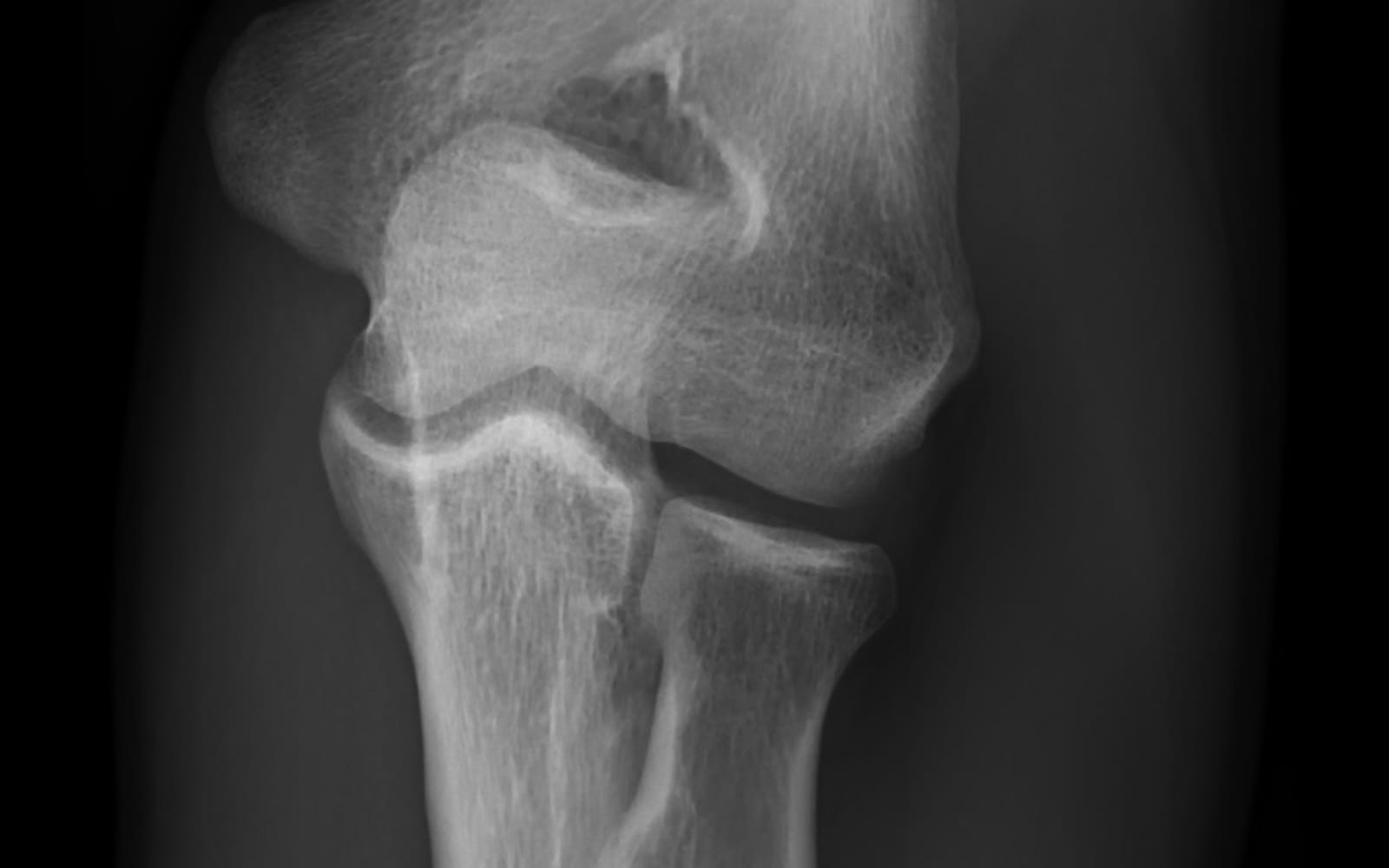
Image: anteroposterior radiograph of a normal elbow. Mikael Haggstrom, CC0, via Wikimedia Commons.