

Pre-season conditioning reduces injury risk when it is built on progressive strength work and a structured neuromuscular warm-up. Stretching on its own does not reduce injury rates. That is the answer from the best randomised trial evidence available, and it has held up for over a decade while the finer points get argued over.
I spent years in the Royal Marines before I trained as an osteopath, so I have a soft spot for the idea that you earn your season in the weeks before it starts. The evidence mostly agrees. What it does not agree with is the shape most amateur pre-seasons take, which is a fortnight of hard running, a lot of static stretching, and very little loading of the tissues that actually fail.
The short version
- Strength training is the strongest single injury prevention measure in trial evidence.
- Stretching before sport does not reduce injury rates.
- Structured warm-up programmes such as FIFA 11+ reduce hamstring injuries in football.
- The Nordic hamstring curl evidence is weaker than the headlines claim.
- Six to eight weeks of progressive load beats two hard weeks before match one.
What actually works, and what does not
The clearest summary is still a 2014 meta-analysis in the British Journal of Sports Medicine that pooled 25 randomised trials, 26,610 participants and 3,464 injuries. It looked at four approaches separately: strength training, proprioception or balance work, multiple combined exposures, and stretching.
The results were not close. Strength training reduced sports injuries to under a third of the control rate (risk ratio 0.32). Proprioception training roughly halved them (0.55). Combined programmes landed at 0.66. Stretching came out at 0.96, which in plain terms means no measurable effect at all. Acute injuries and overuse injuries both fell with activity-based programmes, overuse slightly more so.
Two honest caveats. The overall effect across the trials was heterogeneous, meaning the studies disagreed with each other more than you would like. And these are trial conditions, where somebody supervises the programme. Adherence at your local Sunday league club is a different matter, and a programme nobody does prevents nothing.
Static stretching before sport survives because it feels like preparation, and because most of us were taught it at school. That pooled risk ratio of 0.96 tells you what it does for injury rates, which is close to nothing. It still changes range of motion in the short term and people report feeling readier to move, so it is not worthless. It simply is not prevention, and every minute of the warm-up spent on it is a minute not spent on the things that move the numbers. If you want more usable range, the distinction between mobility and flexibility matters more than the stretch itself, which I have written about in mobility versus flexibility.
Warm-up programmes have the most consistent case
The structured whole-body warm-up is the intervention with the steadiest recent support. A network meta-analysis published this month pooled 11 randomised trials and 9,282 football players, comparing the common prevention programmes against usual training. FIFA 11+ showed the most consistent reduction in hamstring injury incidence, with an incidence rate ratio of 0.55 and a confidence interval of 0.31 to 0.98.
Read that alongside what the authors say about certainty, because they are blunt about it. No trial in the review was judged at overall low risk of bias, between-study heterogeneity was substantial, and the certainty of the evidence ranged from low to very low. Their own conclusion is that the ranking should be read as a population-level summary rather than a firm recommendation.
So the honest position is this. A structured 15 to 20 minute neuromuscular warm-up that includes running mechanics, strength, plyometrics and balance is the best available bet for a team sport, it costs nothing, and it replaces the warm-up you were doing anyway. It is not a guarantee, and anyone selling it as one is going past the data.
The Nordic hamstring curl is not the settled case people think
You will have seen the claim that Nordic hamstring curls halve hamstring injuries. It came from earlier meta-analyses, and it got repeated until it sounded like physics.
Then a group of methodologists went back through the numbers. Their 2021 reappraisal in the Journal of Clinical Epidemiology found that of the 15 studies in the most recent meta-analysis, only five were randomised trials that actually randomised players to the Nordic curl. Reanalysing those five gave a risk ratio of 0.56 with a confidence interval from 0.20 to 1.52. Adding one further trial gave 0.59, confidence interval 0.27 to 1.29. Both intervals cross 1, which means the protective effect could be large, or could be nothing. Their conclusion was that the evidence remains inconclusive and mostly comes from trials at high risk of bias. The 2026 network analysis above reached a similar place, finding only a modest and non-significant reduction for the exercise on its own.
My read, and this is opinion rather than settled evidence: keep doing them. Eccentric hamstring strength has value beyond the injury statistics, the exercise is free, and the downside is soreness. Treat it as one part of a strength plan rather than as the plan.
How to build six weeks that hold up
Sport-specific detail changes the picture, but the skeleton of a sound pre-season block looks similar across running, football, rugby and combat sports.
Weeks one and two. Two full-body strength sessions a week, compound movements, loads you could repeat comfortably. The NHS sets strengthening activities on at least two days a week as the baseline for every adult, so for an athlete this is a floor rather than a target. Start the neuromuscular warm-up now, so it is habit before the season adds pressure.
Weeks three and four. Add load gradually, in the region of five to ten per cent a week, and change one variable at a time. Bring in eccentric hamstring and calf work. Keep the warm-up going every session, because the trial doses were delivered continuously rather than as a block.
Weeks five and six. Introduce the speeds and positions your sport actually demands. This matters more than most amateur players expect. A video analysis of 52 hamstring injuries in professional German football found 48 per cent were sprint-related, all occurring during linear acceleration or high-speed running, and 52 per cent were stretch-related, happening during braking, lunging, landing or kicking. Biceps femoris was the muscle involved in 79 per cent of cases.
The practical conclusion from that is uncomfortable for a lot of pre-seasons. If you have not sprinted at close to full speed before your first match, the match is where you will do it, cold, under pressure, with a defender alongside you. Build a small amount of true high-speed running into the last fortnight, and rehearse the braking and kicking positions rather than avoiding them.
When to stop and get it looked at
Most strains settle on their own. The NHS advice for the first two to three days is protection, rest, ice, compression and elevation, and it notes that most sprains and strains feel better after two weeks, while strenuous exercise such as running is best avoided for up to eight weeks because of the risk of doing it again.
Get urgent advice from NHS 111 if the injury is very painful or getting worse, if there is a large or worsening amount of swelling or bruising, if you cannot put weight on it or walk more than a few steps, if it feels very stiff or is difficult to move, if it is not improving with self-treatment, or if you have a high temperature or feel hot, cold or shivery, which can point to infection.
Separately, and this applies to back injuries in particular: numbness or pins and needles in the saddle area, loss of bladder or bowel control, or progressive weakness in a leg or arm are reasons to seek medical help the same day rather than booking an appointment with anyone in a clinic.
Where an assessment fits before the season
The strongest predictor of a muscle strain is having had the same strain before. An analysis of 83,503 player-matches in Australian football found that for hamstring, quadriceps and calf strains alike, a recent history of that same injury was the strongest risk factor, with a past history of it the next strongest. If you finished last season with something that never quite cleared, or you have an old injury you work around without thinking about it, that is the thing worth looking at in the quiet weeks rather than in October.
What that looks like in our Luton sports injury clinic is a history, a movement assessment, treatment in the same session, and a specific loading plan you take away. Initial assessments are £75 for 45 minutes and follow-ups are £60. Most pre-season work sits with exercise rehabilitation rather than hands-on treatment, which tends to be the part people are surprised by.
If this sounds like what you're dealing with, an assessment is the next step. Book online here.
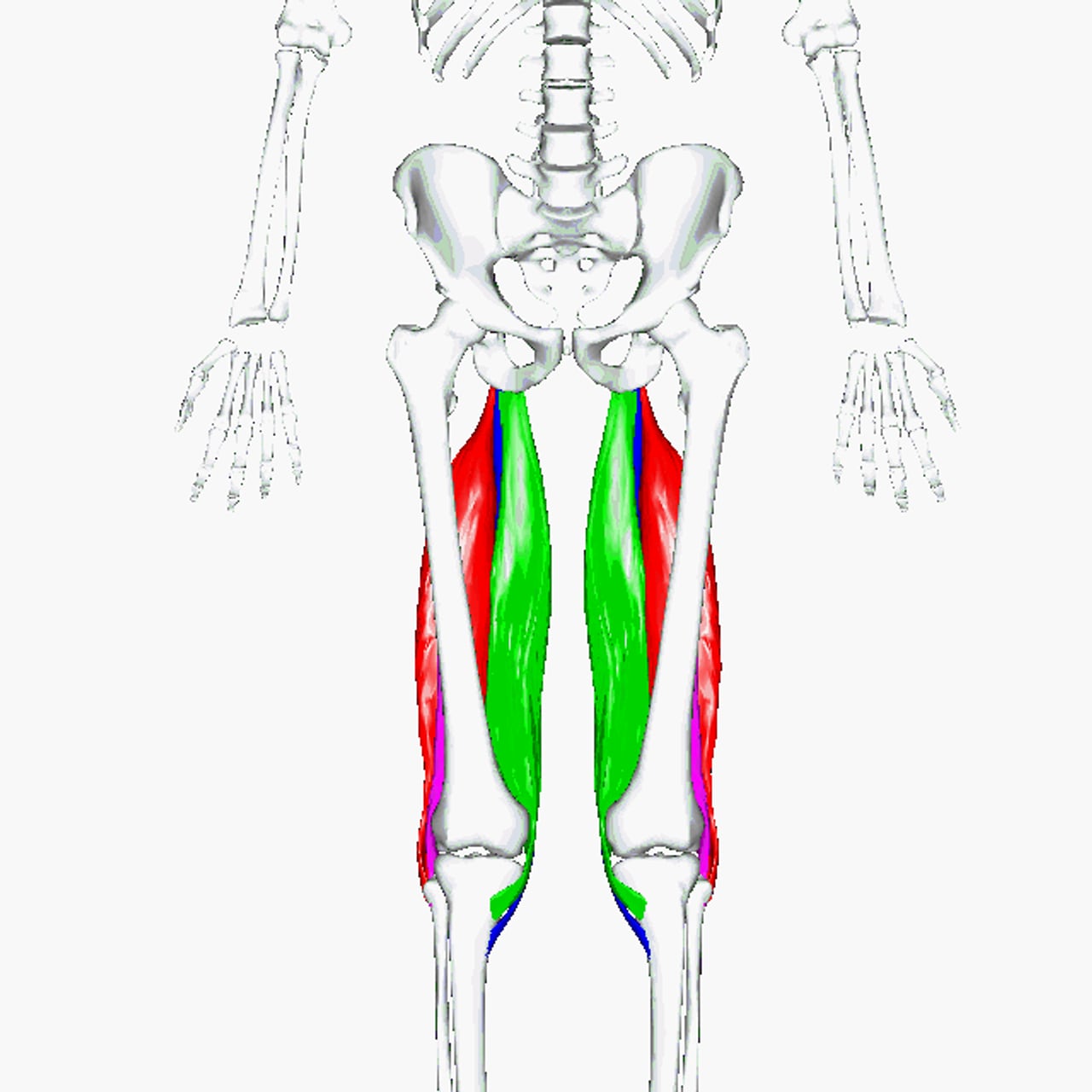
Illustration: BodyParts3D, Database Center for Life Science, CC BY-SA 2.1 JP.