

No, an anterior pelvic tilt is not by itself a cause of back pain. It is the most common pelvic position in people who have no pain at all. In one study of 120 healthy adults with no symptoms, 85% of the men and 75% of the women had an anterior tilt.
The short version
- Anterior pelvic tilt is the normal position in most pain free adults.
- A review of 43 studies found no tilt difference between painful and pain free backs.
- Where a difference does show up, it is small and the studies disagree.
- Posture is associated with back pain. Causation has never been demonstrated.
- Restoring movement and load tolerance matters more than chasing a tilt angle.
What pelvic tilt actually is
Your pelvis sits on top of the hip joints and rotates forwards and backwards over them, like a bucket of water tipping. Tip the front rim down and you have an anterior tilt, which deepens the curve in the lower back. Tip it up and you have a posterior tilt, which flattens that curve. It is measured as the angle from horizontal of a line drawn between two bony landmarks on the pelvic rim, at the front and the back, which you can feel on yourself. The argument is not about whether pelvic tilt exists. It is about what it means.
Anterior tilt is the normal finding, not the fault
The most useful number comes from a study that measured pelvic angle in 120 healthy people with no symptoms, 65 men and 55 women, average age 23.8. Eighty five per cent of the men and 75% of the women presented with an anterior pelvic tilt. Six per cent of men and 7% of women had a posterior tilt. The remainder sat in neutral.
In a group of people with nothing wrong with them, anterior tilt was the majority position by a wide margin. A feature present in roughly eight out of ten pain free people is a normal variant. It is not a defect waiting to be corrected.
What the research actually says about tilt and back pain
The evidence is mixed and the effects are small. A systematic review of 43 studies comparing lumbo-pelvic posture and movement in people with and without low back pain found no difference in standing pelvic tilt angle, and no difference in lordosis angle. What did differ was movement: reduced lumbar range of motion in 19 studies, slower movement in 8, and reduced position sense in 17. The authors added the caveat that matters most, which is that whether those deficits exist before the pain starts is unknown.
A more recent meta-analysis of 46 observational studies, covering 5,097 people with low back pain and 6,974 without, did find pelvic tilt to be statistically higher in the back pain group. The effect size was 0.23, which is small, the studies disagreed heavily, and the authors concluded that no firm conclusions could be made.
One result points the opposite way to the usual story. A meta-analysis of 13 studies comparing 796 people with low back pain to 927 controls found the back pain group tended to have less lumbar curve, not more. If an excessive arch were the villain, that should have gone the other way.
An umbrella review of 41 systematic reviews on spinal posture, physical exposure and low back pain found no consensus on causality. Association has been documented. A causal explanation has not.
Where the tilt correction advice goes wrong
Three problems with it, and a fourth that is harder to see.
First, it treats a normal variant as a fault. If most pain free people stand in an anterior tilt, telling someone their tilt is why they hurt starts from a false premise.
Second, it aims at a static angle when the measurable differences sit in movement. Range, speed and position sense are trainable. A resting pelvic angle largely is not.
Third, the standard prescription is weeks of hip flexor stretching, which is a poor use of the time for most people. We went through the reasons in our post on hip flexor tightness and why stretching often makes it worse.
The fourth matters most. In my years of practice, patients who arrived convinced their pelvis was in the wrong place were consistently harder to get moving than patients who arrived without a mechanical villain in their head. That is a clinical observation, not a trial result. The wider point about how an explanation shapes the pain it describes is covered in placebo and nocebo effects in pain treatment.
What tends to help instead
The NICE guideline on low back pain and sciatica (NG59) makes no recommendation about correcting posture or pelvic position. It recommends advice and information to help people self-manage, including encouragement to continue with normal activities, and a group exercise programme for a specific episode or flare-up. On hands-on treatment it is precise: consider manual therapy, meaning spinal manipulation, mobilisation or soft tissue techniques such as massage, but only as part of a treatment package that includes exercise. That is the honest description of what osteopathy contributes, and it is how the clinic team works.
The exercise evidence is reasonable without being spectacular. A Cochrane review of 249 trials found moderate certainty evidence that exercise reduces pain in chronic low back pain by 15.2 points on a 100 point scale, compared with no treatment, usual care or placebo. The effect on function was smaller at 6.8 points and did not reach the threshold the reviewers had set for a clinically important difference.
A review of 40 randomised trials involving 2,391 people found trunk-focused programmes slightly ahead of general exercise, with a small effect size of 0.20 for pain and the same for disability. The more interesting result was that improvements in trunk and hip range of movement were associated with greater reductions in both.
In practice that means getting the hips and lower back moving through range, building tolerance to load gradually, and staying active while you do it. It is duller than a posture correction and it holds up better.
When to get it looked at properly
Most low back pain settles on its own. Some of it needs a doctor rather than a manual therapist. The NHS advice on back pain is to call 999 or go to A&E if you have back pain along with pain, tingling, weakness or numbness in both legs, a loss of feeling around your genitals or anus, changes in your bladder or bowels such as difficulty passing urine or incontinence, changes in sexual sensation or function, chest pain, or if it started after a serious accident.
Ask for an urgent GP appointment or contact NHS 111 if you feel hot, cold, shivery or generally unwell with the pain, or if severe pain starts suddenly or is getting worse quickly. See a GP if the pain has not improved after a few weeks of looking after it at home, if it is worse at night or does not improve with rest, if you have lost weight without trying to, or if there is a lump or a change in the shape of your back.
None of those are posture problems, and none of them get better with another month of stretching.
If you have an anterior pelvic tilt and no pain, you have a normal pelvis. If you have an anterior pelvic tilt and back pain, you probably have a normal pelvis and back pain, and the two are not necessarily connected. The useful questions are what your back and hips can do, how much load they tolerate, and what changed recently. Those are the questions an assessment works through. You can read more about how we approach back pain treatment at the clinic and about exercise rehabilitation. If this sounds like what you are dealing with, an assessment is the next step. Book online here.
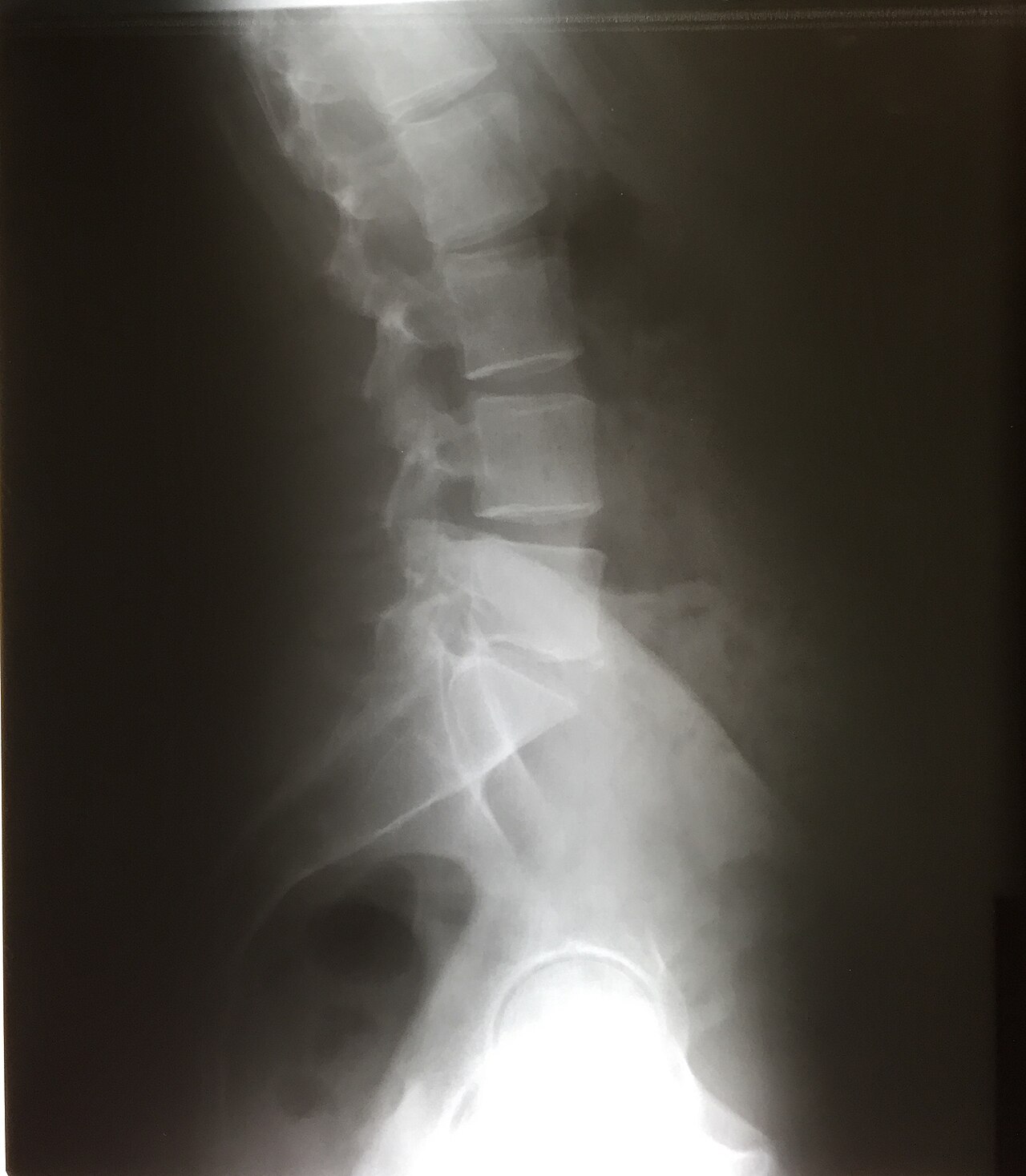
Image: lateral lumbar spine radiograph by FitBro, CC BY-SA 4.0, via Wikimedia Commons.