

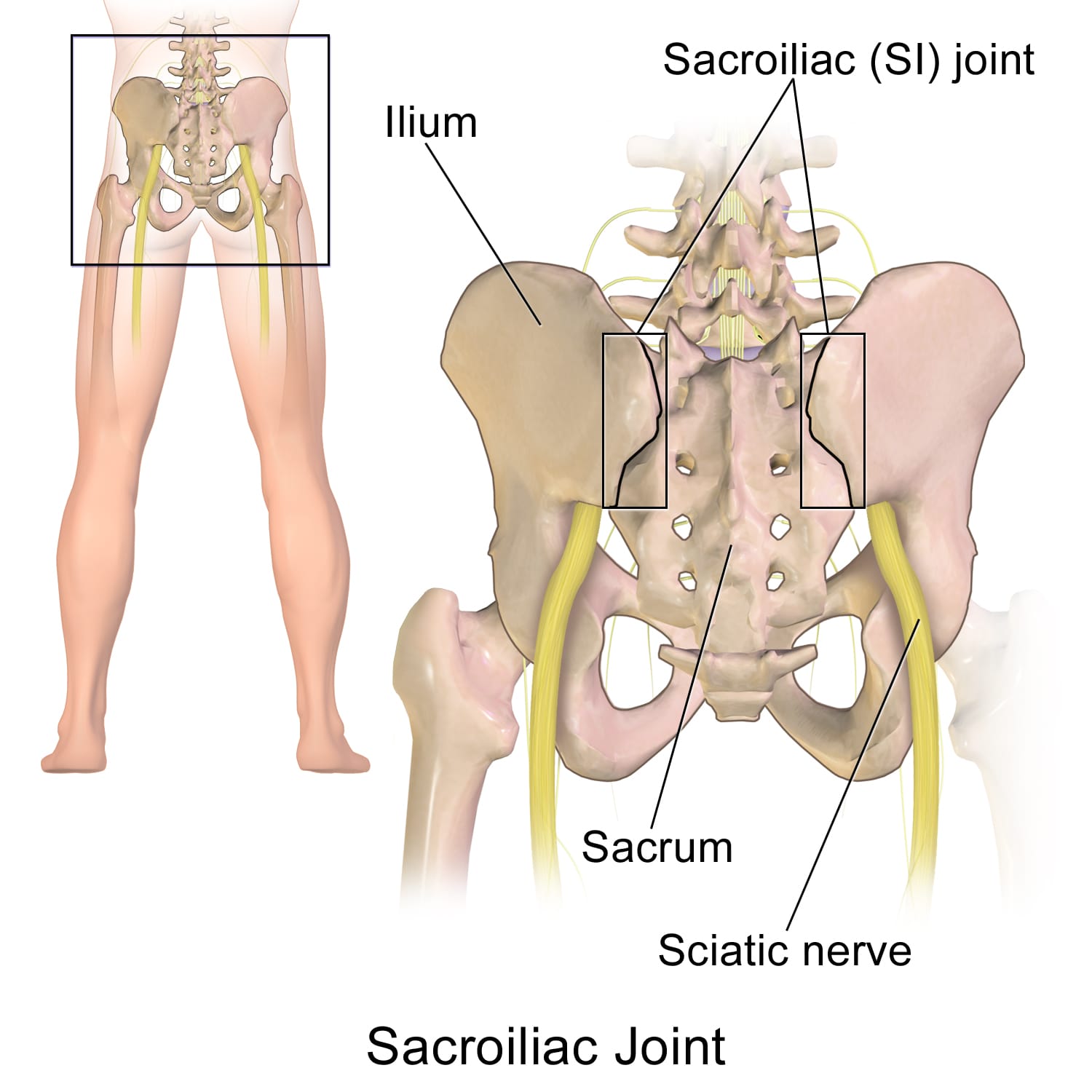
Pain that sits low on one side of your back, in or just above the buttock and below the belt line, often comes from the sacroiliac joint, where the base of the spine meets the pelvis. Research puts the joint as the main source in between 15 and 30% of people with chronic low back pain that is not nerve pain running down the leg. Management follows the same principles as most back pain: stay active, build a graded exercise plan, and use hands-on treatment alongside that.
The awkward part is that SI joint pain is easy to suspect and hard to prove. Here is how it tends to feel, why it is so hard to pin down, what helps, and when it needs a GP rather than an osteopath.
The short version
- The sacroiliac joint links the base of your spine to your pelvis.
- It is the main pain source in roughly 15 to 30% of chronic low back pain.
- Typical pain sits on one side, below the belt line, often in the buttock.
- No single test proves it. A cluster of tests is better at ruling it out.
- Exercise comes first. NICE advises hands-on treatment only alongside exercise.
Where the sacroiliac joint is and what it does
You have two sacroiliac joints, one on each side. Each joins the sacrum, the triangular bone at the base of your spine, to the ilium, the large wing-shaped bone of the pelvis you can feel at your hips. The two small dimples many people have low on the back sit close to them.
The joints move very little. Their job is to pass load between the spine and the legs, and they are held together by thick ligaments at the front and back. Every step, stair and lift sends force through them. That tiny range of movement becomes important when we get to diagnosis.
What sacroiliac joint pain feels like
A 2013 review of SI joint pain found that, compared with pain from the discs or the small facet joints of the spine, people with SI joint pain are more likely to recall a specific event that started it. They are also more likely to feel it on one side only, below the lowest lumbar vertebra (L5).
Where the pain spreads varies more than most people expect. In a study of 50 patients whose pain was confirmed by an image-guided injection into the joint, 94% described buttock pain and 72% had lower back pain. Half had pain in the leg, 28% below the knee and 14% into the foot, while 14% described groin pain. An earlier study using joint injections found that groin pain was the only referral pattern linked to a positive response.
That leg pain is one reason SI joint pain gets confused with sciatica. Sciatica comes from an irritated nerve and, according to the NHS sciatica page, usually brings a sharp or burning pain down the back of one leg with tingling, numbness or weakness. SI joint pain can spread into the leg without a nerve being involved, and the two can also exist side by side. Our page on sciatica treatment in Luton covers the nerve side of things.
Why it is so hard to pin down
No single question or test reliably identifies a painful SI joint. The 2013 review says as much, and adds that a battery of three or more pain provocation tests (movements that stress the joint to see if they reproduce your pain) can predict who responds to a diagnostic injection.
Even then, the numbers are modest. A 2021 meta-analysis of test clusters worked out that if around 20% of people with back pain have SI joint pain, a positive cluster only raises the likelihood to about 35%. A negative cluster is more useful, giving roughly 92% confidence that the SI joint is not the source. The certainty of that evidence was rated very low. A 2023 diagnostic review found that combining provocation tests with the absence of pain in the midline of the back made the picture a little clearer.
Feeling for whether the pelvis has moved does not hold up. A review of 11 reliability studies found no evidence to support motion tests of the SI joint in daily practice. In one study of experienced manual therapists, two examiners agreed on a palpation test 48% of the time, which statistically was no better than chance, while the pain provocation tests showed moderate to good agreement. So if someone feels your hips and tells you your pelvis is out or twisted, be sceptical of the test behind that claim.
What causes it and who gets it
The 2013 review lists the factors linked to SI joint pain: a real or apparent difference in leg length, older age, inflammatory arthritis, previous spinal surgery, pregnancy and trauma. Pregnancy is common enough to have its own post, on pelvic girdle pain in pregnancy.
Inflammatory arthritis deserves a mention because it is easy to miss. Ankylosing spondylitis is a type of axial spondyloarthritis, and the NHS describes its typical pattern: back pain that gets better with exercise but not with rest, pain and stiffness that are worse in the morning and at night, and pain around the buttocks. The NHS notes that it tends to first develop in teenagers and young adults. That pattern needs a GP, who can refer you to a rheumatologist, because it is managed differently from mechanical back pain.
What tends to help
Most guidance for SI joint pain sits inside the guidance for low back pain generally. NICE guideline NG59 recommends advice to help you self-manage, encouragement to carry on with normal activities, and exercise. It says manual therapy, meaning spinal manipulation, mobilisation or soft tissue techniques, should be considered only as part of a treatment package that includes exercise. It also advises against belts or corsets for low back pain and against routine imaging outside specialist settings.
The trial evidence for hands-on treatment of the SI joint itself is thin. A 2024 meta-analysis of 16 trials found that manual therapy improved disability moderately compared with exercise-based physiotherapy or sham treatment, but its effect on pain was uncertain. Certainty was low for disability and very low for pain, and it was unclear whether any one technique did better than another.
So a sensible plan looks like this. The osteopath takes a full history, screens for the red flags below, and examines the lower back and hips as well as the pelvis, using a cluster of provocation tests rather than one. Treatment pairs hands-on work to ease pain and stiffness in the short term with a progressive exercise plan for the hips, trunk and legs, because exercise is what the guidance supports. Our exercise rehabilitation service is built around that second part.
For pain that persists despite this, doctors can offer injections. The 2013 review reports intermediate-term benefit from steroid injections in and around the joint, and relief lasting up to a year from radiofrequency denervation in people whose injections did not give lasting relief. These are specialist options, reached through your GP.
When to see a GP urgently
Back pain often improves on its own within a few weeks, but the NHS back pain page sets out when it needs medical help first.
Call 999 or go to A&E if you have back pain and:
- pain, tingling, weakness or numbness in both legs
- loss of feeling around your genitals or anus
- changes in your bladder or bowels, such as difficulty peeing, or peeing or pooing yourself
- changes in sexual function, such as not being able to get or keep an erection
- chest pain
- pain that started after a serious accident, such as a car accident
Ask for an urgent GP appointment or contact 111 if you feel hot, cold, shivery or generally unwell, or the pain is severe, starts suddenly or is getting worse quickly.
See a GP if the pain does not improve after a few weeks, it does not improve after resting or is worse at night, you have lost weight without trying, or there is a lump or swelling in your back. Add the inflammatory pattern above to that list: back pain that eases with exercise, stiffens with rest and is worst first thing in the morning.
SI joint pain is an easy label to reach for and a hard one to confirm. A careful assessment is less about naming the joint and more about ruling out the things that need a doctor, then finding which movements and loads provoke your pain so the exercise plan targets them. For more on how the clinic approaches low back and pelvic pain, see our back pain treatment in Luton page.
If this sounds like what you're dealing with, an assessment is the next step. Book online here.
Illustration: BruceBlaus, CC BY 3.0, via Wikimedia Commons.