

If your last appointment did not help, the most likely explanation is that the treatment stopped at the hands. No exercise attached, no plan for the weeks in between, and no clear answer about what was actually wrong. That is a problem with how the appointment was run, and it is usually something the next one can put right.
The short version
- Hands-on treatment with no exercise attached is the most common failure.
- NICE recommends manual therapy only as part of a package including exercise.
- Pain returning within a year is common and is not automatic proof of failure.
- If you cannot repeat your diagnosis in one sentence, you were not given one.
- Some back pain is inflammatory and belongs with a rheumatologist.
Hands on the problem, and nothing attached to it
In my experience this is the pattern behind most of these conversations. The session felt good, you left looser, and by Thursday you were back where you started. Nothing was necessarily wrong with the treatment. What was missing was the rest of the plan.
NICE guideline NG59, last updated in July 2026, is blunt about this. Manual therapy, meaning spinal manipulation, mobilisation or soft tissue techniques such as massage, is to be considered for low back pain and sciatica only as part of a treatment package that includes exercise. Not as the treatment. As part of the package.
The exercise half is where the durable change tends to live, and it is the half that gets quietly dropped. A 2025 analysis of 46 trials of exercise for chronic non-specific low back pain found that people with high adherence, doing 80 to 100% of what they were asked, reported pain about 14 points lower on a 100 point scale than people doing no exercise. The authors rated that low certainty and noted the gap between high and low adherers was mostly small, so treat it as a direction rather than a promise.
Hands-on work buys a window: less guarding, more range, a few easier days. What you put into that window decides whether it holds. If nobody gave you anything to put into it, the window closes and Thursday happens. That is why exercise rehabilitation sits alongside the hands-on work here.
You were never told what was wrong in words you could repeat
Try it now. Say out loud what you were told was causing your pain. If the best you can manage is that something was tight, or out, or inflamed, you were given a description rather than a diagnosis.
That matters more than it sounds. A 2026 systematic review of five randomised trials covering 7,575 people found the label attached to musculoskeletal pain changes what patients then want from care. Specific, structural sounding labels increased preference for imaging and surgery and made the condition feel more serious. Non-specific labels produced more positive recovery beliefs but lower satisfaction. Certainty was low and the trials used written scenarios rather than real patients, so read it as a signal. The signal is that the words used in the room do work, for you or against you.
The related failure is a scan being used to fill the gap. NG59 says not to routinely offer imaging in a non-specialist setting for low back pain with or without sciatica, and I have written before about how little most musculoskeletal MRI reports say about the person in front of you.
Nobody set a review point
Without a date to judge it against, treatment drifts. You keep going because it helps for two days, and nobody ever says out loud that the plan is not working.
Set the review point at the start. In my years of practice the working rule was that something measurable should have changed by the third or fourth session: less pain, more range, better sleep, longer walking before it bites. That is a rule of thumb, not a trial result. If nothing has moved by then, what needs changing is the plan.
The opposite mistake is calling a recurrence a failure. In a prospective study of 250 people who had just recovered from an episode of low back pain, 69% had another episode within 12 months, at a median of 139 days. More than two previous episodes, sitting for more than five hours a day and frequent awkward postures all predicted it. A systematic review of recurrence risk found the wider evidence weak and inconsistent, with the single true inception cohort in it reporting 33% at a year, so recurrence is common and poorly quantified. Pain that returns four months later is behaving normally. Pain that never changed at all is the real problem.
The wrong problem was being treated
Some appointments were never going to work, because the pain was not mechanical in the first place.
NG59 opens by telling clinicians to think about alternative diagnoses and exclude specific causes such as cancer, infection, trauma and inflammatory disease. The one most often missed in a private treatment room is axial spondyloarthritis. NICE guideline NG65 states plainly that axial presentations are often misdiagnosed as mechanical low back pain, which delays access to treatment that works.
Its referral rule is worth knowing as a patient. If your low back pain started before the age of 45 and has lasted longer than three months, NG65 says to refer to a rheumatologist when four or more of these are also present: onset before 35, waking during the second half of the night because of symptoms, buttock pain, improvement with movement, improvement within 48 hours of an anti-inflammatory, a first-degree relative with spondyloarthritis, current or past arthritis, current or past enthesitis, current or past psoriasis. With exactly three present, the guideline says to test for HLA-B27 first. NG65 also notes it affects a similar number of women as men, occurs in people who test HLA-B27 negative, and can be present despite a normal plain X-ray. If that reads like your history, the next appointment you need is with your GP.
The room matters, but not as much as it gets sold
Plenty of people leave an appointment feeling unheard and conclude a warmer practitioner would have worked. Partly true, and worth being honest about the size of it. Two systematic reviews of the therapeutic relationship in musculoskeletal care disagree with each other. One, covering seven studies in chronic musculoskeletal pain, found emerging evidence that a strong alliance may improve pain outcomes. The other, covering six papers from four studies, concluded the evidence for a strong relationship with pain relief is not there.
The context around treatment behaves similarly. A meta-analysis of 64 randomised trials with 4,314 participants put the contextual or placebo effect of conservative non-drug treatment at roughly 5 points of pain on a 100 point scale, graded very low certainty, and called it small. My reading is that being listened to properly does not resolve pain directly. It decides whether you understand the plan and whether you do it, which is where it earns its keep.
When the appointment is not the problem at all
Some symptoms need a different door entirely. The NHS back pain guidance says to call 999 or go to A&E with back pain plus tingling, weakness or numbness in both legs, loss of feeling around the genitals or anus, changes in bladder or bowel control such as difficulty passing urine, chest pain, or onset after a serious accident. Ask for an urgent GP appointment or use 111 if you feel hot, cold, shivery or generally unwell with it, or if severe pain starts suddenly or worsens quickly. The NHS sciatica page carries the same emergency list for leg symptoms on both sides.
See a GP in the ordinary way if the pain has not improved after a few weeks of home treatment, is worse at night or does not settle with rest, if you have lost weight without trying, if there is a lump or a change in the shape of your back, or if it sits between your shoulder blades rather than in the lower back. No amount of good manual therapy substitutes for that list.
What I would do before booking again
Five steps, in order.
- Write down the diagnosis you were given. If you cannot, ask for one in a sentence next time.
- Check the red flag list above, and the NG65 criteria if your pain started young and has lasted months.
- Ask what happens between sessions. If there is no answer, that is the gap.
- Give the exercise an honest run for the agreed period.
- At the review point, judge the plan before you judge the person.
Changing practitioner is sometimes the right call, and I would rather someone found the right room than sat politely in the wrong one. My view, from years of these conversations, is that most failed appointments were an incomplete plan rather than a skill problem, and a second opinion that repeats the same structure produces the same result.
That is how the clinic runs it. An initial assessment is £75 for 45 minutes: history, hands-on examination, a diagnosis in plain language, treatment on the day, and a home exercise plan to take away. Follow-ups are £60 for 30 minutes. You should also get an honest estimate of how many sessions you need, and you should hold us to it. There is more on back pain treatment in Luton and on what changes once pain has been there for months.
If this sounds like what you're dealing with, an assessment is the next step. Book online here.
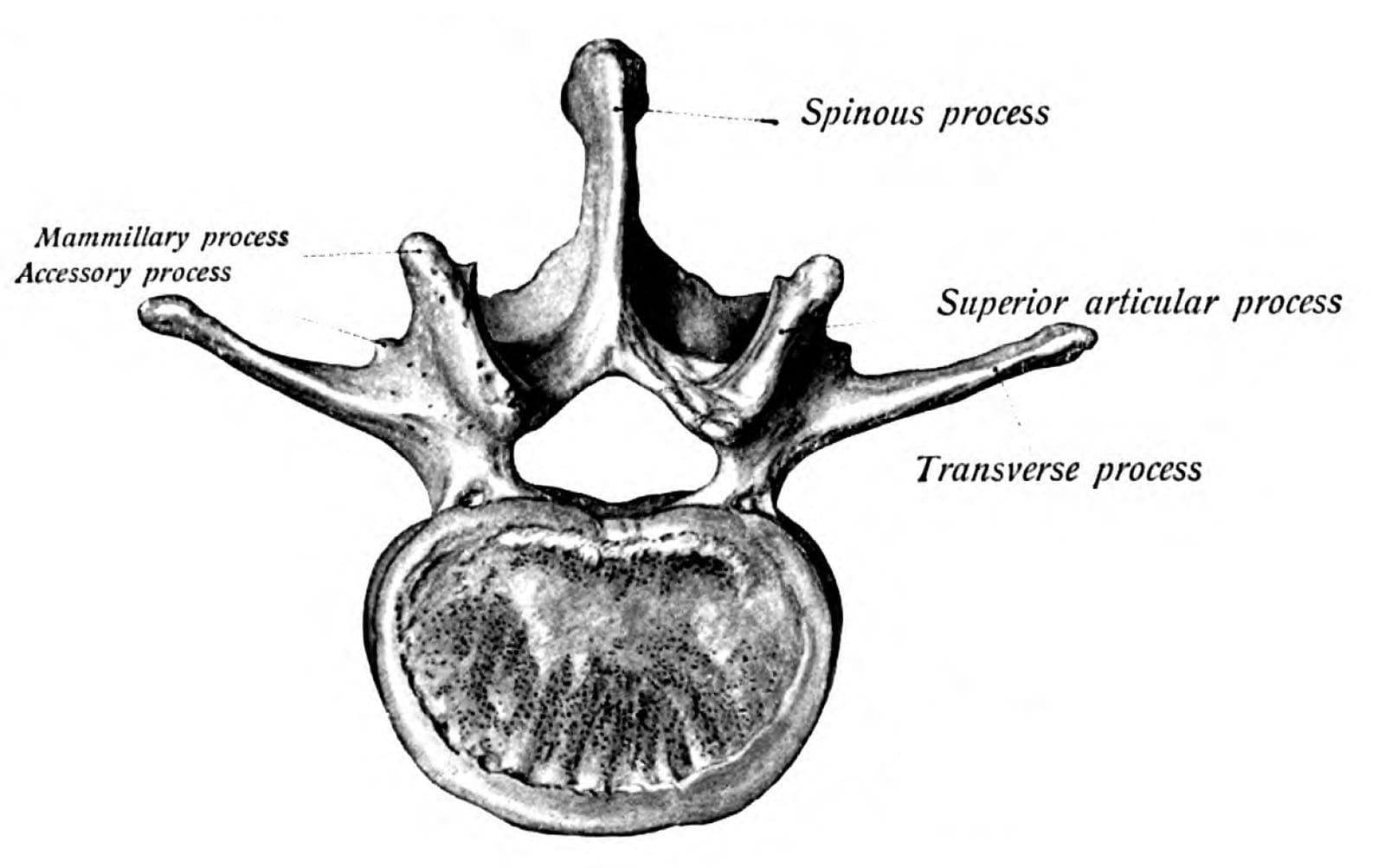
Image: lumbar vertebra from above, plate from Sobotta's Human Anatomy 1909, public domain, via Wikimedia Commons.