

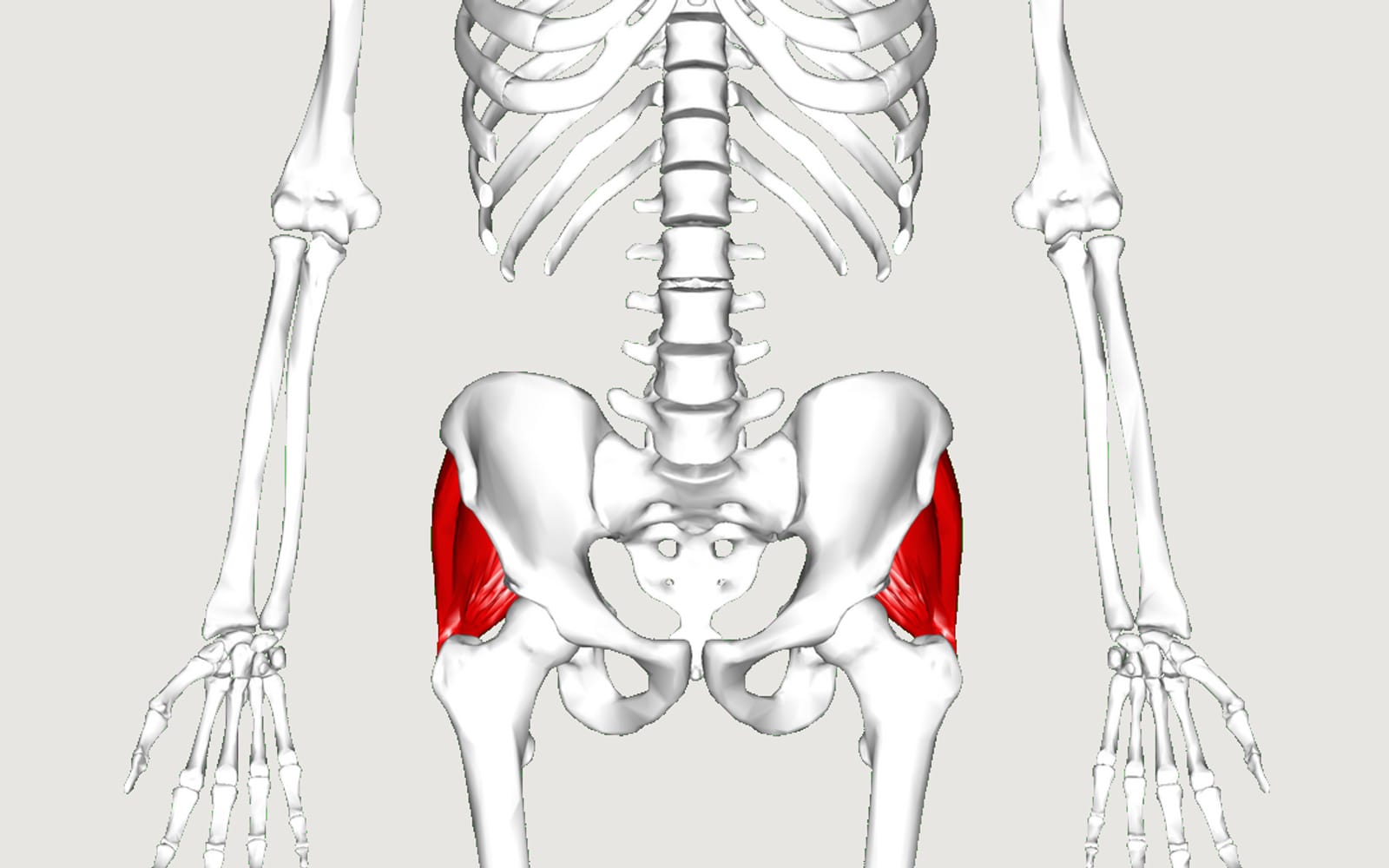
Pain on the outside of the hip that is worst when you lie on that side is most often greater trochanteric pain syndrome (GTPS). In most people the main source is the gluteal tendons where they attach to the bony point of the hip, rather than the bursa that usually gets the blame. It tends to settle with the right kind of loading, though it rarely settles quickly.
The short version
- GTPS is pain over the bony point on the outside of the hip.
- Irritated gluteal tendons are the usual source. True bursitis is the minority.
- Lying on either side, crossing your legs and stairs commonly aggravate it.
- Education plus exercise outperformed a steroid injection in a 204-person trial.
- A hot, swollen hip with a fever needs urgent medical help.
What greater trochanteric pain syndrome is
The greater trochanter is the bony lump you can feel on the outside of your upper thigh, just below the hip. Two of the muscles that hold your pelvis level when you stand on one leg, gluteus medius and gluteus minimus, attach to it by tendons. There are also small fluid-filled sacs (bursae) in the area that reduce friction.
For years this pain was simply called trochanteric bursitis. The imaging says otherwise. In an ultrasound review of 877 people with pain over the greater trochanter, 79.8% had no bursitis at all. Around half (49.9%) had changes in the gluteal tendons, and 28.5% had a thickened iliotibial band. That is why most clinicians now use the broader name GTPS, or gluteal tendinopathy when the tendons are clearly the driver.
It is common. A study of 3,026 adults aged 50 to 79 found GTPS on one side in 15.0% of women and 6.6% of men, and on both sides in 8.5% of women and 1.9% of men. It was more likely in people who also had low back pain or knee osteoarthritis. A review of gluteal tendinopathy describes it as mostly a mid-life condition that affects women more than men, and turns up in regular exercisers and non-exercisers alike.
Why it hurts when you lie on your side
Tendons cope well with steady, progressive load. What they tolerate poorly is being squashed against bone while also under tension. The same review points to that mix of compression and tensile load as the most irritating combination, with the hip drawn in across the midline of the body (adduction) as a key position.
That explains the classic night pattern. Lie on the sore side and you press the tendons straight into the bone. Roll onto the good side and the top knee drops down and across, which pulls the same tendons tight over the trochanter. Many people end up sleeping on their back by default.
The daytime aggravators follow the same logic:
- Sitting with your legs crossed, or in low chairs where the knees end up higher than the hips. The NHS hip pain advice also suggests avoiding low chairs.
- Standing with your weight hung on one hip.
- Stairs, hills and getting in and out of the car, which load one leg at a time.
- Stretches that pull the leg across the body, often prescribed for a "tight IT band", which add compression to tissue that is already irritated.
How it is told apart from other hip pain
The outside of the hip is a crossroads, so the first job is ruling other things in or out. Osteoarthritis of the hip joint tends to give groin pain and stiffness after rest, and the NHS links it to people over 45 whose pain is worse when walking. We cover that in more detail in our post on hip osteoarthritis. Pain referred from the lower back can also land on the outside of the hip, especially if it travels below the knee or comes with pins and needles, which points more towards sciatica.
Two simple clinical tests carry real weight. In a study of 65 people with outer hip pain who also had an MRI, pain that came on within 30 seconds of standing on the affected leg had a specificity of 100%. On the authors' figures it moved the chance of MRI-confirmed gluteal tendinopathy from a nominal 50% to 98%. At the other end, no tenderness when the greater trochanter was pressed (a test with 80% sensitivity) made it unlikely. The sample was small and the authors flag that, so these tests guide the assessment rather than settle it.
Most people do not need a scan to get started. The same study found that 31% of participants had tendon changes on MRI without the matching clinical signs, which is a reminder that a scan finding and the source of your pain are not always the same thing.
What tends to help
The strongest single trial is the LEAP trial published in the BJSM. It took 204 people aged 35 to 70 with MRI-confirmed gluteal tendinopathy and more than three months of pain, and compared three approaches: 14 sessions of education plus exercise over 8 weeks, one steroid injection, or wait and see.
- At 8 weeks, 51 of 66 people in the education and exercise group (77%) reported success, against 38 of 65 after injection (58%) and 20 of 68 with wait and see (29%).
- At one year, the exercise group still did better on overall improvement than the injection group (51 of 65 against 36 of 63), although average pain scores between those two groups were similar by then.
The injection picture matches a Dutch primary care trial of 120 patients. At 3 months, 55% of the injection group had recovered against 34% with usual care. At 12 months the gap had gone (61% against 60%). An injection can be a reasonable way to take the edge off, but on this evidence it does not change where most people end up.
A 2024 systematic review of six trials and 733 patients concluded that exercise should be the first-line treatment for GTPS, while noting that the evidence rests on few trials. Shockwave therapy is sometimes offered too. A 2024 meta-analysis of shockwave for GTPS found no statistically significant difference against control, with only low-quality evidence of benefit, so we would not lead with it.
In practice, the education part matters as much as the exercises. That means:
- Sleeping on your back, or on the good side with a pillow between your knees so the top leg cannot drop across.
- Uncrossing your legs and choosing chairs that keep your hips level with or above your knees.
- Standing with your weight spread across both feet.
- Strengthening the hip muscles with exercises that start easy and build over weeks, rather than stretching into the sore spot.
The LEAP programme ran for 8 weeks, which is a fair expectation for meaningful change. When the clinic team see GTPS, the work is a clear assessment, an explanation of which positions are loading the tendon, a progressive strength plan you can run at home, and hands-on treatment where it helps comfort and movement. The trials tested education and exercise rather than manual therapy, and we are upfront about that.
When to see a GP urgently
Most outer hip pain is not dangerous, but some patterns need a doctor first. The NHS hip pain page says to call 999 or go to A&E if you have severe hip pain after a fall or injury, cannot walk or put weight on the leg, or have tingling or loss of feeling in the hip or leg after an injury.
Ask for an urgent GP appointment or contact 111 if the pain started suddenly and severely without an injury, the hip is swollen and feels hot, the skin around it has changed colour, or you feel unwell with a high temperature. A hot, swollen joint can be infection, and infected bursitis is treated with antibiotics rather than exercise.
If the pain comes with numbness around your genitals or bottom, weakness or numbness in both legs, or new problems controlling your bladder or bowels, go to A&E. The NHS lists these as signs of a serious back problem that needs hospital treatment.
For everything else, see a GP or a registered clinician if the pain is stopping normal activities or your sleep, is getting worse, or has not improved after two weeks of looking after it at home.
Getting it assessed in Luton
If you are in or around Luton and outer hip pain is waking you up at night, an assessment sorts out whether it is the tendons, the joint or your back, and gives you a plan built around that. Our hip pain page covers how the clinic approaches it. An initial consultation is £75 for 45 minutes, including your first treatment and a home exercise plan.
If this sounds like what you're dealing with, an assessment is the next step. Book online here.
Illustration: gluteus medius, Anatomography, CC BY-SA 2.1 JP, cropped and background changed.
