

The usual point to think seriously about a hip replacement is when the hip is substantially affecting your quality of life and non-surgical treatment has stopped working or is unsuitable. That is the test NICE uses for referral, and it rests on how you are living with the hip, rather than on how bad the X-ray looks.
That sounds vague, so this post breaks it down: what hip osteoarthritis feels like, why the scan is a poor guide, what is worth trying first and how strong the evidence is, and what a new hip realistically offers.
The short version
- Hip osteoarthritis is diagnosed mainly from symptoms and examination.
- X-ray changes and hip pain often do not line up.
- Exercise and weight loss come first, though their effect is modest.
- Referral depends on quality of life and failed non-surgical care.
- Most modern hip replacements last decades, but not every patient ends pain-free.
What hip osteoarthritis feels like
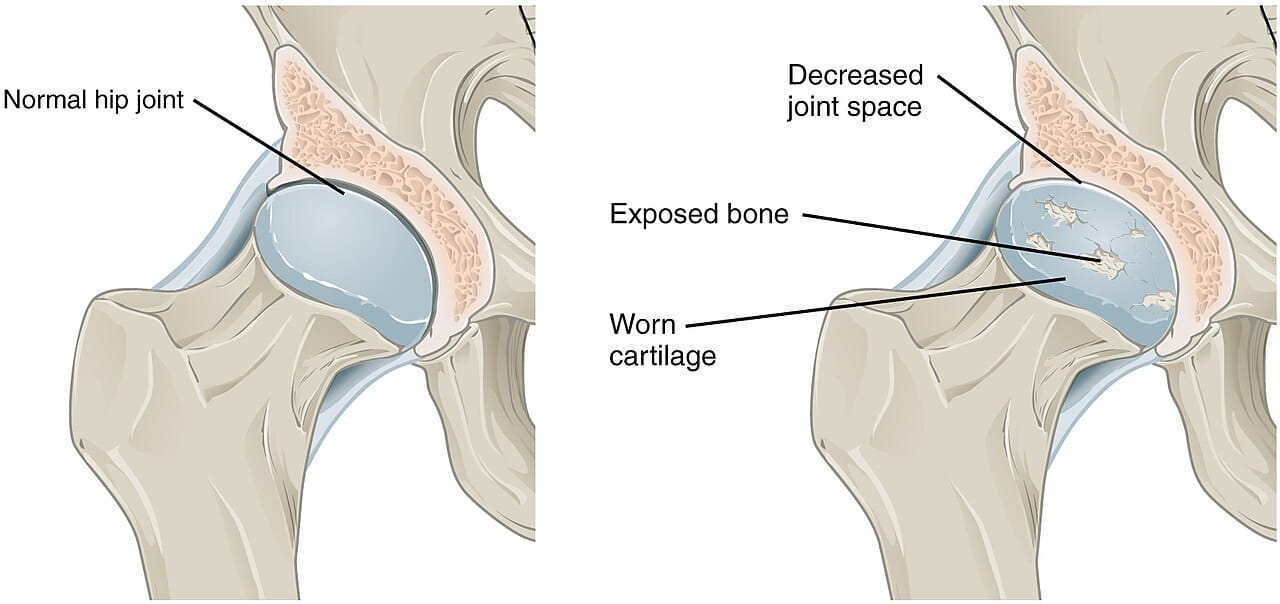
Osteoarthritis is the most common type of arthritis in the UK. The cartilage covering the ends of the bones thins, the joint space narrows, and bony growths can form around the edges. The NHS describes hip osteoarthritis as pain in the groin or the outside of the hip, often worse when you move, with trouble putting on shoes and socks or getting in and out of a car.
Stiffness is usually short-lived. NICE advises that osteoarthritis can be diagnosed clinically, without imaging, in people aged 45 or over with activity-related joint pain and either no morning stiffness or stiffness that lasts 30 minutes or less. Long morning stiffness points towards an inflammatory arthritis instead, which needs a GP.
It is common. A US population study estimated that about one in four people who live to 85 will develop symptomatic hip osteoarthritis in at least one hip.
Not every sore hip is the joint itself. Pain on the outside of the hip when lying on that side is often a tendon problem, and pain in the buttock can come from the lower back. Sorting out which one you have is the first job of any assessment.
Why the X-ray is only part of the picture
Many people assume the decision is made on the scan. The research says the link between X-ray findings and pain is weak. In a 2015 BMJ study of two large cohorts, only 9 to 16% of hips that were frequently painful showed osteoarthritis on X-ray. Going the other way, only around 21 to 24% of hips with X-ray osteoarthritis were frequently painful.
That is why NICE recommends against routine imaging to guide non-surgical care, and why it tells clinicians to use clinical assessment when deciding on referral, rather than scoring systems that rate disease severity. A worn-looking joint on film with a manageable life is a different situation from the same film with someone who can no longer walk to the shops.
The NHS also notes that osteoarthritis does not necessarily get worse over time, and can sometimes gradually improve. A diagnosis is not a countdown to surgery.
What to try before surgery, and how good the evidence is
NICE recommends therapeutic exercise for everyone with osteoarthritis, tailored to the person, such as local muscle strengthening and general aerobic fitness. It also warns that joint pain may increase when you start, which is worth knowing before you give up after a week. For people living with overweight, NICE advises that any weight loss helps, and that losing 10% of body weight is likely to be better than 5%.
The honest part is the size of the effect. The 2026 Cochrane review of exercise for hip osteoarthritis pooled 18 trials with 1,368 people. Compared with no treatment or usual care, exercise probably reduces pain and improves function slightly, but the authors judged those improvements unlikely to be clinically meaningful on average. Most of the trials were small and unblinded.
Hands-on treatment is similarly mixed. One Dutch trial of 109 patients found 81% reported improvement after five weeks of manual therapy compared with 50% after exercise therapy. A later Australian trial of 102 people, using 10 sessions of education, manual therapy and home exercise, found no greater improvement in pain or function than a sham treatment. NICE says manual therapy should only be considered for hip osteoarthritis alongside exercise, and that the evidence does not support it alone.
So the realistic aim of conservative care is to see how far you can get: a stronger hip, better walking tolerance, and a clearer picture of whether the joint is limiting you. For some people that is enough for years. For others it shows fairly quickly that surgery is the right next step, and that is a useful answer too. Our exercise rehabilitation work is built around this kind of graded plan.
On medication, NICE suggests considering an oral anti-inflammatory if topical ones are unsuitable, with stomach protection and a check on other health risks, and advises against glucosamine and strong opioids. Medication decisions sit with your GP or pharmacist.
When to think about a hip replacement
NICE suggests considering referral for joint replacement when two things are true. Your symptoms (pain, stiffness, reduced function or worsening deformity) are substantially affecting your quality of life, and non-surgical management such as exercise, weight loss and pain relief has been ineffective or is unsuitable.
Some practical signs that you may have reached that point:
- Pain is waking you most nights, despite sensible pain relief.
- Your walking distance keeps shrinking, even with a consistent exercise plan.
- You have stopped work, sport, travel or time with family because of the hip.
- Daily tasks like socks, stairs or getting out of the car are a struggle most days.
- You have given a structured exercise programme a fair trial and the trend is still downhill.
NICE is also clear that people should not be excluded from referral because of age, sex, smoking, other health conditions, or their weight or BMI. If you have been told you are too young or too heavy to be considered, that is worth raising with your GP.
What a new hip can and cannot do
Hip replacement has a strong track record. A 2019 Lancet analysis of national joint registry data estimated that around 58% of hip replacements last 25 years. Case series reported higher figures, around 78%.
It is also worth going in with accurate expectations. A systematic review in BMJ Open found that between about 7% and 23% of people reported an unfavourable long-term pain outcome after hip replacement, with 9% or more in the best-quality studies. Most people do well, but the operation does not guarantee a pain-free hip.
The NHS hip replacement guide covers what the surgery involves and the recovery. Strength built before surgery is rarely wasted, and the same rehab principles carry into recovery afterwards.
When hip pain needs a GP or urgent care
Hip arthritis tends to build gradually. A sudden change is a different story. The NHS hip pain page advises calling 999 or going to A&E if you have severe hip pain after a fall or injury, you cannot walk or put weight on the leg, or you have tingling or loss of feeling in the hip or leg after an injury.
Ask for an urgent GP appointment or contact 111 if severe hip pain has started suddenly without a fall, the hip is swollen and hot, the skin around it has changed colour, or you feel generally unwell with a high temperature.
See a GP if hip pain is stopping normal activities or affecting your sleep, keeps getting worse or keeps coming back, has not improved after two weeks of looking after it at home, or comes with hip stiffness lasting more than 30 minutes after waking.
Our osteopaths assess hip pain to work out whether the joint, the surrounding tendons or the lower back is driving it, build a graded plan, and tell you plainly when a GP referral for a surgical opinion makes sense. For more on how the clinic approaches this, see our hip pain treatment in Luton page.
If this sounds like what you're dealing with, an assessment is the next step. Book online here.
Illustration: OpenStax, CC BY 4.0, via Wikimedia Commons.