

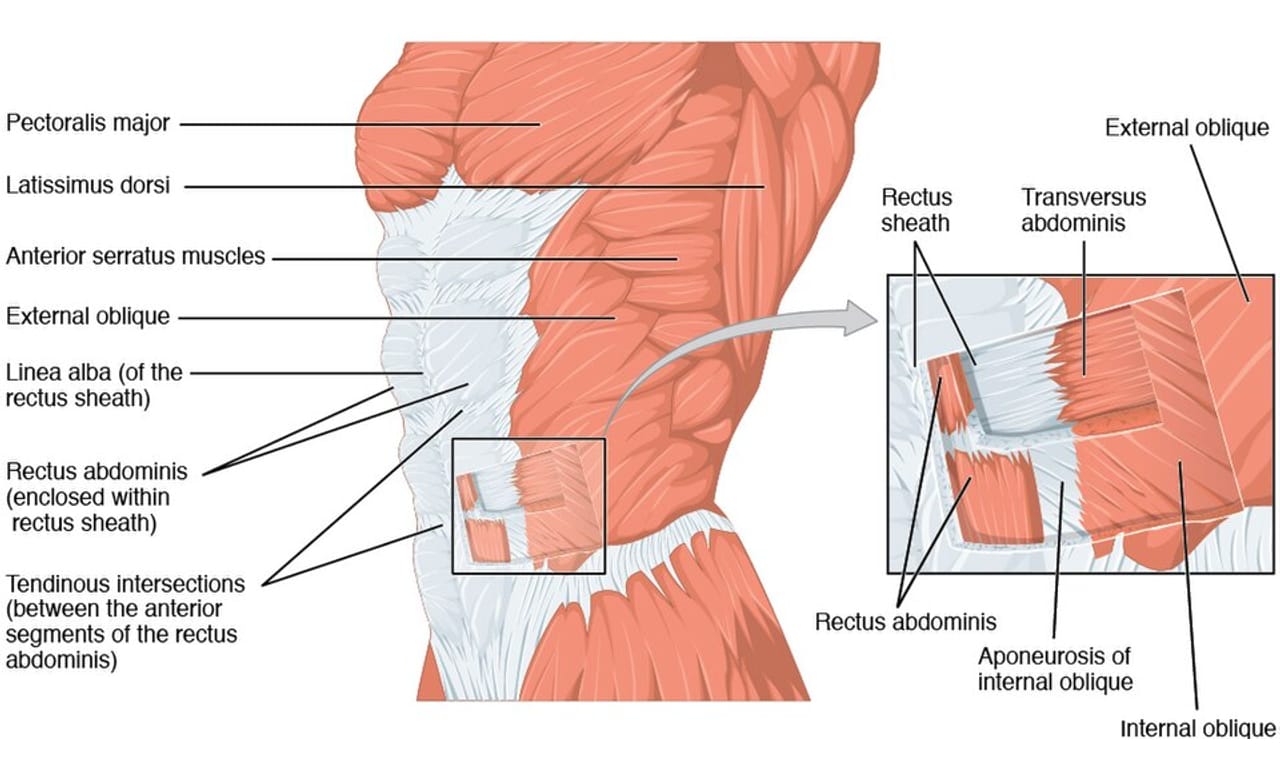
Diastasis recti is a widening of the gap between the two muscles that run down the front of your tummy, and after a baby the cause is the growing womb stretching them apart. It is common, and the NHS says it usually goes back to normal by the time the baby is 8 weeks old. If the gap is still obvious after that, get it checked. Exercise is the usual first step.
The short version
- In one study, 60% had a gap six weeks after a first birth.
- About a third still had a gap at twelve months.
- The link between the gap and back pain is weak.
- Exercise makes the tummy muscles stronger, but may not close the gap.
- A lump at the belly button needs a GP to check for hernia.
How do I check for diastasis recti?
The two long muscles are the rectus abdominis, the ones people call the six-pack. They are joined down the midline by a band of connective tissue called the linea alba. In pregnancy that band stretches, so the muscles sit further apart.
The NHS self-check goes like this. Lie on your back with your legs bent and feet flat. Raise your shoulders slightly off the floor and look down at your tummy. Use your fingertips to feel between the edges of the muscles, above and below the belly button, and count how many fingers fit in the gap.
The NHS describes a separation of about two finger widths as common in pregnancy. European Hernia Society guidelines, written for surgeons, define it as a gap wider than 2 cm. Finger widths vary, so treat your own check as a rough guide to whether things are changing.
In a study that followed 300 first-time mothers, 60.0% had a gap of two finger widths or more at six weeks after birth, 45.4% at six months and 32.6% at twelve months. The authors described it as mild. A small gap a year on is very ordinary.
Does diastasis recti cause back pain?
Probably less often than people think, and the evidence is mixed. A 2023 systematic review of 13 studies covering 2,820 patients found that eight showed no association between the gap and low back pain, and five did. The authors asked for better studies.
The 300-mother study points the same way. Women with and without a gap reported the same amount of low back and pelvic pain twelve months after birth. The NHS is more cautious. It says a gap that is still obvious at 8 weeks may put you at risk of back problems, and that some women also have tummy pain or discomfort.
Tummy pain is where the link looks clearer. In a small study of 72 women, those with a gap had more abdominal pain. They had no more back pain, pelvic girdle pain or pelvic floor problems than the women without one.
If you have back pain and a gap, then, the gap may be a bystander. Lifting, broken sleep and lost fitness deserve a look too, and our guide to the first 12 weeks after birth has more on that.
Can exercise close the gap?
Possibly, by a little, and the research disagrees with itself. Two reviews came out in the same journal on the same day in April 2026. One pooled nine trials with 450 women and found exercise programmes narrowed the gap by about 8 mm. The other gathered 15 studies but found only three similar enough to combine, and those showed no clear difference between deep tummy muscle exercises and little or no treatment.
The detail matters. In the positive review, results varied a great deal between trials, average follow-up was only two months, and the authors said the certainty of the evidence is likely to be low. Two of its trials measured disability, and the exercise groups did no better on that score. It also reported bigger changes when women started within three months, but the difference between early and late starters was not statistically significant.
Binders and corsets have some support too. A 2025 analysis of 21 trials found that a corset and exercise each narrowed the gap by around half a centimetre compared with no treatment, with exercise plus electrical muscle stimulation ranking highest. I would not rely on a binder by itself.
Hands-on treatment has less behind it. A 2026 trial of 96 women added a manual fascia technique to an exercise and muscle stimulation programme. Pain improved more in that group, although they also had 20 more minutes of treatment every session. The extra change in the gap did not hold up after statistical correction. My reading is that manual therapy may help with soreness, with strength work as the main part of the plan.
Are sit-ups and planks safe with diastasis recti?
Leave them out at first, then build back up. The NHS advises avoiding sit-ups, planks and high-impact exercise to start with, along with heavy lifting and straining on the toilet. It recommends regular pelvic floor and deep stomach muscle exercises.
Avoiding them for good is harder to justify. In a randomised trial of 70 women who were 6 to 12 months past birth, one group did a 12-week home programme of head lifts and curl-ups five days a week. Their gap did not get better or worse compared with women who did nothing. Their tummy muscles got thicker and stronger, and there was no change in the severity of back pain, pelvic girdle pain or pelvic floor problems.
A sensible order is breathing and pelvic floor work first, then gentle deep tummy work, then head lifts and curl-ups, then loaded lifting and impact. If you see a ridge or dome push up along the midline, make the exercise easier and try again in a week or two. That is a clinical rule of thumb rather than a trial result. Anyone heading back to impact can read our piece on running after birth, and our exercise rehabilitation service can help you plan the stages.
Could it be a hernia instead?
It could be, and the two can exist together. A diastasis usually shows as a long, soft ridge down the midline when you sit up. A hernia is more often a distinct lump. The NHS explains that a hernia is where part of an internal organ pushes through a gap or weak area in the muscle, and the lump may get bigger when you cough and smaller when you lie down.
At the belly button this is called an umbilical hernia, and the NHS lists multiple pregnancies as one cause in adults. It says to see a GP if you think you have one, or if you have a lump that is painful, hard or does not move, or one that is getting bigger or does not go away. Surgery is usually recommended for adults, because an umbilical hernia is unlikely to get better by itself.
Surgery for a diastasis with no hernia is a different decision. European Hernia Society guidelines say physiotherapy may be considered first, and an Italian expert consensus also puts exercise programmes first. If a wide gap still causes trouble after a proper spell of rehab, ask your GP about a surgical opinion.
When should I see someone?
The NHS says to contact the GP if the gap is still obvious 8 weeks after the birth. They can refer you to a physiotherapist for specific exercises. Mention any leaking, or heaviness or pressure in your vagina, because those can be symptoms of prolapse.
Get help from NHS 111 if you have a hernia along with pain in or around it, a bloated tummy, vomiting, constipation or a high temperature. Call 999 or go to A&E for a stomach ache that starts suddenly and is severe, or a stomach ache where you cannot pee, or cannot poo or fart at all. Do the same for back pain with a loss of feeling around the genitals or anus, weakness or numbness in both legs, or changes in your bladder or bowels.
For back, hip or pelvic pain alongside a gap, an osteopath can assess how you are moving and lifting, and set out a strengthening plan. If this sounds like what you're dealing with, an assessment is the next step. Book online here.
Illustration: OpenStax, Anatomy and Physiology, CC BY 4.0, via Wikimedia Commons (cropped).