

There is no single safe date to start running after having a baby. In a survey of 881 postpartum women published in the British Journal of Sports Medicine, the median time to a first run was 12 weeks, and the better test of readiness is whether you can walk, load and hop without leaking, heaviness or pain. The calendar tells you far less than your symptoms do.
The six to eight week postnatal check often gets treated as a green light. It was never designed as a running assessment, and most of what decides how a return to running goes happens after it.
The short version
- No fixed safe date exists for running after birth.
- In one large survey, the median first run came at 12 weeks.
- Leaking, heaviness or pain during a run means scale back.
- Expert consensus favours walk-run plans plus strength training.
- Poor sleep and heavy fatigue raise the odds of running pain.
Why running asks more of a postnatal body than the gym does
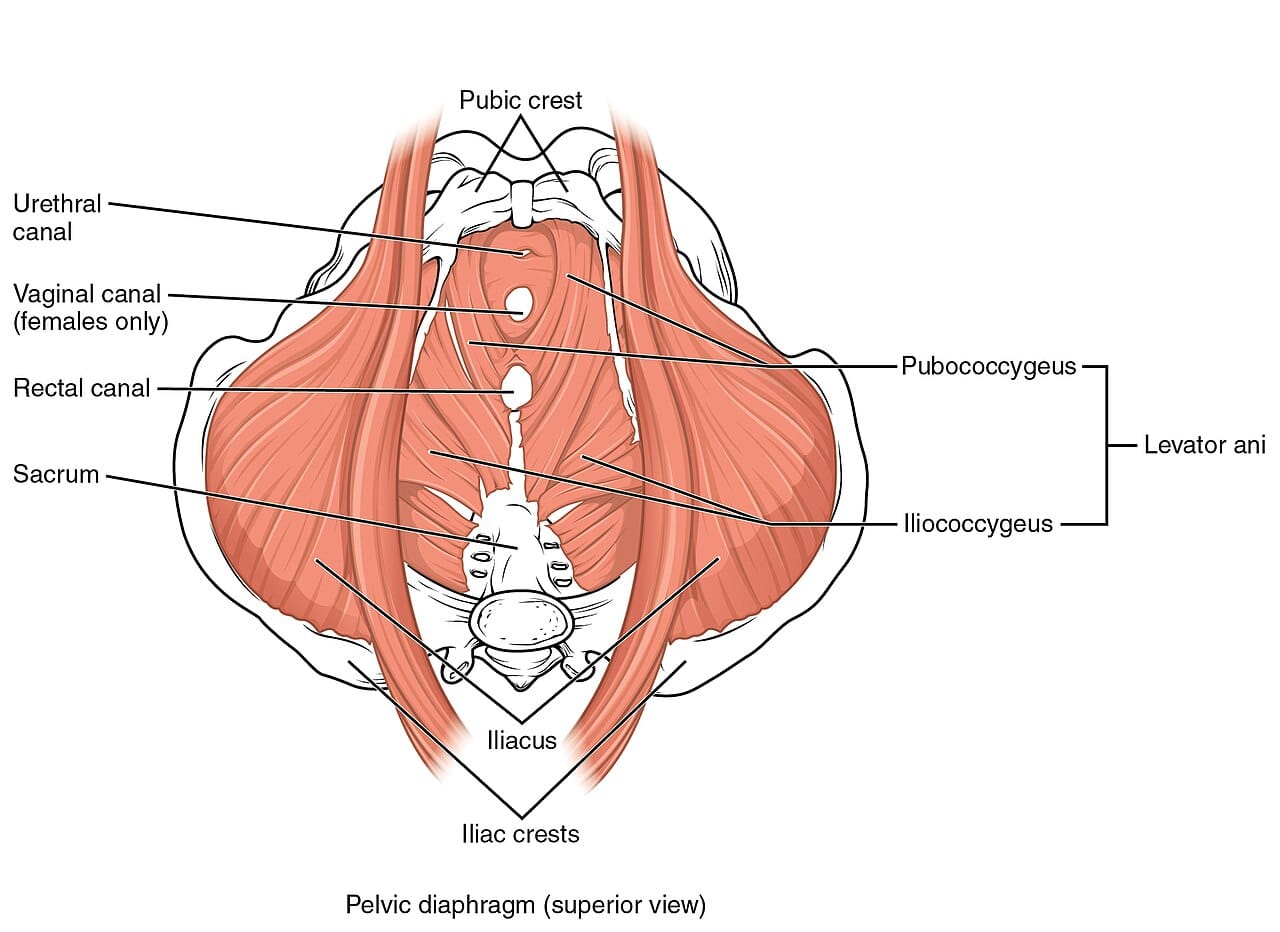
Running is a repeated impact load. Every stride lands through the pelvis, and the muscles that close off the bladder and bowel and hold the pelvic organs up, the pelvic floor, have to respond to each one. The illustration above shows the main sling, the levator ani, seen from above. Pregnancy loads it for months, and a vaginal birth stretches it further.
The abdominal wall has its own recovery. The NHS explains that the two long muscles down the front of the tummy separate during pregnancy, and it advises avoiding sit-ups, planks and high-impact exercise to start with. If the gap is still obvious eight weeks after the birth, the same NHS guidance says to contact a GP, who can refer you to a physiotherapist.
A caesarean adds abdominal surgery on top. NHS caesarean recovery guidance lists exercising among the activities you may not be able to do straight away, and says it may not be for six weeks or so. That applies to exercise in general, and running sits at the high-impact end of it.
What the research says about timing
The best data we have comes from surveys of women who run, so it describes patterns rather than proving cause. Still, the patterns are useful. In the 881-woman BJSM study, women who ran during pregnancy had higher odds of getting back to running (odds ratio 2.81), as did those with lower fear of movement and those without a sensation of vaginal heaviness.
The same study found the strongest risk factors for leaking while running were having leaked when running before or during pregnancy. Having had a caesarean lowered the odds of running-related leaking. One likely reason is that the pelvic floor takes less stretch during a caesarean birth, though the abdominal wall then has its own healing to do.
Pain is common too. In a study of 538 postpartum runners, 32.7% reported running-related pain. Six factors were linked to it: being a newer runner, high fatigue scores, a previous running injury, a vaginal delivery, incontinence and averaging under 6.8 hours of sleep a night. Women with four or more of those had a 61.2% probability of running-related pain.
Your running history matters as well. In that same study of postpartum runners, newer runners had roughly three and a half times the odds of running-related pain (odds ratio 3.51) compared with more experienced runners. If you only took up running during or after pregnancy, give yourself a slower build than a friend who ran right through it, and expect the early weeks to feel harder than the numbers on your watch suggest.
One more finding stands out. A survey of 507 postpartum runners in Sports Health found that weight training during pregnancy was associated with lower odds of postpartum pain, leaking and abdominal separation. It is a cross-sectional study, so it cannot prove the training caused the difference, but it lines up with the rest of the evidence on strength work.
A sensible way back: walk, strengthen, then run
There is now an international expert consensus in the British Journal of Sports Medicine on how to build a postpartum return-to-running programme. The panel agreed on a period of relative rest, gradual increases in duration and intensity, starting with a walk-run protocol, and strength training alongside. It also agreed the plan should change in response to pelvic or musculoskeletal symptoms, sleep, mental health, breastfeeding and energy levels.
In practice that tends to look like three stages. First, regular brisk walking that you can do for 30 minutes without symptoms. Second, strength work for the hips, thighs and calves, plus a few low-level impact drills such as hopping on the spot or a short jog in place. Third, walk-run intervals, short running blocks with walking breaks, stretched out over several weeks. These checkpoints are a practical rule of thumb rather than validated tests. The point is to find out how your pelvic floor handles impact before you are two miles from home.
Pelvic floor exercises belong in the plan from early on. The NHS post-pregnancy guidance sets out how to do them and says they can help with incontinence and prolapse. NICE guideline NG210 recommends encouraging pelvic floor muscle training during routine postnatal care, and considering a supervised three-month programme after an assisted vaginal birth with forceps or ventouse, a birth with the baby lying face up, or an injury to the anal sphincter.
The evidence on those exercises is more mixed than the advice suggests. The Cochrane review of 46 trials found good evidence that training started in pregnancy helps prevent leaking, but uncertainty about how well it treats leaking that persists after the birth. That is a reason to get properly assessed if symptoms hang around, rather than a reason to skip the exercises.
Symptoms that mean ease off
Some aches in the first weeks back are normal. The symptoms below are signs that the load is ahead of your recovery, and the usual answer is to drop back a stage rather than push on.
- Leaking urine during or after a run.
- A feeling of heaviness, dragging or a bulge in the vagina. The NHS lists these as possible symptoms of pelvic organ prolapse and advises avoiding high-strain activities such as running if you have one.
- Pain in the pelvis, lower back or hips that builds over a run or lingers into the next day.
- A doming or bulging along the middle of the tummy when you load it.
Leaking or heaviness that keeps coming back is worth raising with a GP. The NHS says you can ask a GP or health visitor for help with any physical problem after birth at any time, and they can refer you to a specialist. A pelvic health physiotherapist is the right person for an internal pelvic floor assessment.
Sleep and energy count as well. Short sleep and high fatigue were both linked to running pain in postpartum runners, so a week of broken nights is a fair reason to hold your plan where it is rather than progress it.
When to get medical help first
Running symptoms are one thing. A few postnatal symptoms need medical attention before any exercise at all.
- Heavy vaginal bleeding, or a caesarean wound that becomes more red, painful or swollen, or has a discharge. NHS guidance says to contact your midwife or a GP straight away.
- Throbbing pain and swelling in one leg, usually the calf or thigh, can be a blood clot. The NHS DVT page says to call 999 or go to A&E if that comes with chest pain or breathlessness.
- Back pain with tingling, weakness or numbness in both legs, loss of feeling around the genitals or anus, or new problems with bladder or bowel control. The NHS back pain page says to call 999 or go to A&E.
Where an osteopath fits
Pelvic floor assessment is pelvic health physiotherapy territory, and if leaking or heaviness is your main problem, that is where to start. Where our osteopaths help is the musculoskeletal side of coming back: pelvic girdle, hip and lower back pain, a running plan matched to how your body is actually responding, and the strength work that supports it. Our exercise rehabilitation service covers that progression, and we will refer on when a pelvic health physio is the better call.
A useful way to think about the first few months is as training for running. The run itself comes once walking, strength and low-level impact feel comfortable.
If this sounds like what you're dealing with, an assessment is the next step. Book online here.
Illustration: OpenStax, CC BY 4.0, via Wikimedia Commons.