

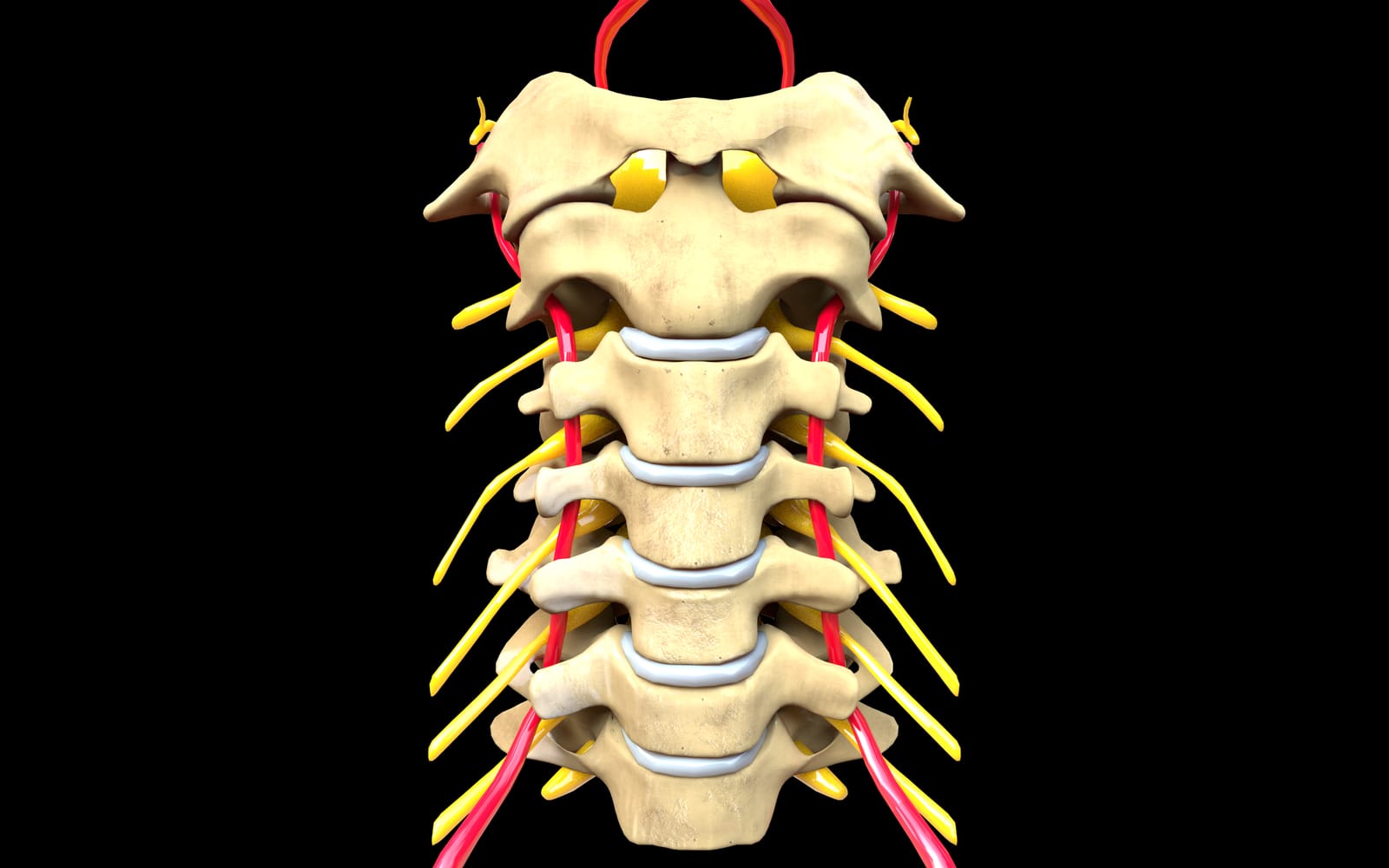
A cervicogenic headache is a headache caused by a problem in the neck, usually in the joints, discs or muscles of the top three segments of the spine, just under the skull. The pain is felt in the head, but the source is the neck. The International Classification of Headache Disorders lists it as a diagnosis in its own right, separate from migraine and tension-type headache, and a Norwegian population study that examined 1,838 adults found it in about 4% of them.
This post covers how a neck problem produces a headache, how to tell it apart from the other common headaches, what the trials say about treatment, and the symptoms that need a GP rather than an osteopath.
The short version
- Cervicogenic headache is head pain referred from the upper neck.
- It usually stays on one side and starts at the back of the head.
- Neck movement or pressure on the neck brings the headache on.
- Manual therapy and neck exercise both reduce how often it happens.
- A sudden severe headache, or one with weakness or confusion, is a 999 call.
How a neck problem becomes a headache
The nerves from the top three levels of the neck share a relay point in the brainstem with the trigeminal nerve, which carries sensation from the face and head. Pain signals arriving from the upper neck can be read by the brain as coming from the head. The ICHD-3 notes describe this as the now well-understood convergence between upper cervical and trigeminal nociception, and a 2009 review in The Lancet Neurology confirms that laboratory and clinical studies have shown pain from the upper cervical joints and muscles can be referred to the head.
The usual culprits are the small facet joints between the first three vertebrae, the joint between the skull and the top vertebra, and the muscles that run from the base of the skull into the neck. The upper discs can contribute. What a scan shows is less useful than people expect. ICHD-3 states plainly that imaging findings in the upper cervical spine are common in patients without headache, so a bit of wear on an X-ray or MRI is suggestive at most and does not prove the neck is the cause.
What it feels like
Three features tend to separate a cervicogenic headache from migraine and tension-type headache, according to ICHD-3. The pain is side-locked, meaning it stays on the same side rather than swapping. Pressing on the neck muscles or moving the head brings on the usual headache. And the pain spreads from the back of the head forwards, often towards the eye or temple on the same side.
In the Vågå study, 97% of people with the condition said their flare-ups began in the neck or the back of the head. Migraine traits such as nausea, vomiting and throbbing were rarely present, and unlike migraine there were slightly more men than women among the clearest cases. Reduced neck movement and discomfort in the shoulder or arm on the same side are part of the picture too.
None of those features is unique to it. ICHD-3 is careful on this point: side-locked pain and a neck trigger may be features of cervicogenic headache, but they do not on their own prove the neck is the cause, and some nausea or light sensitivity can be present without it being a migraine. The Lancet Neurology review goes further and says the clinical diagnostic criteria have not proved valid. The only way to prove the neck is the source is a controlled diagnostic nerve block under X-ray guidance, which is a hospital procedure. In clinic, the diagnosis is a probable one, built from the history and the examination.
How it differs from tension headache and migraine
NICE guideline CG150 sets out the features of the three common primary headaches. Tension-type headache is on both sides, pressing rather than pulsating, mild or moderate, and not aggravated by routine activity. Migraine is pulsating, moderate or severe, aggravated by routine activity, and comes with sensitivity to light or sound, nausea or vomiting. Cervicogenic headache sits apart from both because it is a secondary headache: the head pain is a symptom of something in the neck, and it rises and falls with the neck problem.
The overlap is real. Plenty of people with migraine have neck pain during attacks, and plenty of people with tension headache have tender neck muscles. We covered the tension side in a separate post on tension headaches and neck mechanics. The question that separates them is direction: does the neck problem come first and drive the headache, or is the neck sore because the head hurts?
How we assess it in clinic
The history does most of the work: which side, where it starts, what sets it off, whether turning the head or a long stretch at a desk reliably brings it on. The examination then looks at how far the neck turns, and whether pressing on the upper neck joints and the muscles at the base of the skull reproduces the familiar headache. Reproducing your usual headache from the neck is one of the ICHD-3 causation criteria.
One test is worth naming. The cervical flexion-rotation test tucks the chin fully down and then turns the head to each side, which isolates the movement at the joint between the first and second vertebrae. In a 2007 study of 23 people with cervicogenic headache, 23 healthy controls and 12 people with migraine with aura, the test picked out the headache group with 91% sensitivity and 90% specificity. It is a small study, but it is the test most clinicians reach for when the top of the neck is the suspect.
A headache diary helps more than most people expect. NICE recommends recording frequency, duration, severity, associated symptoms, every painkiller taken and possible triggers for at least eight weeks. Bring it to the appointment. It settles arguments that memory cannot.
What the treatment evidence says
The best-known trial is Jull and colleagues' 2002 randomised trial of 200 people with cervicogenic headache, split between manipulative therapy, a low-load neck exercise programme, both combined, or a control group, over six weeks. At 12 months both the manual therapy group and the exercise group had significantly fewer and less intense headaches than the controls, and the effect held. Combining the two was not statistically better than either alone, though 10% more people in the combined group gained relief.
Later trials point the same way. A 2018 trial of 256 adults with chronic cervicogenic headache found a dose-response to spinal manipulation: the highest dose, 18 visits over six weeks, roughly halved headache days from about 16 to 8 per four weeks, about three days a month better than a light-massage control. Pain intensity on the days it occurred did not change much. A 2016 trial of 110 people found six to eight sessions of upper neck and upper back manipulation reduced intensity and disability more than mobilisation and exercise at three months.
The honest caveat comes from the reviews. A 2026 systematic review of 29 trials rated the evidence low-certainty: manual therapy reduced headache intensity compared with sham in the first two weeks, but the difference had gone by 12 months, while exercise alone showed a benefit at 12 months. A separate 2026 network meta-analysis of 41 trials concluded that combinations of hands-on treatment and exercise outperformed any single treatment in the short term, and that passive treatment on its own, massage included, and drugs such as pregabalin and botulinum injections had limited effect.
The practical reading is this. Hands-on treatment to the upper neck tends to help, and helps faster. Exercise that trains the deep neck muscles is what makes the improvement last. Having one without the other is the common mistake, and it is the reason some people feel better for a week after treatment and then slide back.
When a headache needs a GP, not an osteopath
Most headaches are not serious, but some are, and a neck-related label must never be applied to a headache that has not been checked. The NHS says to call 999 or go to A&E if a headache came on suddenly and is extremely painful, comes with numbness or weakness, difficulty speaking, walking or balancing, drowsiness or confusion, loss of vision, a seizure, a head injury in the last three months, or a very high temperature with a stiff neck and sensitivity to light. Ask for an urgent GP appointment or call 111 if a headache comes with vision problems, is triggered by coughing, sneezing, bending or exercise, comes with vomiting, or comes with jaw pain when eating or a tender scalp.
NICE adds a headache that changes with posture, a worsening headache with a fever, a change in personality, and a substantial change in the pattern of a long-standing headache to the list that needs investigation. If any of those apply, the GP comes first. An osteopath should be asking you these questions at the first appointment, and should send you back to the GP if the answers are wrong.
What to do about it
If the pattern above fits, an assessment is the sensible next step. A first appointment at the clinic is 45 minutes and costs £75. It covers the history, the neck examination described above, your first treatment and a home exercise plan. Our headache treatment page explains how the clinic team approaches neck-related headaches. If this sounds like what you're dealing with, an assessment is the next step. Book online here.
Illustration: DrJanaOfficial, CC BY-SA 4.0, via Wikimedia Commons.