

Pain catastrophising is a way of thinking about pain: dwelling on it, expecting the worst from it and feeling helpless against it. Reviews of the research rank it among the strongest psychological predictors of how pain turns out, and unlike most predictors, such as age or how the injury happened, it can be changed.
The word is unhelpful. It sounds like an accusation that you are overreacting or making the pain up. Nobody is suggesting that. The pain is real. Catastrophising describes what the mind does with that pain, and that part has a measurable effect on how much it hurts, how much it stops you doing and how long it hangs around.
The short version
- Catastrophising means ruminating on pain, magnifying its threat and feeling helpless.
- It does not mean the pain is imagined or exaggerated.
- Higher catastrophising is linked with more pain and disability later in back pain studies.
- Talking therapies, especially CBT and ACT, reduce it, with modest average effects.
- Gradual movement and clear explanation help break the fear and avoidance loop.
What does pain catastrophising mean?
Researchers define it as a negative thinking and emotional response to pain you have now or expect to have. The tool most studies use to measure it, the Pain Catastrophizing Scale, splits it into three parts: rumination, magnification and helplessness.
In plain terms, those three look something like this:
- Rumination: you cannot stop thinking about the pain. It is the first thing on your mind in the morning and the last at night.
- Magnification: you read the pain as a sign of something serious. A twinge while bending becomes proof the disc is getting worse.
- Helplessness: you feel there is nothing you can do. The pain is in charge and you are waiting for it to decide.
Most people in pain have some of these thoughts some of the time. That is normal. What the research tracks is how strong and persistent they are, because that is where the link with outcome shows up.
How can a thought change the pain?
The best-known explanation is the fear-avoidance model. Vlaeyen and Linton's 2000 review set it out: when pain is read as a threat, it breeds fear of pain and of movement. People respond to that fear in one of two broad ways. Confronting the feared activity tends to shrink the fear over time. Avoiding it tends to keep the fear going, or make it worse.
Avoidance has knock-on effects. The same review describes people becoming hypervigilant to body sensations, moving in a guarded way and losing fitness through disuse. Each of those can make the next episode of pain more likely to be read as a threat, and the loop tightens. A later review of the model lists pain catastrophising as one of its core components, alongside attention to pain, avoidance behaviour, disability and disuse, and describes the model as an account of why a minority of people with acute low back pain go on to develop a chronic problem.
There is also a nervous system side. A 2009 critical review looked at proposed mechanisms including how attention is drawn towards pain and how the brain and spinal cord process pain signals. That work is still developing, so treat it as a plausible explanation rather than a settled one. The practical point holds either way: pain is shaped by how the nervous system interprets what is happening, and interpretation is something we can work on.
What the evidence says about outcomes
Most of the research is in low back pain, so that is where the clearest picture comes from.
A 2014 systematic review in The Spine Journal pooled 16 studies that followed people for at least three months. Two thirds of the studies that measured self-reported outcomes found catastrophising was linked with more pain and disability at follow-up, in acute, subacute and chronic back pain. In five of the six studies that split people into high and low catastrophisers, the high group did worse. The authors were careful: they called it "some evidence" of delayed recovery and said the link was not fully established.
A companion review of 11 treatment studies covering 2,269 patients found something more useful. Catastrophising at the start predicted disability later in four studies and pain in two, while three found no effect. But in all five studies that measured whether catastrophising dropped during treatment, a bigger drop went with a better result.
It does not explain everything. A 2026 review of 37 studies on knee replacement found that no psychological factor, catastrophising included, showed a reproducible link with pain a year after surgery. Patient expectations were the only factor that lined up consistently, and most patients improved whatever their psychological profile. So catastrophising is a real influence on recovery, more clearly in some conditions than others, and one factor among several.
Can catastrophising be reduced?
Yes. A 2018 meta-analysis of 79 randomised trials involving 9,914 adults, mostly with musculoskeletal pain, found nine types of treatment reduced catastrophising. The best quality evidence was for cognitive behavioural therapy (CBT), acceptance and commitment therapy (ACT) and multimodal programmes that combine psychological and physical work.
The authors were honest about the size of the effect. On average it was medium and of questionable clinical significance. Effects were larger and more consistent in the eight trials that only recruited people with high catastrophising, which makes sense: the people with the most room to change got the most from treatment aimed at it.
That fits UK guidance. NICE guideline NG193 recommends considering ACT or CBT for people with chronic primary pain, delivered by trained professionals. The NHS back pain page lists CBT, alongside exercise and manual therapy, as an option when back pain has not settled after a few weeks. Pain education, covered in our post on pain neuroscience education, works on the same thoughts from a different angle.
What this looks like in an osteopathy clinic
Osteopaths are not psychologists, and anyone with high, persistent catastrophising may well need a referral for CBT or ACT. But a lot of the fear that drives the loop comes from not knowing what the pain means, and that is squarely our job.
In my years of practice, the most useful thing I could often give a worried patient was a clear explanation. What is most likely going on, what is very unlikely, and why it is safe to move. The words clinicians use matter. Phrases like "your spine is crumbling" or "worst back I have seen" can stick with people long after the appointment, and they feed the magnification part of catastrophising directly.
The clinic team builds on that with movement. If bending is the thing you fear, we work out a version of it you can do today, then build from there. Each session where the feared movement goes fine is evidence against the catastrophic prediction, and that evidence carries more weight than reassurance alone. The NHS advice on easing pain makes the same point: if you build activity up gradually, it is unlikely you will cause damage.
A few things you can do yourself:
- Notice the thought and name it. "That is my brain predicting the worst" puts a little distance between you and the prediction.
- Ask what the evidence is. Has this pain actually got worse over the last month, or does it just feel that way today?
- Keep moving in small doses rather than waiting for the pain to go first.
- Protect sleep and keep in touch with people. Both are on the NHS list for good reason.
If the thoughts are taking over your day, or your mood has dropped with them, speak to your GP about talking therapies. The NHS page on CBT explains what it involves.
When to see a GP first
Working on how you think about pain only makes sense once anything serious has been ruled out. The NHS advice is to call 999 or go to A&E if you have back pain with numbness, tingling or weakness in both legs, loss of feeling around the genitals or anus, or changes in bladder or bowel control. Ask for an urgent GP appointment if you feel hot, shivery or generally unwell with the pain, or if severe pain comes on suddenly or gets worse quickly.
See a GP as well if pain is worse at night and does not ease with rest, if you have lost weight without trying, or if you are struggling to cope. Struggling to cope is a valid reason to ask for help in its own right.
If this sounds like what you're dealing with, an assessment is the next step. Book online here.
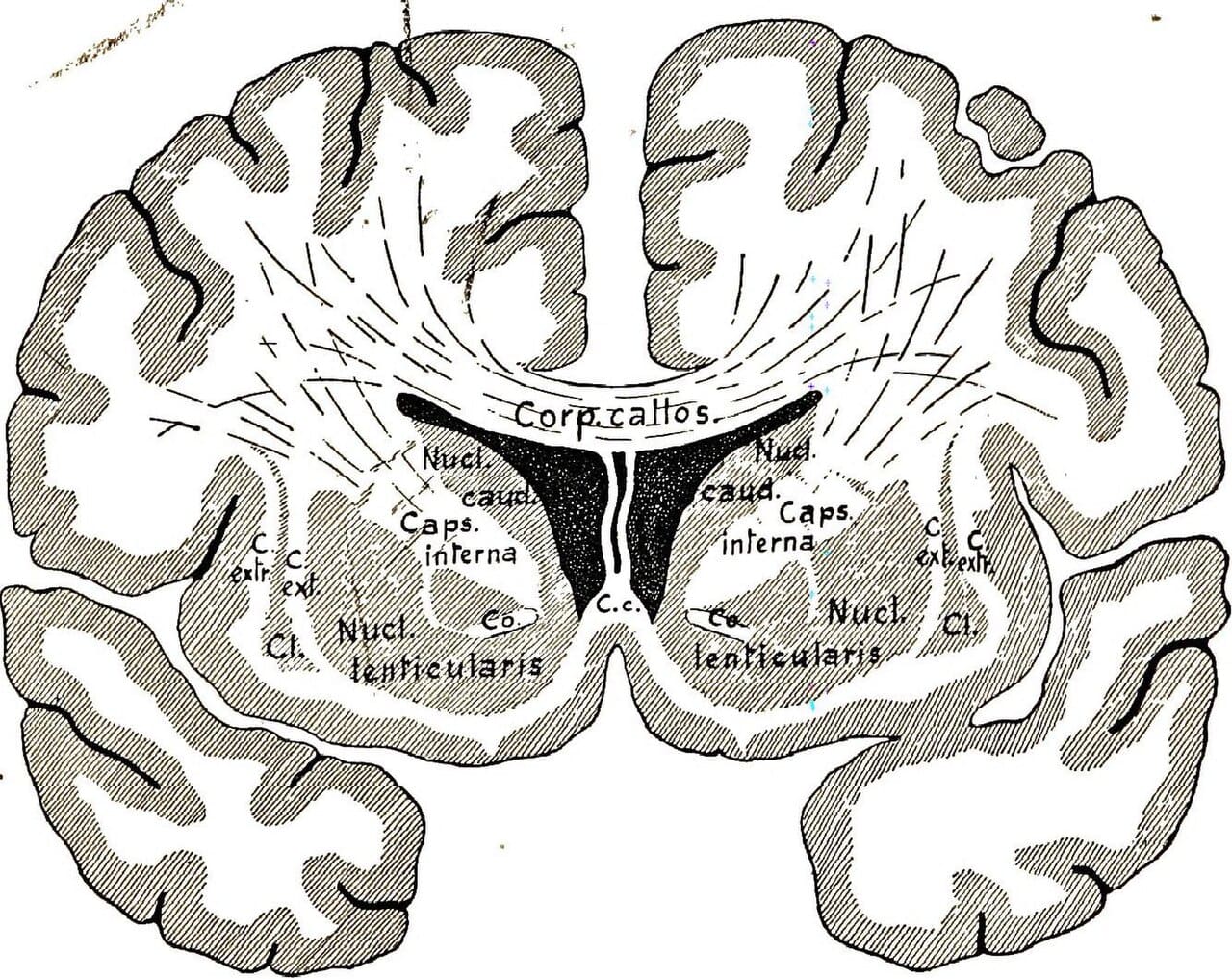
Illustration: coronal section of the brain, from Brain and Spinal Cord (1912), via Wikimedia Commons, public domain.