

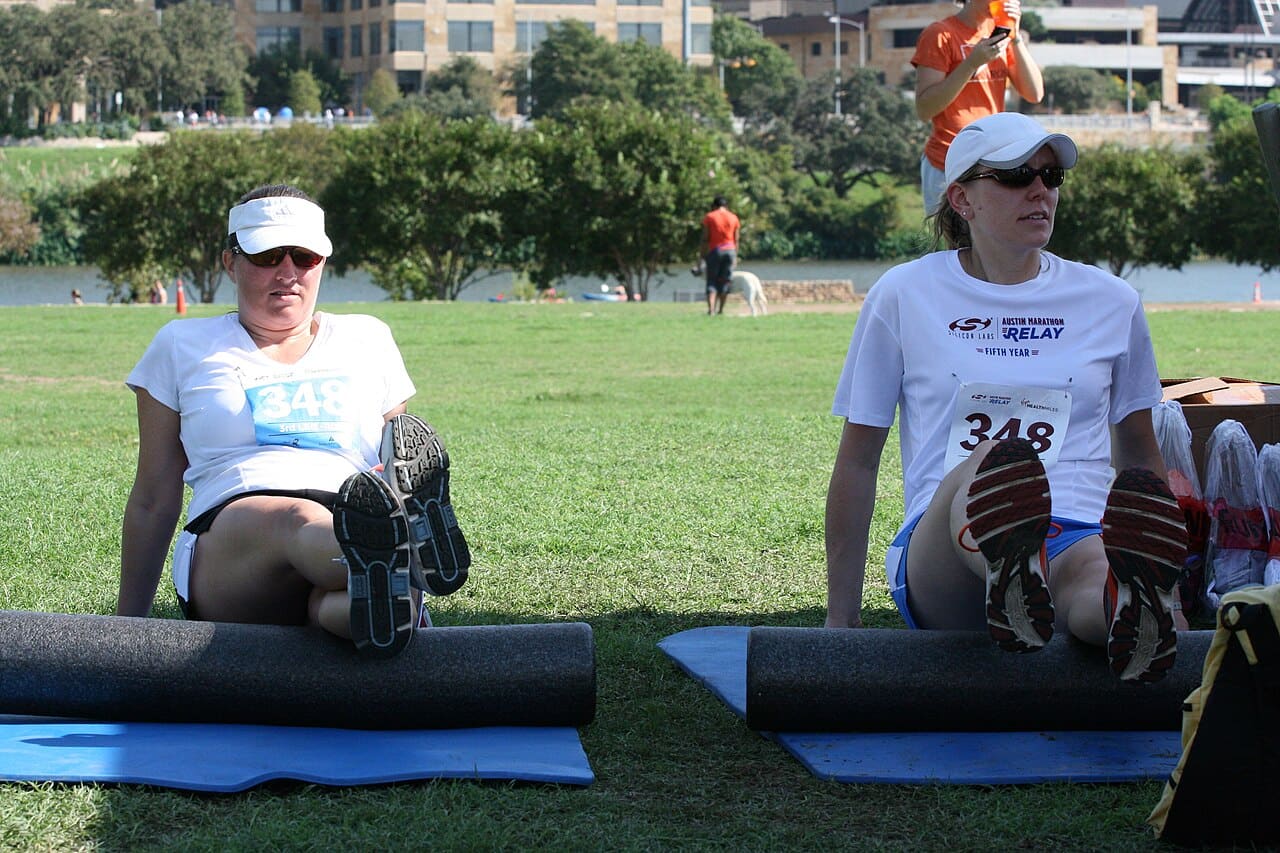
No, foam rolling does not release fascia or break down scar tissue. What it does is change how your nervous system responds to that limb for a while, which is why you get a genuine short-term gain in range of motion and feel a bit less sore afterwards. That is worth having. It is a smaller claim than the one printed on the box.
The short version
- Foam rolling does not release fascia or break down scar tissue.
- The effect runs through your nervous system, not the connective tissue.
- Rolling before you train gives a real short-term range of motion gain.
- It is no better than stretching for flexibility.
- After hard exercise it reduces how sore you feel, not how fast you recover.
What foam rolling does not do
The name gives the game away. "Self-myofascial release" implies the roller is releasing something that was stuck. Fascia is tough, load-bearing connective tissue, and the evidence that a foam roller changes it in any lasting way is not there. A 2019 review in Sports Medicine worked through every proposed mechanism and concluded that there is insufficient evidence that rolling works by releasing myofascial restrictions, and that calling these tools self-myofascial release devices is misleading.
Rollers are also sold as trigger point treatment. The same review points out the awkward step before that: identifying a trigger point reliably is itself a problem, and the reliability of trigger point identification is not high. It is difficult to treat a spot precisely when clinicians cannot agree where the spot is.
What it actually does
Skin, fascia and muscle are densely supplied with sensory nerve endings, and rolling loads a lot of them at once. The routes proposed in that review include cutaneous and fascial mechanoreceptors, type III and IV afferents that shift the balance between sympathetic and parasympathetic activity, activation of the body's own pain modulating systems, and reflex reductions in muscle tone. Blood flow and tissue hydration change briefly as well, which alters stiffness for a short period.
In plain terms: you have not lengthened the muscle. You have turned down the protective tension and the sensitivity for a while, so you can move further and it hurts less to do so. That is a real effect and a useful one. It is also temporary, and it does nothing on its own to change why the area was guarded in the first place.
What the evidence shows, before and after training
Before training is where rolling looks best. A 2020 multilevel meta-analysis in Sports Medicine pooled 26 trials of high methodological quality and found that, compared with doing nothing, a single bout of rolling produced a large improvement in joint range of motion (SMD 0.74, 95% CI 0.42 to 1.01). A 2019 meta-analysis of 21 studies is more conservative about the size of it, reporting that pre-rolling improved flexibility by about 4% and sprint performance by about 0.7%, with negligible effects on jump and strength. Two credible analyses, two different magnitudes. Treat the direction as solid and the size as uncertain.
The practical advantage is that you get the range without paying for it in output. A 2015 systematic review of 14 studies found short-term range of motion increases without negatively affecting muscle performance, which is what you want from anything you do in a warm-up.
Afterwards, the picture is thinner. The same 2019 analysis found post-rolling reduced muscle pain perception by about 6% and slightly softened the exercise-induced drop in sprint and strength performance, in the region of 3% to 4%. The authors describe the overall effects on performance and recovery as rather minor and partly negligible, and conclude that the evidence justifies foam rolling as a warm-up activity rather than a recovery tool. You feel less sore. You do not recover meaningfully faster.
Foam rolling versus stretching
If the goal is range of motion, the roller has no edge. In that 2020 meta-analysis, rolling was not superior to stretching for immediate range (SMD -0.02, 95% CI -0.73 to 0.69). Over a training block the two are close as well: a 2024 review of 85 studies found both static stretching and foam rolling training increase range with a moderate effect and no significant difference between them, except when the block runs four weeks or less, where static stretching had a clear advantage.
Rolling as a habit does build range over time. A 2022 meta-analysis of 11 studies and 290 participants found a moderate increase in range from foam rolling training (ES 0.823, 95% CI 0.325 to 1.322), with interventions longer than four weeks outperforming shorter ones. One finding in there is worth knowing if you own a roller: range improved at the hamstrings and quadriceps, but rolling the calf produced no improvement in ankle dorsiflexion. If you have been rolling your calves to get depth in a squat, the pooled data does not support it.
How to use it so it earns its ten minutes
There is no established optimal protocol. The 2015 review said so plainly, and nothing since has settled it, so treat the following as reasonable practice rather than a prescription.
- Put it in the warm-up rather than the cool-down if you only do one.
- Aim at the big thigh and glute muscles, where the range gains actually show up.
- Go slow with moderate pressure. The moderator analysis in the 2020 review found speed and duration did not significantly change the outcome, so grinding harder or longer is not buying you more.
- Follow it immediately with the movement you want to keep. Range you do not use goes away again, which is the difference between mobility and flexibility.
- Treat it as a warm-up tool, not a treatment. If rolling one spot is the only thing keeping the pain manageable, the roller is managing a symptom and something else is driving it.
When rolling is the wrong answer
Do not roll a fresh, swollen injury. NHS advice for a sprain or strain is ice early, no heat for the first couple of days, and gentle progressive movement, not deep pressure over inflamed tissue. Keep off bone, off a joint line, and off any area that feels numb.
Rolling is also no substitute for staying active. The NHS guidance for back pain is to stay active and continue with your daily activities, and that remains the single most useful thing most people with a sore back can do.
Some symptoms need medical attention rather than a roller. The NHS says to call 999 or go to A&E if back pain comes with pain, tingling, weakness or numbness in both legs, a loss of feeling around the genitals or anus, or changes in your bladder or bowels. Ask for an urgent GP appointment or contact 111 if you feel hot, cold, shivery or generally unwell with it, or if the pain started suddenly and is severe or getting worse quickly.
Short of that, if you have been rolling the same area for months and it keeps coming back, the useful question is not how to roll it better. It is what that tissue is compensating for. That is an assessment question, and it is what exercise rehabilitation is built around: find the driver, load it properly, and let the roller go back to being a warm-up tool.
If this sounds like what you're dealing with, an assessment is the next step. Book online here.
Photo: Roger Mommaerts, CC BY-SA 2.0, via Wikimedia Commons.