

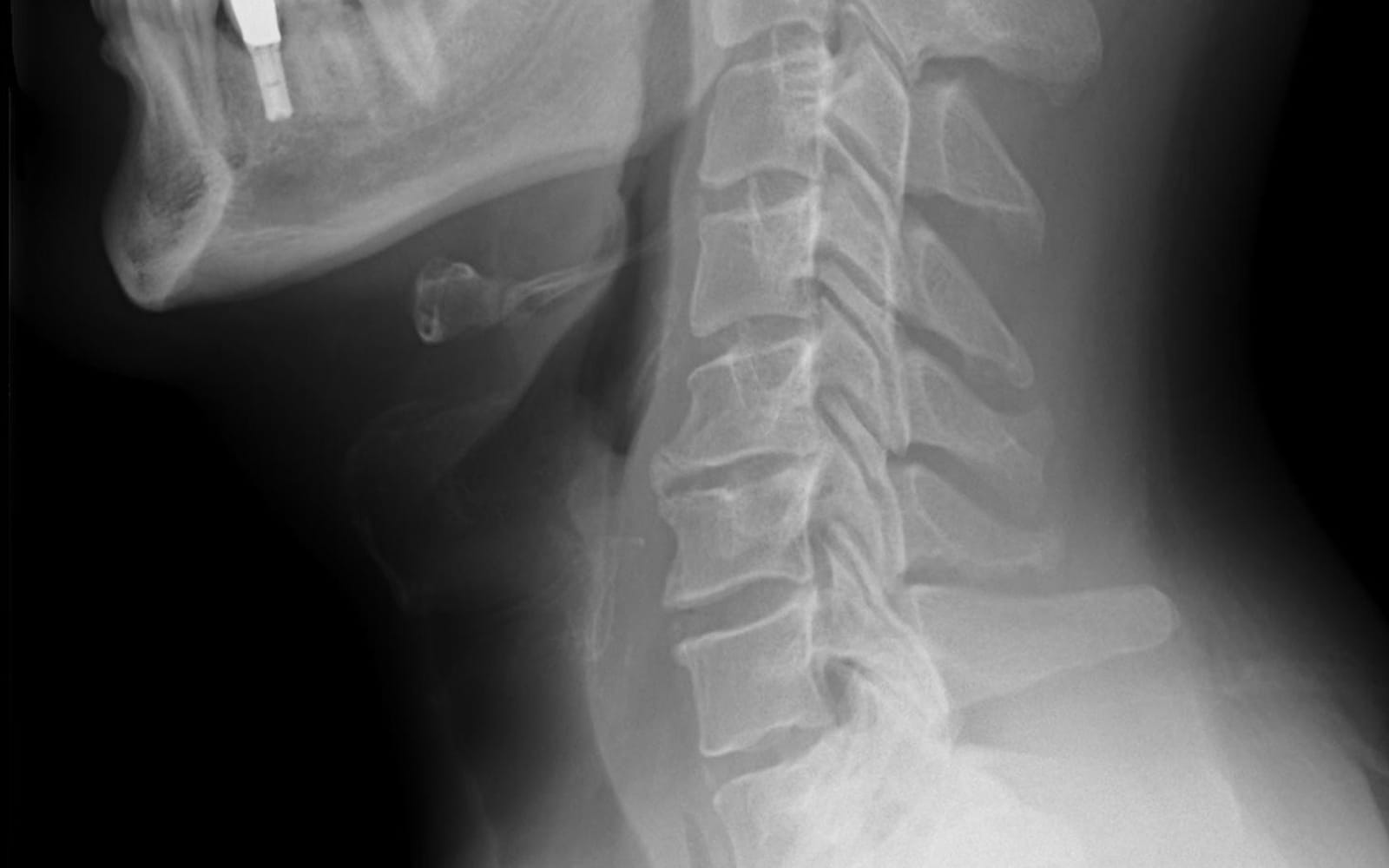
Composite case. A typical pattern drawn from many similar histories, not one specific patient.
Chronic neck pain that has been around for years is usually a stiff, under-loaded neck and upper back rather than a spine falling apart. A first appointment is 45 minutes, and most of the useful work happens in the history rather than the hands-on exam. Here is how a typical one runs, start to finish.
Composite case. The patient below is a pattern drawn from many similar histories seen by the clinic team. No single patient is described.
The short version
- Chronic neck pain rarely has one clear structural cause.
- Wear and tear on cervical scans is common in people without pain.
- The history tells you more than the hands-on examination does.
- Neck and shoulder blade strength work has the best evidence.
- Hands-on treatment plus exercise outperforms either one alone.
The presentation
A desk-based worker in their forties books in with neck pain that has come and gone for about four years. It is worst by mid-afternoon, sits on one side between the neck and the shoulder blade, and turns into a dull ache behind one eye by the evening. Massage has helped for two days at a time. An MRI reported degenerative changes at two levels. Nobody has given them anything to do between appointments.
That is the most common long-standing neck presentation the clinic team sees: no single injury, a scan that reads worse than the person feels, and no plan.
What the first twenty minutes are really for
An initial consultation is 45 minutes and costs £75. Roughly the first twenty are questions, and patients are often surprised how few are about the neck itself.
NICE guidance on chronic pain asks clinicians to run a person-centred assessment that identifies what is contributing to the pain and how it affects the person's life, including work, sleep disturbance, psychological wellbeing and stressful life events.
In practice: hours at a screen, what the pain does at the weekend, how sleep is, what has already been tried. A neck that eases on holiday and builds by Wednesday afternoon tells you something palpation will not.
What gets ruled out first
Before any treatment, the assessment screens for the things that need a doctor rather than an osteopath. The NHS advises seeing a GP if neck pain or stiffness has not gone after a few weeks, if painkillers such as paracetamol or ibuprofen have not worked, or if there are other symptoms like pins and needles or a cold arm, which can point to something more serious.
The osteopath also asks about significant trauma, unexplained weight loss, fever, night pain that repeatedly wakes the patient, and any loss of strength or coordination in the arms or legs. Here the answer to all of them was no, which is the usual answer.
Had any answer been yes, the appointment would have ended with a letter to the GP rather than a treatment plan.
The scan that showed wear and tear
The MRI report is usually the thing the patient is most worried about and the thing that changes the plan least.
In 1,211 healthy volunteers with no neck symptoms, 87.6% had disc bulging on cervical MRI, including 73.3% of the men and 78.0% of the women in their twenties. Spinal cord compression was far rarer at 5.3%, and became more common after the age of 50.
Wear and tear on a neck scan is close to a normal finding in adults, and it still deserves explaining. NICE asks clinicians to be sensitive when communicating normal or negative test results, because it is easy to leave someone feeling their pain has been written off.
The honest version: the scan shows a neck that has aged, plenty of people with the same scan have no symptoms, and the report does not tell us what to do next. The examination does. We covered the same ground for the lower back in disc bulge vs disc herniation.
The physical assessment
The hands-on part starts with movement. Rotation each way, side bending, extension, and how much of that range comes from the neck rather than the upper back. In this pattern rotation is restricted towards the painful side and the thoracic spine barely extends, leaving the neck to make up the difference.
Then: how well the shoulder blades hold position under load, how the deeper neck flexors cope with a light endurance test, and what the upper trapezius and levator scapulae feel like under the hands. Any arm symptom adds a neurological screen of power, reflexes and sensation.
By the end there is an explanation the patient can repeat back, which is the real output of a first appointment.
What the treatment plan looked like
Two things, run together, because the combination beats either part alone.
Hands-on work in the room came first: soft tissue through the neck and upper back, and graded joint mobilisation to get rotation and thoracic extension moving. A 2025 network meta-analysis of 101 randomised trials and 7,633 patients found that multimodal treatment, meaning two or more manual approaches combined, reduced both neck pain intensity and neck disability more than any single technique. The same authors rated 61.3% of those trials at high risk of bias, so treat the size of that effect with caution.
Exercise is the part that holds the gain. Cochrane's review of exercise for mechanical neck disorders found moderate quality evidence that strength training for the neck, shoulder blade and upper limb improves chronic neck pain, and that stretching used on its own produced no beneficial effect. Those reviewers were clear that no high quality evidence exists and uncertainty remains. A 2025 network meta-analysis in The Spine Journal agreed: resistance training combined with coordination work ranked highest for non-specific neck pain, with manual therapy showing a moderate but genuine benefit.
So the plan this patient left with was short and dull: a deep neck flexor endurance hold, a banded row for the shoulder blades, thoracic extension over the back of a chair, and a daily walk. Four things, most days, progressed at each follow-up. Our exercise rehabilitation sessions are for people who need that supervised rather than emailed.
How the twelve weeks actually went
Follow-ups are 30 minutes and cost £60. Here the course ran to roughly six sessions across twelve weeks, and not in a straight line.
Little moved in the first two sessions beyond a day or two of relief after each one. Rotation improved before the pain did. Around week five a heavy week at work triggered a flare, which is ordinary and worth saying in advance. NICE asks clinicians to discuss up front that symptoms are likely to fluctuate over time and flare-ups may happen, and that quality of life can improve even when the pain itself is unchanged.
By week twelve the neck was a background ache on bad weeks rather than something that shaped the day, and the patient had four exercises that reliably brought it back down. It did not vanish. For a neck that has hurt for four years, that is usually what a good outcome looks like.
If this sounds like what you're dealing with, an assessment is the next step. Book online here.