
Thoracic outlet syndrome (TOS) is compression of the nerves or blood vessels near the top of the ribs, in the narrow gap between your collarbone and first rib. In most cases it is the nerves that are irritated, which gives pins and needles, aching and an arm that tires quickly, usually on one side. It is genuinely rare, so most tingling arms turn out to be something else. The few versions that involve blood vessels need urgent medical attention.
This post covers what the condition is, how it tends to feel, why it is one of the hardest diagnoses in musculoskeletal medicine, what helps, and the arm symptoms that should send you to a GP or NHS 111 today rather than to an osteopath.
The short version
- TOS is compression of nerves or blood vessels above the first rib.
- Nerve-type TOS is the most common form, roughly 80% of cases.
- It is rare: around 2 to 3 new nerve cases per 100,000 people a year.
- No single test confirms it. Diagnosis rules other causes out first.
- A swollen, red, blue or cold arm needs urgent medical help.
What the thoracic outlet is and what gets compressed
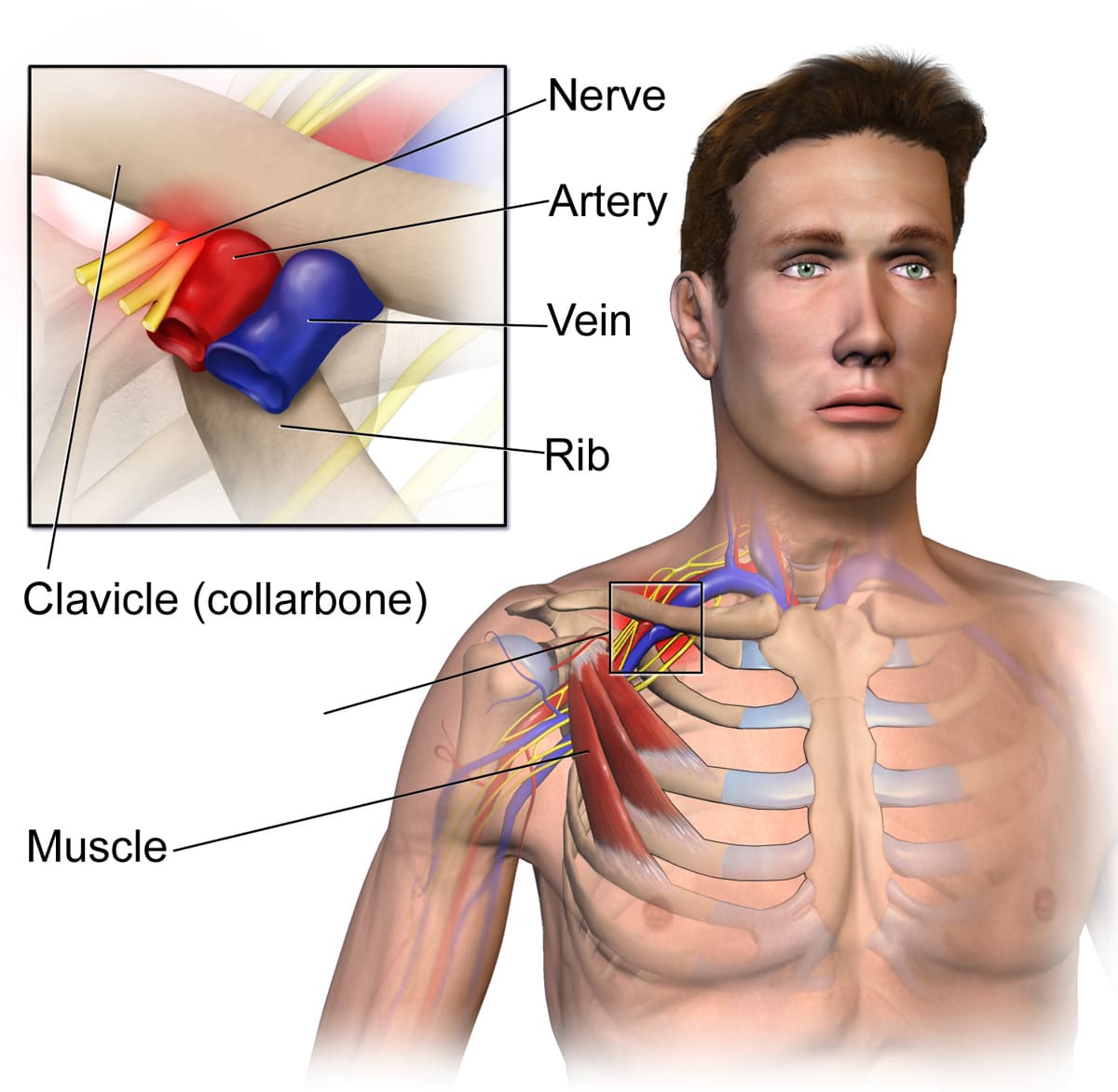
The thoracic outlet is the space at the base of your neck where everything heading for your arm squeezes past the top of the rib cage. Three structures make that trip: the brachial plexus (the bundle of nerves that supplies the arm and hand), the subclavian vein and the subclavian artery. They pass between the scalene muscles at the side of the neck, over the first rib, under the collarbone and beneath the small pectoral muscle at the front of the shoulder.
Compress any of the three and you get a different condition. The Society for Vascular Surgery's reporting standards split TOS into neurogenic, venous and arterial types, and treat them as separate problems that can occasionally overlap. In one prospective database of 526 referrals to a specialist TOS clinic, 82% had symptoms suggesting the nerve type, 16% the venous type and 2% the arterial type. From those referrals the authors estimated around 2 to 3 new cases of the nerve type per 100,000 people a year, and 0.5 to 1 of the venous type, much lower than earlier estimates.
The NHS lists the usual contributors as an extra rib in the neck (a cervical rib), posture, large breasts, an injury to the chest, neck or ribs, repetitive arm work such as building or swimming, and gaining a lot of muscle. A review written for sports medicine adds throwing, weightlifting and manual labour to the list of activities linked to symptoms.
What thoracic outlet syndrome feels like
According to the NHS, TOS usually affects one arm and hand. The symptoms it lists are pins and needles that can be worse at night and wake you up, an arm that gets tired easily, pain and swelling in the arm, a hand and arm that feel cold, and skin on the hand that turns blue, grey or pale.
The nerve type tends to be the aching, tingling, heavy-arm version. People often notice it with the arms overhead (hanging washing, putting things on a high shelf, drying hair) or with the arm dangling and loaded, such as carrying shopping. The vascular types look different. Colour change, coldness and swelling point towards a blood vessel rather than a nerve, and that changes how fast you need to act.
Why it is hard to diagnose, and what else it could be
A Cochrane review opens by calling TOS one of the most controversial diagnoses in clinical medicine, largely because there is no agreed set of diagnostic criteria. The vascular surgery standards try to address that by requiring three of four features before the nerve type is diagnosed: pain or tenderness at the thoracic outlet, signs of nerve compression further down the arm (often worse overhead or dangling), no other condition that explains the symptoms, and a positive response to a test injection into the scalene muscle.
Clinical tests help less than you would hope. The elevated arm stress test, where you hold both arms up and open and close your hands for a few minutes, showed low discriminative value in 266 patients with suspected nerve-type TOS, and the authors advise using it with caution. A sports medicine review describes TOS in athletes as a diagnosis of exclusion for the same reason.
So the first job is to rule out the more common causes of a tingling, aching arm:
- Carpal tunnel syndrome, pressure on a nerve at the wrist that causes tingling, numbness and pain in the hand and fingers, usually worse at night.
- A trapped nerve in the neck, often alongside cervical spondylosis, the age-related wear in the neck that many people have without symptoms.
- Shoulder problems such as rotator cuff pain, which can ache down the upper arm.
- Nerve irritation further down the arm, such as at the elbow.
Even in a specialist centre, the label often does not stick. Of 856 people referred to a Dutch TOS service with suspected nerve-type TOS, the diagnosis was confirmed in 476 (55.6%). If you have read about TOS online and think it fits, that is a reasonable starting point for an assessment, but the odds favour something more ordinary.
When arm symptoms need urgent help
The NHS gives clear red flags for TOS:
- Ask for an urgent GP appointment or contact NHS 111 if you have throbbing or cramping pain, swelling, redness and warmth in one arm. These can be signs of a blood clot.
- Call 999 if you have sudden breathlessness, sharp chest pain that may be worse when you breathe in, and a cough or coughing up blood.
Speed matters with the venous type. A review of venous TOS notes it frequently affects young, otherwise healthy patients, and that starting treatment within 14 days of symptoms is one of the most important predictors of outcome. A hand that is cold, pale or blue, or new weakness and wasting in the hand muscles, also needs a GP rather than a wait-and-see approach.
What tends to help
For the nerve type, conservative care comes first. An international consensus of hand surgeons recommends conservative management as first line, except in patients with significant muscle wasting or weakness. The NHS describes the main treatment as physiotherapy with stretching and strengthening exercises to reduce pressure on the nerves and blood vessels, with medicines for pain where needed. Surgery is kept for serious problems such as clots, or when other treatment has not worked.
The evidence for any of this is thin, and it is worth being honest about that. A German review found no multicentre randomised trial for nerve-type TOS. Observational studies report physiotherapy helping in 27 to 59% of cases, and 56 to 90% of people who go on to surgery after failed conservative care benefiting. In the Dutch cohort, dedicated physiotherapy was successful in 186 of 476 confirmed patients (39.1%). The Cochrane review found no randomised evidence that surgery beats no treatment, and Botox injections into the scalene muscles were no better than salt water for pain.
In practice, rehab usually means building endurance in the muscles around the shoulder blade, adjusting the positions and loads that bring symptoms on, and gradually reintroducing overhead work. It takes weeks to months. Most people are better off treating it as a long programme than looking for one session that changes everything.
How an osteopath fits in
An osteopath's first job here is assessment and screening. That means taking a careful history, checking the neck, shoulder, elbow and wrist, testing strength, sensation and reflexes, and looking for vascular signs that need onward referral. If the picture suggests a clot, artery problem or significant nerve damage, the right move is a same-day GP or NHS 111 referral, and our osteopaths will tell you that plainly.
Where the nerve type is the more likely explanation, or where the symptoms turn out to come from the neck or shoulder instead, hands-on treatment can be used alongside a structured exercise programme. There are no trials specific to osteopathy for TOS, so the exercise plan carries most of the weight. For more on how the clinic approaches upper limb problems, see our shoulder pain treatment in Luton page.
If this sounds like what you're dealing with, an assessment is the next step. Book online here.
Illustration: BruceBlaus, CC BY-SA 4.0, via Wikimedia Commons.