

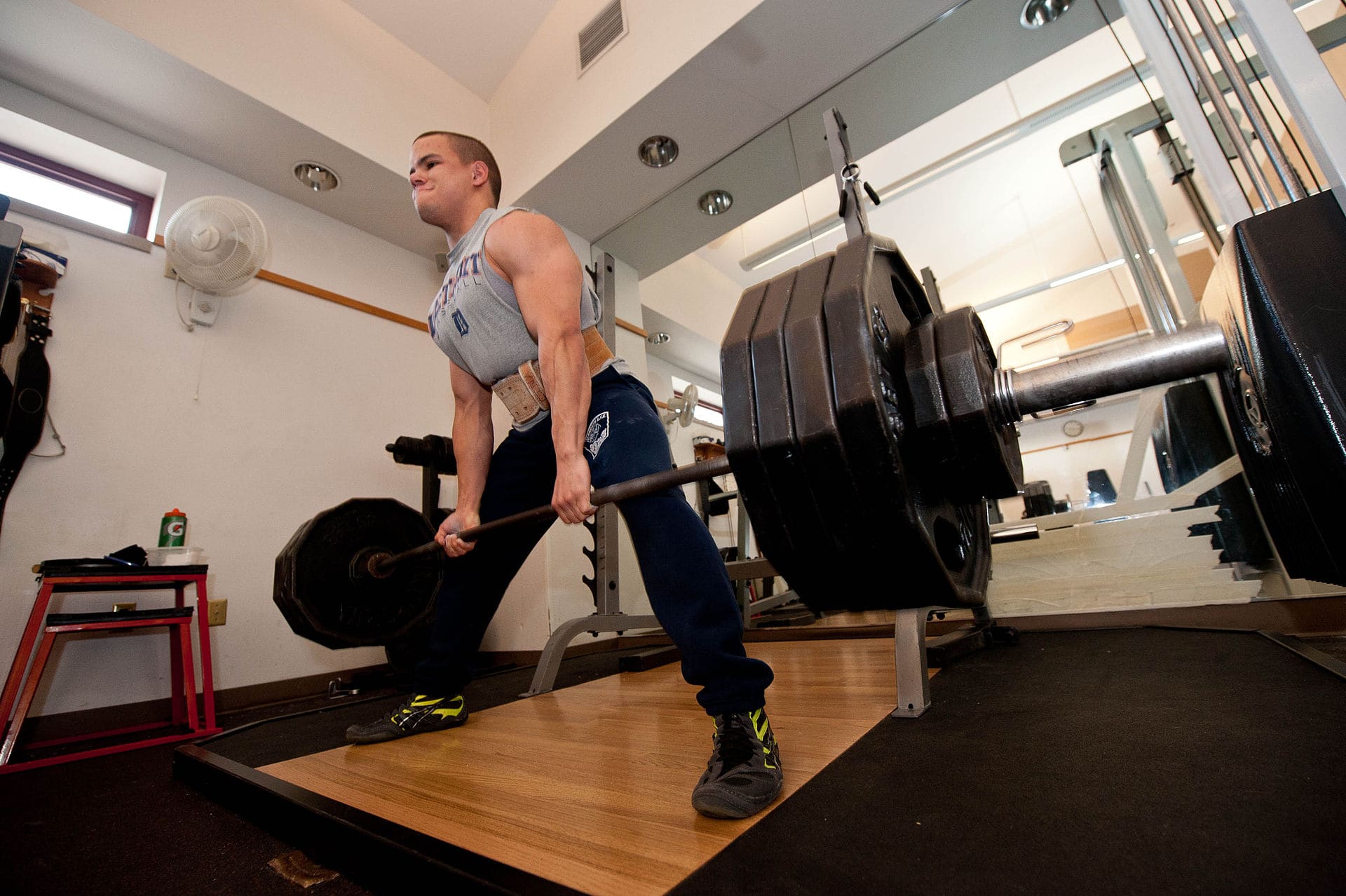
Most people with a bout of low back pain should keep strength training rather than stop. Advice to stay active beats advice to rest, and exercise is one of the better supported treatments for chronic low back pain. What usually needs to change is the load, the range and two or three exercise choices, for a few weeks.
There is a smaller group who should stop and get checked first. The signs that put you in that group are at the bottom of this post.
The short version
- Keep training. Staying active beats resting for back pain.
- Reduce load and range before you cut a lift entirely.
- Mild pain during a set is acceptable. Sharp or spreading pain is not.
- Rebuild with heavier sets and fewer sessions once symptoms settle.
- Numbness in both legs or bladder changes is an emergency, not a training question.
Why stopping altogether usually backfires
The NHS advice for back pain is to stay active, keep going with daily activities, and avoid staying in bed for long periods. NICE guideline NG59 puts the same thing in clinical terms: self-management should include encouragement to continue with normal activities.
The trial evidence supports that, modestly. A 2025 Cochrane overview of 31 reviews covering 644 trials and 97,183 adults found that advice to stay active probably gives a small reduction in pain and a small improvement in function compared with advice to rest, on moderate certainty evidence. Small, not dramatic. It is still the better bet than sitting it out.
In my years of practice, the more common problem was the person who stopped everything for three weeks, got weaker and more guarded about moving, then went straight back to their old numbers on week four and stirred the whole thing up again. The flare came from the gap, not from the training.
What to keep
Start from the assumption that most of your programme stays in, then subtract. That is a very different exercise from starting at zero and adding back.
- Everything that does not clearly reproduce your pain. For most people that is the majority of the session, including all upper body work.
- Lower body work you tolerate, at a lighter load. Split squats, leg press, hip thrusts and machine work often stay in when a heavy barbell squat has to come out.
- Walking and easy aerobic work. It keeps you moving and costs you almost nothing in recovery.
- Loaded carries and short holds, if they feel fine. They give you spinal loading without the range of motion that tends to be sore.
- Back extensor work, once the first few sore days have passed. A 2026 systematic review of strength exercise dosage in low back pain found the clearest results for exercises targeting the back extensors, and for higher intensities above 60 percent of one rep max. Worth knowing that the authors rated confidence in their own findings as low to very low, so treat it as a reasonable direction rather than a rule.
What to drop, for now
The "for now" matters. Most of these come back within a few weeks.
- Maximal and near maximal attempts. Testing your one rep max during a painful episode tells you nothing you need to know.
- Anything that sends symptoms down the leg. A local ache is workable. Pain, pins and needles or numbness travelling below the knee is a reason to leave that movement alone and get it looked at.
- Heavy loaded rounding at the end of a set, when you are tired and form is drifting. Your spine is not fragile and bending is not dangerous, but an irritated joint or disc is temporarily sensitive to end range positions under load.
- Testing it. Bending forward twenty times a day to see whether it still hurts keeps the area stirred up and tells you very little.
- Wearing a belt for every set to get through pain. NICE advises against belts and corsets for managing low back pain. That is a different thing from a lifting belt on a genuinely heavy set, which is a performance tool. If you have started wearing one all session because it hurts without it, take the weight off instead.
How much pain is acceptable during a set
This is the question that comes up most, and the honest answer is that some pain is allowed.
A 2017 systematic review in the British Journal of Sports Medicine pooled seven trials in chronic musculoskeletal pain and found that protocols allowing painful exercise gave a small but significant short term advantage over pain free protocols, on moderate quality evidence. Over the medium and long term there was no clear difference between the two. The authors' conclusion is the useful part: pain during therapeutic exercise need not be a barrier to a good outcome.
A common clinical rule of thumb, and it is a rule of thumb rather than a trial finding, is that pain should stay mild during the set, should not climb set to set, and should be back to your usual baseline by the following morning. If you are noticeably worse the next day, the dose was too high. Take 20 percent off and repeat the session.
How to bring the load back
The 2021 Cochrane review of exercise therapy for chronic low back pain pooled 249 trials. It found moderate certainty evidence that exercise reduces pain compared with no treatment, usual care or placebo, by an amount the authors judged clinically important. The improvement in day to day function was smaller and did not reach their threshold for a meaningful difference, and exercise was no better than manual therapy in their subgroup analysis. Exercise is worth doing. It is not magic, and nobody should sell it to you as if it were.
No trial gives you a week by week loading plan. A workable starting point is to take the painful lift down to roughly half your usual working weight, keep the reps moderate, and add around 5 to 10 percent a week for as long as the next morning rule holds. If a week goes badly, repeat it rather than pushing through it.
Keep the general strength work going alongside that. The NHS physical activity guidance asks adults for strengthening activities covering all the major muscle groups on at least two days a week, and that does not get suspended because one lift is sore.
When to stop and see someone
Most back pain settles on its own. A small number of presentations need urgent assessment rather than a training tweak.
The NHS says to call 999 or go to A&E if back pain comes with pain, tingling, weakness or numbness in both legs, a loss of feeling around the genitals or anus, changes to bladder or bowel control, or chest pain, or if it started after a serious accident. Ask for an urgent GP appointment or call 111 if you feel hot, cold, shivery or generally unwell with it, or if severe pain starts suddenly or is getting worse quickly.
See a GP in the normal way if the pain has not improved after a few weeks, is worse at night or does not settle with rest, or comes alongside weight loss you cannot explain.
Short of that, a scan is rarely the answer early on. NICE advises against routinely offering imaging for low back pain in a non-specialist setting, because the result usually does not change what should happen next.
If your training keeps stalling around a back that flares every few weeks, the useful thing is an assessment that looks at what you are actually doing in the gym, rather than a generic sheet of stretches. That is what our back pain treatment and exercise rehabilitation appointments are for. An initial assessment is £75 and covers history, movement testing and a plan for the next few weeks.
If this sounds like what you're dealing with, an assessment is the next step. Book online here.