

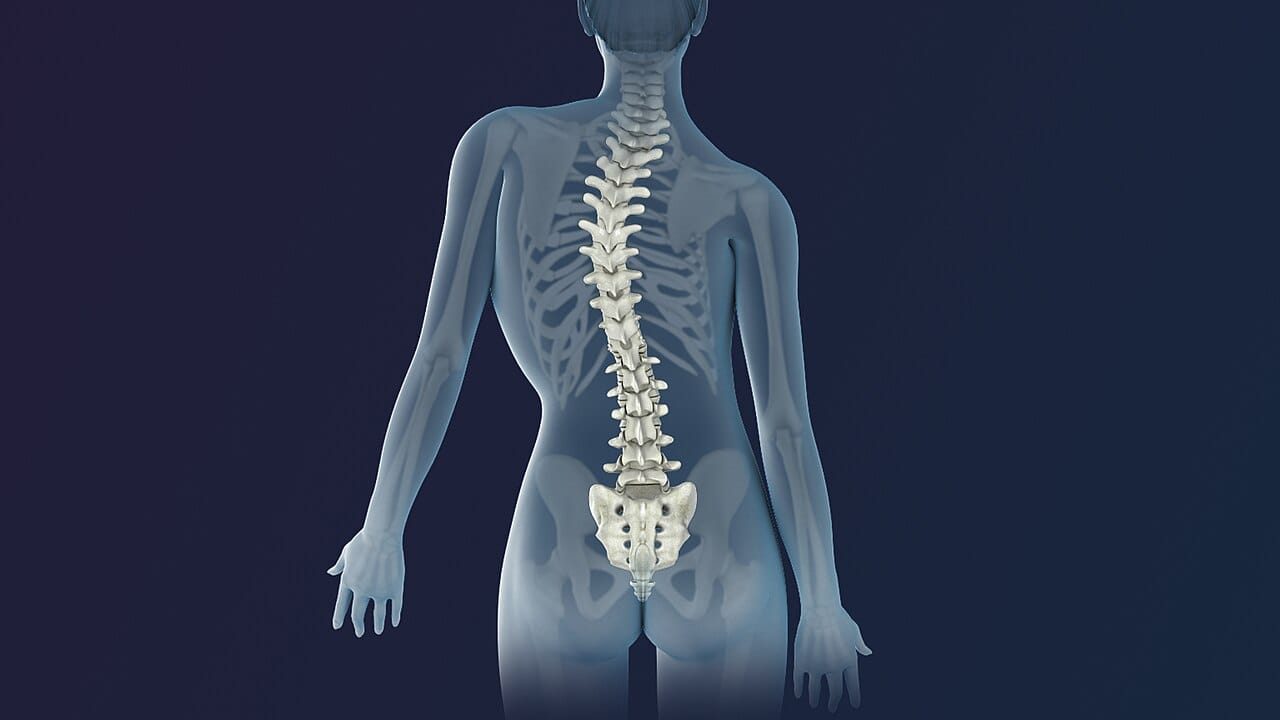
Scoliosis in adults is common, usually mild, and often has little to do with the back pain that brings someone to a clinic. In a study of healthy volunteers over 60, 68% had a sideways curve big enough to count as scoliosis, and the size of the curve did not track with their pain. It matters when it is causing pain, irritating nerves or getting worse.
The short version
- Scoliosis is a sideways curve of the spine of more than 10 degrees.
- Adult curves either started in childhood or developed later with disc wear.
- Many adults with a curve have no pain or limitation from it.
- Exercise often eases the pain, though it rarely changes the curve.
- Most adults with scoliosis never need surgery.
What adult scoliosis is, and how common it is
The NHS describes scoliosis as the spine twisting and curving to the side. It is measured on a standing X-ray using the Cobb angle, the angle between the most tilted vertebrae at the top and bottom of the curve. A curve of more than 10 degrees is the usual threshold for calling it scoliosis.
Adults with scoliosis fall into two broad groups. The first had a curve that started in childhood or the teenage years. Across all ages, the NHS says the cause is unknown in around 8 in every 10 cases, and that this idiopathic type is not thought to be linked to bad posture, exercise or diet. The second group develops a curve later in life, as the discs in the lower back wear more on one side than the other. This is called degenerative, or de novo, scoliosis.
The wear-related type is more common than most people expect. A Japanese study that followed 144 women with an average starting age of 54 found that 29% already had a lower-back curve over 10 degrees, and that 29% of those without one developed a new curve over the following 12 years. A second community study, running for 15 years, found new curves in 17% of older adults, and none of them went past 30 degrees. Most sat between 10 and 20.
The over-60 volunteers in the study above had no known history of scoliosis. Plenty of people carry a curve without knowing, and only find out when an X-ray or scan is done for another reason.
Does scoliosis cause back pain?
Sometimes. The NHS treatment page for adults says back pain is one of the main problems scoliosis causes in adults, and it is more common in adults with the condition than in children. But the link between the curve on the film and the pain someone feels is loose.
In the over-60 study, the authors found no significant correlation between the X-ray measurements and pain scores, and noted that a large group of people with adult scoliosis have no marked physical or social impairment.
The longest follow-up we have is a 50-year natural history study in JAMA. It compared 117 people with untreated late-onset idiopathic scoliosis, average age 66 at review, with 62 matched volunteers. Chronic back pain was more common in the scoliosis group, 61% against 35%. Yet among those with pain, about two-thirds in both groups described it as little or moderate, and the authors concluded that untreated adults were productive and functional at a high level. Breathlessness was linked to very large curves, over 80 degrees with the peak of the curve in the upper back, which is a different situation from the mild curves most adults have.
So a curve can raise the odds of back pain without being the explanation for a particular episode. The question I would put to anyone told they have scoliosis on a scan is simple: is this curve why you hurt, or is it just there? Ordinary back pain is very common with or without a curve. It is also why the NICE back pain guideline advises not routinely offering imaging outside specialist settings, and keeping it for cases where the result is likely to change management.
Will the curve get worse?
For most adults, slowly if at all. The NHS says scoliosis tends to stay the same once you stop growing, and to see a GP if it gets worse.
Wear-related curves can creep. In the 12-year study of Japanese women, about a quarter of those with an existing lower-back curve progressed by more than 5 degrees. A systematic review of de novo scoliosis found the strongest predictors of progression were all seen on imaging: more disc degeneration, a vertebra shifted sideways by 6 mm or more at the peak of the curve, and where the line across the top of the pelvis sits against the lower spine. The review found no clinical risk factors.
In practical terms, progression is something a specialist judges by comparing X-rays over time. You cannot tell it from how your back feels on a given day. Changes worth getting checked are the visible ones the NHS lists: shoulders becoming more uneven, one hip or one side of the ribs sticking out more, or clothes starting to fit differently.
What tends to help, and where surgery fits
For adults, the NHS says treatment is mainly aimed at pain relief, and that if the curve is not severe and not causing pain, treatment may not be needed at all.
Exercise comes first. The NHS advice is that activities which strengthen and stretch the back may help reduce pain, that the type of exercise matters less than keeping the back moving, and that it is worth choosing something you will stick with. It also says back exercises taught by a physiotherapist are unlikely to improve the curvature, but may help with pain. Be wary of anyone who promises to straighten an adult curve. The realistic aim of conservative care is a back that hurts less and does more.
Anti-inflammatory painkillers such as ibuprofen are usually the first medicine recommended, though they are not suitable for everyone, so check with a pharmacist. Hands-on treatment has a defined place too. NICE recommends considering manual therapy for low back pain only as part of a package that includes exercise. That guideline covers back pain in general rather than scoliosis specifically, and osteopathic treatment for scoliosis-related pain works best in the same role, making it easier to move and to exercise. It does not change the shape of the spine.
Where a curve is irritating the nerves, causing pain, numbness or tingling from the lower back down towards the feet, steroid and local anaesthetic injections may help, though the NHS notes the benefit usually lasts weeks or months. Braces are rarely used in adults.
The NHS is clear that most adults with scoliosis will not need surgery. It may be considered when the curve is severe or getting significantly worse, when back pain is severe and other treatments have not helped, or when nerves in the spine are being squashed. Surgery is generally better at relieving pain that travels into the legs than pain in the back itself, and full recovery can take a year or more.
For people whose lower-back curve is causing significant symptoms, the best long-term data comes from the ASLS-1 study, published in JAMA Surgery in 2025. It followed 286 adults aged 40 to 80 across 9 North American centres. On average, those who had surgery reported less disability and better scoliosis-specific scores than those treated without surgery at 2, 5 and 8 years, with no sign of the benefit fading. The cost was real: treatment-related serious adverse events ran at about 22 per 100 person-years in the first 2 years. The study was not fully randomised. Surgery is a genuine option for the right person, and that decision belongs with a spinal surgeon.
When to get urgent help
Having scoliosis does not change the warning signs for back pain. The NHS back pain page says to call 999 or go to A&E if you have back pain with:
- pain, tingling, weakness or numbness in both legs
- loss of feeling around your genitals or anus
- changes in your bladder or bowels, such as difficulty peeing or not being able to control it
- pain that started after a serious accident, such as a car crash
Ask for an urgent GP appointment or use 111 if you feel hot, cold, shivery or generally unwell, or if severe pain starts suddenly or gets worse quickly. See a GP if you have lost weight without trying, if your back has changed shape or there is a lump or swelling, or if the pain is worse at night and does not settle with rest.
How the clinic team approaches scoliosis
If you know you have scoliosis, or suspect it, an assessment starts with the history: whether the curve is already known, whether the pain is new or has changed, and whether anything is travelling into the legs. Our osteopaths look at how your back, hips and ribcage move, check the nerves to the legs, and then work out whether this is ordinary back pain in someone who happens to have a curve, something that needs a GP or specialist, or both.
For most people the plan is exercise you can keep up, hands-on treatment where it helps you move, and a clear idea of which changes would warrant a recheck. Our back pain page explains how the team approaches back problems more broadly.
If this sounds like what you're dealing with, an assessment is the next step. Book online here.
Illustration: 3D render of a spine with scoliosis, Scientific Animations, CC BY-SA 4.0.
