

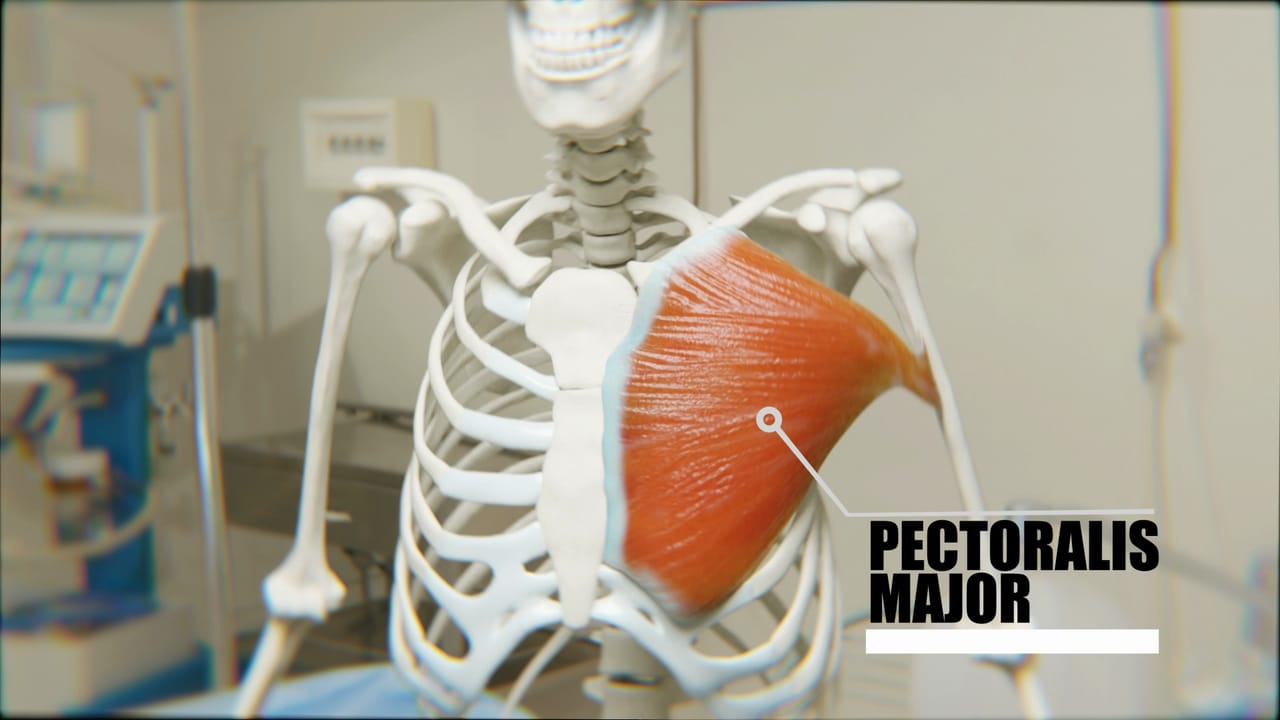
A pec strain hurts at the front of the chest or in the front fold of the armpit, and it flares when you push or squeeze your arms together. A shoulder strain, which usually means an irritated rotator cuff, hurts over the outside of the shoulder and upper arm, and flares when you lift the arm out to the side or overhead. In most cases, where it hurts and which movement sets it off will tell you which one you have.
The short version
- A pec strain hurts at the front of the chest or armpit fold.
- A rotator cuff problem hurts over the outside of the shoulder.
- Pushing and pressing provoke a pec strain most.
- Lifting the arm out to the side provokes the rotator cuff most.
- A sudden tear during a heavy bench press needs a surgical opinion quickly.
Where each one hurts
The pectoralis major is the large fan-shaped muscle across the front of your chest. It starts from the collarbone, the breastbone and the upper ribs, then narrows into a flat tendon that attaches to the front of the upper arm bone, just below the shoulder. That tendon forms the front fold of your armpit, the ridge you can pinch when your arm hangs by your side. A strain can sit anywhere along that line, from the middle of the chest out to the armpit.
The rotator cuff is a group of four smaller muscles that wrap around the shoulder blade and hold the ball of the upper arm in its socket. When people say they have strained their shoulder, this is usually the area involved. Rotator cuff pain tends to sit over the outside of the shoulder and can spread down the upper arm. A 2013 review in JAMA described rotator cuff disease as the most common cause of shoulder pain that doctors see.
The two sit close together at the front of the shoulder, and that is where most of the confusion comes from. Pain right at the front of the joint could be either, so the movement tests below matter more than the exact spot.
How each one usually happens
Pec injuries tend to be sudden. A systematic review of 365 published pectoralis major injuries found that 83% came from indirect force, meaning the muscle gave way under its own load rather than from a blow, and 48% happened during weight training. A 2022 review in the Journal of the American Academy of Orthopaedic Surgeons names the bench press as the most common cause, with the muscle torn while it is working hard and being stretched at the same time, which is the lowering part of the lift. Milder strains follow the same pattern at lower loads, such as an awkward rep on dips or an arm forced backwards in sport.
Rotator cuff problems more often build up over time. A tendon that has been asked to do more overhead work than it is used to will often grumble for weeks before it gets bad enough to notice. A new gym programme, a weekend painting a ceiling or a season of throwing are typical triggers. They can also follow a fall or a sudden heavy lift.
Telling them apart: the movements that give it away
You can learn a lot by testing a few movements gently on both sides. Stop at pain. The point is information, so there is nothing to gain from pushing through.
- Press your palms together in front of your chest and squeeze. Pain at the front of the chest or armpit points towards the pec.
- Push against a wall at chest height, as if starting a push-up. A pec strain usually complains here too.
- Stretch the arm out wide and back, as if opening your chest. This lengthens the pec, so a pec strain often pulls here.
- Lift your arm slowly out to the side and up overhead. Pain over the outside of the shoulder through the middle of the movement, easing as the arm goes higher, is called a painful arc. In the JAMA review it was the most useful single pain test for rotator cuff disease.
- Hold your elbow at your side, bent to a right angle, and push the back of your hand outwards against a door frame. Pain or weakness here points to the rotator cuff, and the same review rated this resisted outward rotation among the most accurate findings.
Then look in a mirror. Compare the front fold of both armpits. If one side looks flatter or has lost its edge, or bruising is spreading across the chest or upper arm, treat it as a possible tear rather than a strain. The JAAOS review lists swelling, bruising and loss of that armpit fold as the key examination findings, and stresses comparing with the other side.
None of these tests settles it on its own. The JAMA authors pointed out that the shoulder tests were studied in specialist hands, in patients already referred, so how well they work in everyday settings is unknown. An osteopath combines your history, the movement tests and what they can feel, and also checks the neck, because a neck problem can send pain into both the chest and the shoulder.
When a pec injury is more than a strain
Many pec strains are minor and settle with sensible loading. A full tear of the tendon is a different problem, and it is time-sensitive. The warning signs are a sudden sharp or tearing pain during a heavy push, weakness pressing or bringing the arm across the body, bruising that appears over the next few days, and a change in the shape of the armpit fold.
If that fits, get a surgical opinion within days rather than weeks. The JAAOS review found that surgical repair of an acute rupture gives better function than non-surgical care, with high rates of return to work and sport, while repairing an older tear is more difficult and may need a tendon graft. Resting it for a month to see what happens can close off the simpler option.
What tends to help each one
For a pec strain, the NHS advice on sprains and strains applies. For the first 2 to 3 days, protect it, rest it from exercise, ice it for up to 20 minutes every 2 to 3 hours, and avoid heat, alcohol and massage. Once you can move without pain stopping you, keep moving so it does not stiffen. The NHS says most strains feel better after 2 weeks, that strenuous exercise is best avoided for up to 8 weeks, and that severe strains can take months.
When you go back to pressing, it makes sense to start with a shorter range and lighter loads, because the bottom of a bench press or dip is where the pec is both stretched and loaded. Incline push-ups against a bench, then floor push-ups, then light pressing is a sensible order. Add range before you add weight.
For a rotator cuff problem, the NHS shoulder pain page says to stay active and keep gently moving the shoulder, to avoid stopping using it altogether, and to keep up shoulder exercises for 6 to 8 weeks. It usually takes about 2 weeks of this before pain starts to ease, and full recovery can take 6 months or longer. Loaded exercise is the backbone of treatment. A systematic review in Physiotherapy found the evidence supportive of exercise for rotator cuff tendinopathy, while noting it rested on only four small trials.
Hands-on treatment can ease pain and help you get moving, but the exercises do most of the work. If you want the full picture on shoulder assessment at the clinic, our shoulder pain page covers it.
When to get help urgently
Chest pain without an obvious injury needs a different kind of check. The NHS says to call 999 if you have sudden chest pain or pressure that does not go away, pain that spreads to your arm, neck, jaw, stomach or back, or chest pain with sweating, sickness, light-headedness or breathlessness. Do not assume it is a pulled muscle because you went to the gym that week.
For the shoulder, the NHS advises an urgent GP appointment or NHS 111 if you have sudden or very bad pain, cannot move your arm, your arm or shoulder has changed shape or is badly swollen, you have pins and needles that do not go away or no feeling in the arm, the arm is hot or cold to touch, the pain started after a fall or accident, you have severe pain in both shoulders, or you feel feverish or unwell. See a GP if the pain is getting worse or has not improved after 2 weeks.
If this sounds like what you're dealing with, an assessment is the next step. Book online here.
Illustration: DrJanaOfficial, CC BY 4.0, via Wikimedia Commons.