

For most people with knee osteoarthritis, the treatments that help most before anyone mentions injections are strengthening and general fitness exercise, losing some weight if you are carrying extra, and an anti-inflammatory gel rubbed into the knee. That is the order the UK's NICE osteoarthritis guideline (NG226) puts them in. Injections sit further down the list because the relief they give is short.
The short version
- Knee osteoarthritis is usually diagnosed from your symptoms, without an X-ray.
- Exercise and weight management are the core treatments in NICE guidance.
- Anti-inflammatory gel is the first medicine NICE recommends for the knee.
- Steroid injections give short-term relief, roughly 2 to 10 weeks.
- A hot, swollen knee with a high temperature needs same-day advice.
What knee osteoarthritis is and how it is diagnosed
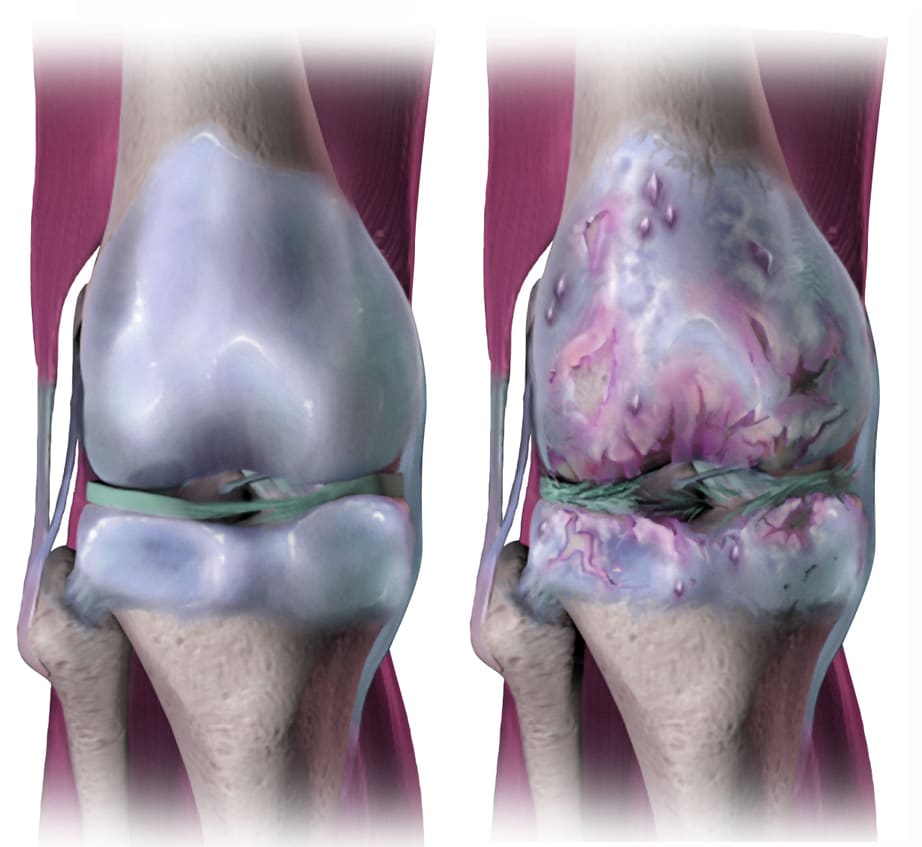
Osteoarthritis is the most common type of arthritis in the UK, and the knee is one of the joints it affects most. The smooth cartilage covering the ends of the thigh bone and shin bone thins, the bone underneath changes shape at the edges, and the joint can become stiff, sore and sometimes swollen. Risk goes up with age, a previous knee injury, a family history and extra body weight, and it is more common in women.
You usually do not need a scan to confirm it. NICE advises diagnosing osteoarthritis clinically, without imaging, in people who are 45 or over, have joint pain that comes on with activity, and have either no morning stiffness or stiffness that wears off within 30 minutes. Imaging is kept for atypical features, such as a recent injury, long morning stiffness, a hot swollen joint or symptoms that are getting worse quickly.
That matters because an X-ray of a knee in middle age often shows wear whether it hurts or not. The picture on the film tells you less about what you can do than how the knee behaves when you climb stairs, squat or walk for half an hour. The NHS also notes that osteoarthritis does not necessarily get worse over time, and symptoms can sometimes gradually improve.
Exercise: the treatment with the most evidence
NICE says to offer therapeutic exercise to everyone with osteoarthritis, tailored to the person. In practice that means two things: strengthening the muscles around the knee, mainly the thigh and hip muscles, and building general aerobic fitness through walking, cycling or swimming.
The evidence base is large. The 2024 Cochrane review of exercise for knee osteoarthritis pooled 139 trials with 12,468 participants. Exercise probably improves pain, physical function and quality of life in the short term. Two honest caveats from the same review: the average improvement was modest, and no one type of exercise came out ahead of the others. The best programme is the one you will keep doing.
A common worry is that exercise will wear the joint out faster. NICE addresses this directly. It advises telling people that pain may increase when they first start exercising, and that regular, consistent exercise will still benefit the joint over the long term. A mild rise in ache that settles by the next morning is usually an acceptable dose. A knee that is more swollen and sorer for days afterwards is a sign to scale back, then build up again more slowly.
A sensible starting programme might include sit-to-stand from a chair, step-ups on the bottom stair, a straight-leg raise, a bridge for the hips and 20 to 30 minutes of walking or cycling most days. Supervised sessions, which NICE also suggests considering, help most when you are unsure how hard to push.
Weight, gels and the medicines that come before injections
If you are carrying extra weight, losing some of it is one of the most effective things you can do for a sore knee. NICE says any amount of weight loss is likely to help, and that losing 10% of your body weight is likely to be better than 5%.
The IDEA trial tested this in 454 overweight and obese adults aged 55 and over with knee osteoarthritis. After 18 months, the group who combined diet with exercise lost an average of 10.6 kg (11.4% of body weight) and had less pain and better function than people who did diet alone or exercise alone. The diet groups also had lower compressive forces through the knee.
For medication, NICE recommends offering a topical non-steroidal anti-inflammatory (NSAID) gel for knee osteoarthritis as the first option, used alongside exercise rather than instead of it. If gels do not help, an oral NSAID can be considered with stomach protection, taking account of your other health conditions and medicines. That is a conversation for your GP or pharmacist.
Some popular options sit lower than people expect. NICE advises against routinely offering paracetamol, noting there is no strong evidence of benefit. It recommends against glucosamine, acupuncture and dry needling, and electrotherapy such as TENS and ultrasound. Braces, insoles and tape are not routinely recommended unless the knee is unstable and exercise alone is not enough. A walking stick can be worth considering.
What injections and surgery actually offer
Steroid injections have a place, but a narrow one. NICE says to consider them when other medicines have not worked or are unsuitable, or to support exercise, and to explain that they only give short-term relief of 2 to 10 weeks. The Cochrane review of steroid injections for knee osteoarthritis (27 trials, 1,767 people) found a moderate benefit at 1 to 2 weeks, a small one at 13 weeks and no evidence of an effect at 26 weeks, with the overall evidence rated low quality.
The most useful way to think about a steroid injection is as a window. If pain is stopping you from exercising, a few weeks of relief can let you build strength that lasts longer than the injection does. NICE advises against hyaluronic acid (gel) injections altogether, and against keyhole washout or tidy-up surgery (arthroscopic lavage and debridement) for osteoarthritis.
Knee replacement is a different matter. NICE says to consider referral when symptoms substantially affect your quality of life and non-surgical care has not worked or is unsuitable. In a randomised trial of 100 people with moderate to severe knee osteoarthritis, replacement followed by 12 weeks of exercise, education and diet advice improved symptoms more at 12 months than the 12-week programme alone. It also brought more serious adverse events (24 against 6). The non-surgical group still improved, and only 26% of them had gone on to a replacement by 12 months. For the right person, replacement works well. Most people are better served by giving a structured programme a proper trial first.
When to see a GP urgently
Most knee osteoarthritis can be managed without urgent care. The NHS knee pain guidance says to get advice from 111 straight away if:
- the knee is very painful, or you cannot move it or put any weight on it
- the knee is badly swollen or has changed shape
- the knee locks, gives way, or catches painfully
- you have a very high temperature or feel hot, cold or shivery, with redness or heat around the knee, which can be a sign of infection
Sudden attacks of very bad pain in a hot, red knee can also point to gout or a joint infection. See a GP if knee pain has not improved within a few weeks, or if morning stiffness is lasting well over half an hour, since that pattern can suggest an inflammatory arthritis rather than osteoarthritis.
Getting knee osteoarthritis assessed in Luton
NICE is clear that hands-on treatment should only be considered alongside exercise for hip and knee osteoarthritis, and that there is not enough evidence to support it on its own. That is how the clinic uses it. An assessment confirms whether the picture fits osteoarthritis or something else, checks the hip and ankle that share the load, and sets a strength and activity plan you can follow at home. Manual therapy, where it helps, is used to make that plan easier to start.
Our knee pain page explains how the team approaches knee problems more broadly. An initial assessment is 45 minutes and costs £75.
If this sounds like what you're dealing with, an assessment is the next step. Book online here.
Illustration: healthy knee (left) and knee with osteoarthritis (right), BruceBlaus, CC BY-SA 4.0.
