

Most carpal tunnel syndrome that is mild or moderate is worth treating conservatively first: a night splint, changes to the hand-heavy tasks that set it off, and, if it is not settling, a steroid injection. Surgery comes into the conversation when symptoms are constant, the thumb muscles are weakening, or six weeks of sensible conservative care has not moved things.
That is the short answer. The longer one matters, because carpal tunnel is common, the evidence for each option is uneven, and plenty of people either wait too long with a weakening hand or get pushed towards an operation they may not have needed yet.
The short version
- Carpal tunnel syndrome is pressure on the median nerve at the wrist.
- It causes tingling, numbness and pain in the thumb and first fingers.
- Symptoms are usually worse at night and often wake people up.
- Mild or moderate cases get a six-week trial of conservative care first.
- Constant numbness or thumb weakness needs a GP review, not more waiting.
What carpal tunnel syndrome actually is
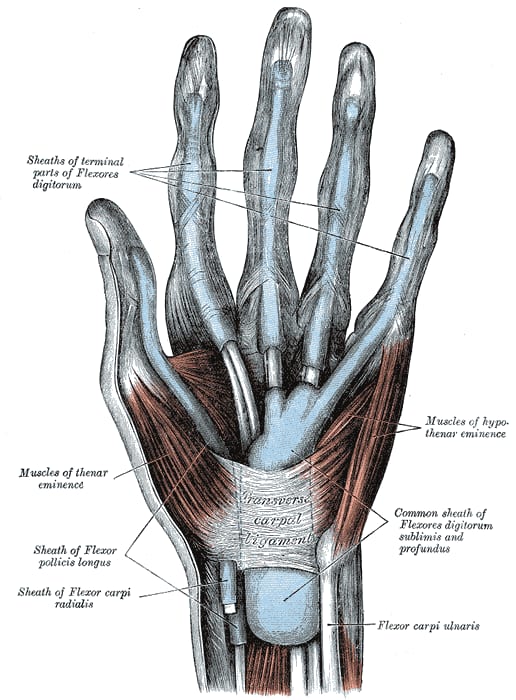
The carpal tunnel is a narrow channel at the front of the wrist. Its floor and walls are the small wrist bones and its roof is a tough band of tissue called the transverse carpal ligament. Nine tendons that bend your fingers run through it, along with the median nerve, which supplies feeling to the thumb, index finger, middle finger and half of the ring finger.
When the space inside the tunnel shrinks or its contents swell, pressure on the nerve goes up. NICE's Clinical Knowledge Summary describes this as reducing blood supply to the nerve and slowing its signals, which is what produces the pins and needles. It is the most common nerve entrapment in the arm, and in most people no single cause is ever found.
The NHS lists the usual symptoms as aching or pain in the fingers, hand or arm, numbness, tingling, and a weak thumb or trouble gripping. They tend to come on slowly, come and go, and get worse at night. A lot of people describe waking up and shaking their hand out to get the feeling back. Clinicians call that the flick sign, and it is one of the more telling features in the history.
Who gets it, and the keyboard question
The NHS lists the main risk factors as being overweight, pregnancy, work or hobbies that involve repeated wrist bending or hard gripping (vibrating tools are the classic example), arthritis, diabetes, a previous wrist injury, and a parent or sibling with the condition. NICE adds hypothyroidism and rheumatoid arthritis to that list.
The one most people expect to see is typing, and the evidence there points the other way. A Swedish population study found that people who used a keyboard for four or more hours a day were less likely to have carpal tunnel syndrome than people who used one for under an hour or not at all (2.6% against 5.2%). Typing will not protect your wrists, and a desk job can still aggravate symptoms you already have. But office work on its own is a weaker explanation than most people assume, and forceful gripping, vibration and the medical risk factors above are worth looking at first.
Pregnancy is worth its own mention. Fluid retention narrows the tunnel, and the NHS notes that pregnancy-related carpal tunnel often settles on its own within a few months.
What else can feel like carpal tunnel
Tingling in the hand is not automatically carpal tunnel. NICE advises that the assessment should cover the whole arm, including the neck, shoulder and elbow, to rule out other causes, especially when the pattern is unusual. The common mimics are:
- A nerve root irritated in the neck. This often comes with neck pain, and the symptoms may run down the arm rather than starting in the hand.
- Ulnar nerve problems at the elbow. These affect the little finger and the outer half of the ring finger, which is the opposite side of the hand from carpal tunnel.
- Thumb base arthritis. This gives an ache at the base of the thumb on pinching and gripping, and NICE lists it as a risk factor for carpal tunnel too, so the two can coexist.
Which fingers are affected is one of the most useful clues. If your little finger is involved, carpal tunnel is less likely to be the whole story. During an assessment, the clinician will usually check sensation and thumb strength, look for wasting at the base of the thumb, and use provocation tests such as Phalen's test (holding the wrist bent for 60 seconds) and Tinel's test (tapping over the nerve at the wrist), all of which NICE describes in its assessment guidance. Nerve conduction tests are not usually needed when the symptoms are typical. They are used when the diagnosis is uncertain or surgery is being planned.
What the evidence says about conservative care
For mild or moderate symptoms, NICE recommends a six-week trial of conservative treatment: a night splint holding the wrist in a neutral position, a steroid injection, hand exercises or mobilisation, or a combination, followed by a review at six weeks if symptoms persist. Here is how each option holds up.
Night splints. A wrist splint stops the wrist curling into a bent position while you sleep, which keeps pressure in the tunnel lower. The 2023 Cochrane review of 29 trials was honest about the limits: the evidence is low certainty and any benefit may be small. It also concluded that splints are cheap, have no plausible long-term harm, and that people may be more likely to report overall improvement with night splints than with nothing. The NHS suggests wearing one for up to six weeks before judging it.
Steroid injection. This has the strongest evidence of the non-surgical options. The Cochrane review comparing injection with placebo concluded that it works for mild and moderate carpal tunnel, with benefits lasting up to six months and a reduced need for surgery up to 12 months. In the UK INSTINCTS trial, published in The Lancet, 234 primary care patients were given either one injection or a night splint, and the injection group had better symptom and function scores at six weeks. The NHS is clear that symptoms can return after a few months, so an injection buys relief and time rather than a guaranteed end point.
Exercises and hands-on treatment. This is where honesty matters for a clinic like ours. The Cochrane review of exercise and mobilisation, covering 16 trials, found only limited, very low quality evidence of benefit, and recommended that patients who want this kind of treatment are told about the limited evidence. The NHS describes a small amount of evidence for hand exercises. So nerve gliding, wrist mobilisation and soft tissue work are reasonable to try as part of a plan, particularly when the neck, shoulder or forearm are also contributing, but nobody should sell them to you as a proven standalone treatment for carpal tunnel.
Changing the load. The NHS advice to cut down on frequent wrist bending, hard gripping and vibrating tools sounds obvious, but it is often the piece that gets skipped. A workplace assessment, tool changes or a different grip can make a real difference, and NICE includes this in its first-line advice. Painkillers may take the edge off short term, but the NHS notes there is little evidence they treat the cause.
When to escalate, and what surgery offers
NICE advises specialist referral when the diagnosis is unclear, when symptoms persist despite conservative treatment, when symptoms are progressing or severe enough to affect daily function, or when symptoms come back after surgery. In practical terms, the signs that you have moved past the self-management stage are:
- Numbness that is there all the time rather than coming and going.
- Weakness when pinching or gripping, or dropping things.
- Visible thinning of the muscle at the base of the thumb.
- No real change after six weeks of splinting and load changes.
Constant numbness and muscle wasting suggest the nerve is under sustained pressure. That is not something to sit on for months. Book a GP appointment and say clearly that you have weakness or constant numbness.
Surgery, called carpal tunnel release, cuts the roof of the tunnel to take the pressure off the nerve. The NHS describes a roughly 20-minute day case under local anaesthetic, with about a month to get back to normal activities. The NHS calls it a usual cure. The research picture is more mixed than that. The 2024 Cochrane review of surgery against non-surgical treatment found surgery probably gives a higher rate of clinical improvement than splinting in the longer term, but probably not a clinically important difference in symptom or function scores. It concluded that people with severe symptoms who want the best chance of improvement may choose surgery, while those with tolerable symptoms who have not yet tried non-surgical options can reasonably start there and have surgery only if needed.
That is a sensible way to frame it. Surgery is a good option for the right person at the right point. It does not have to be the first move.
Where an osteopath fits in
Osteopaths do not inject or operate, so for carpal tunnel our role is narrower than it is for, say, back pain. What an assessment at the clinic can usefully do is check whether the pattern fits carpal tunnel or something else, such as a nerve root problem in the neck, and look at the whole arm. The clinic team can set up a splinting and load plan, work on the neck, shoulder and forearm where they are contributing, and give you clear criteria for when to go to your GP for an injection or a surgical opinion. In my years of practice, the patients who did best were the ones who knew from the start which signs meant they should stop waiting.
If your symptoms are mild and come and go, conservative care is a reasonable start. If you already have constant numbness or a weak thumb, see your GP first. The conditions we treat page covers the rest of what the clinic sees.
When to see a GP urgently
Most carpal tunnel is not an emergency, but some hand and arm symptoms need prompt medical attention:
- Numbness or weakness in an arm that comes on suddenly. If it comes with a drooping face or slurred speech, call 999.
- Numbness or weakness in both arms, or in your legs as well, or problems with walking, balance, or bladder or bowel control. Call 999 or go to A&E.
- Rapidly worsening numbness or swelling after a wrist injury or fracture.
- Constant numbness, wasting at the base of the thumb, or loss of grip. Book a GP appointment soon.
If this sounds like what you're dealing with, an assessment is the next step. Book online here.
Illustration: the transverse carpal ligament and flexor tendon sheaths of the hand, Gray's Anatomy (1918), public domain, via Wikimedia Commons.