
Sudden pain in the back of the calf in anyone over 35 is most often a tear of the medial head of the gastrocnemius, the inner of the two big calf muscles. It has a nickname, tennis leg, and tennis is rarely involved. The usual story is a push off, a sprint for a bus or a change of direction, followed by the feeling of being kicked hard in the back of the leg.
Two things about this injury get handled badly. The first is a small but real chance that the pain is a blood clot rather than a torn muscle. The second is the recovery timeline, which most people underestimate by roughly half.
The short version
- Sudden calf pain over 35 is usually a medial gastrocnemius tear.
- The nickname is tennis leg. Tennis is rarely the cause.
- Up to 10 per cent of these presentations turn out to be a blood clot.
- Elite athletes return to play in about 19 days. Recreational timelines run longer.
- Most recurrences happen within six months of the first tear.
What actually tears
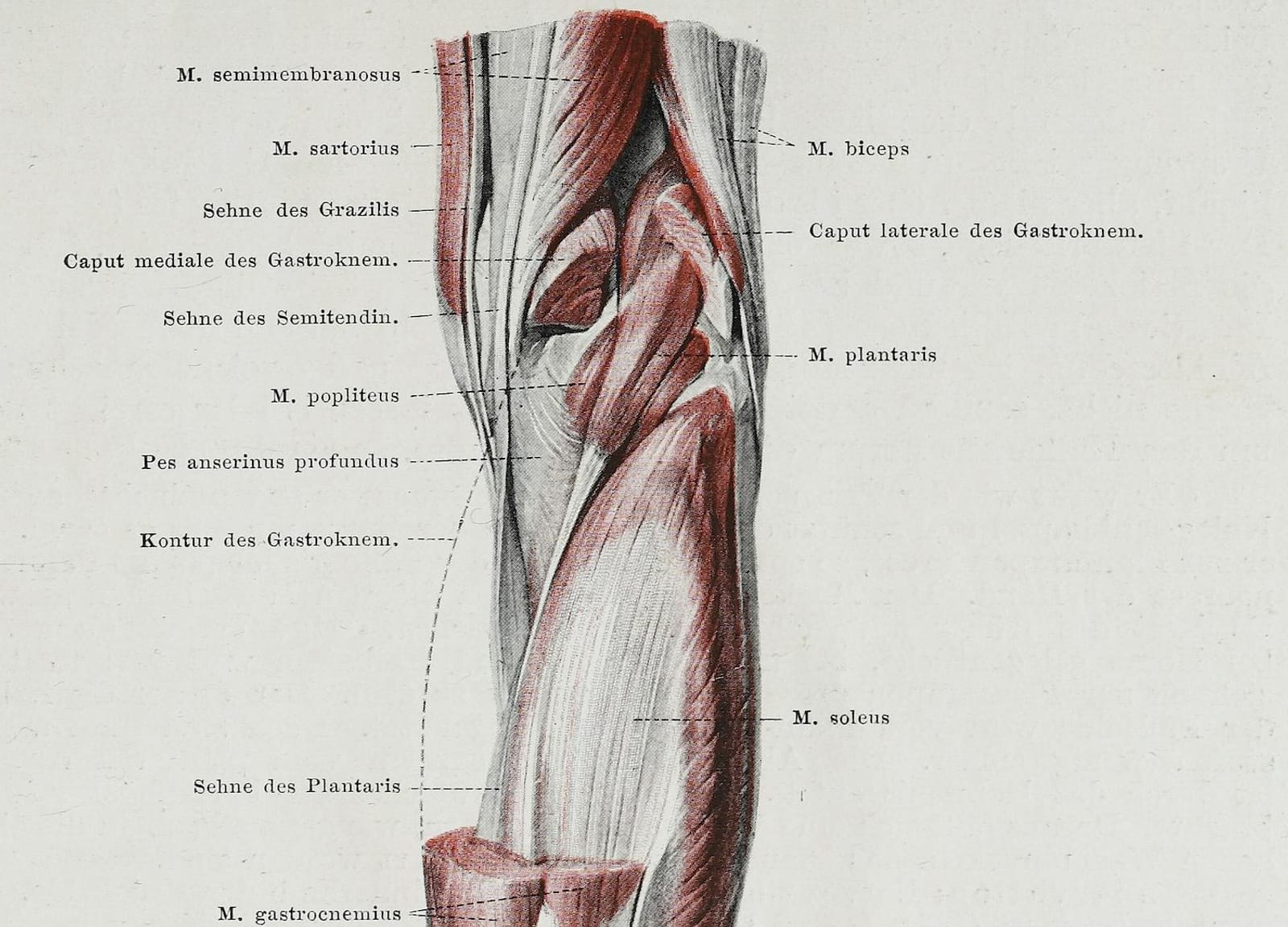
The calf is two muscles stacked on each other. The gastrocnemius is the visible one, with a medial and a lateral head that start above the knee and run down into the Achilles tendon. Underneath sits the soleus, flatter and deeper, starting below the knee and feeding into the same tendon. Because the gastrocnemius crosses both the knee and the ankle, it takes the most strain when the knee is straight and the ankle is being driven into a push off.
The medial head is the one that goes. In a ten year cohort of 82 MRI confirmed gastrocnemius injuries in elite Australian Football players, 78 per cent involved the medial head. The tear itself is usually not in the middle of the muscle belly. It happens at the junction where muscle fibres blend into the aponeurosis, the broad sheet of connective tissue that transmits force into the tendon.
For over a century the injury was blamed on rupture of the plantaris, a small and largely vestigial muscle running alongside the calf. Ultrasound and MRI have since shown that most cases are gastrocnemius or soleus injuries and the plantaris is only rarely involved. If someone tells you that you have snapped your plantaris, the odds are against it.
One more feature explains something patients often find alarming. An ultrasound series of 30 patients aged 30 to 45 found a fluid collection between the medial gastrocnemius and the soleus in 83 per cent of them. That fluid and the bleeding around it drain downwards under gravity, which is why a calf tear can produce a spectacular bruise around the ankle and heel two or three days later, well away from where it hurts.
Why it happens more from your 40s onwards
Calf pain turns up in runners of every age, but it is most frequent in masters athletes. The mechanism is not mysterious. The calf absorbs and produces very high forces at push off and landing, the muscle and its connective tissue lose some of their tolerance for rapid stretch with age, and most people over 40 do their sport in concentrated bursts rather than daily.
The same Australian Football data set found that older age, a running related mechanism and a recent change in training load all predicted a longer recovery. Acceleration was the single most common running mechanism recorded. That is the sprint for the ball, the sprint for the bus, the first fast tennis point of the summer.
In my years of practice, the calf tears that came through the door were rarely full time athletes. They were people fit enough to sprint and not conditioned enough to absorb it, usually with a five day gap between anything strenuous.
Rule out a blood clot before you rehab anything
This is the part that matters most. Reviewing the imaging literature on tennis leg, up to 10 per cent of these presentations turn out to be a deep vein thrombosis masquerading as a muscle injury. One in ten is not a rare exception. It is a routine part of assessing calf pain.
The NHS lists the symptoms of DVT as throbbing pain in one leg, usually in the calf or thigh, swelling in one leg, skin around the painful area that looks red, blue or darker than usual, and swollen veins. The risk goes up if you are over 60, have recently had surgery or a hospital stay, have taken a journey of more than four hours, are pregnant or within six weeks of giving birth, take the combined pill or HRT, or have had a clot before.
The most useful distinction in practice is the moment. A torn calf almost always has one, a specific instant where it happened and often an audible or felt snap. A clot usually builds over hours or days with no injury behind it. That is a rule of thumb rather than a test, and it does not replace an assessment.
If you think you might have a DVT, the NHS advice is to ask for an urgent GP appointment or call 111 the same day, and to call 999 if you also have chest pain or shortness of breath. Separately, NHS guidance on strains says to contact 111 if the injury is very painful or getting worse, if there is a large amount of swelling or bruising, or if you cannot use the limb normally. In my experience the other injury that gets confused with a calf tear is a complete Achilles rupture, which sits lower down at the tendon and leaves you unable to push off the ball of the foot at all. That needs assessing the same day.
How long a calf strain really takes
There are decent numbers on this, and they depend almost entirely on whether the connective tissue is involved rather than on how much it hurts on day one.
A study of 100 patients with 114 calf injuries graded each tear on MRI by the integrity of the connective tissue. Mean time to return to play was 8 days for grade 0, 17 days for grade 1, 25 days for grade 2 and 48 days for grade 3, where grade 3 means the connective tissue itself has failed. Connective tissue was involved in 63 of the 100 patients.
A separate analysis of 149 calf strains in Australian Football found the same pattern. Players with severe disruption of the aponeurosis took 31.3 days to return to play against 19.4 days for those without it. In the ten year gastrocnemius cohort, the median milestones were 3 days to walk pain free, 14 days to run at more than 90 per cent of maximum speed, 14 days to full training and 19 days to return to play.
Read those numbers with one caveat firmly in mind. Every one of them describes a professional athlete with daily supervised rehabilitation, a medical team and no job to go to in between. For everyone else they are a floor, not a forecast. The NHS puts it more conservatively: most strains feel better after two weeks, strenuous exercise such as running should be avoided for up to eight weeks, and severe strains can take months to get back to normal.
What to do, week by week
Days 0 to 3. The NHS recommends PRICE for the first two to three days: protection, rest, ice for up to 20 minutes every two to three hours, compression with a bandage during the day, and elevation. It also advises avoiding heat, alcohol and massage in that window, and suggests ibuprofen gel or spray before oral anti inflammatories. The small ultrasound series mentioned earlier found that the compression group healed faster than the group treated conservatively. Thirty patients is not proof, but compression is cheap and low risk, so it is worth doing properly. A heel raise in both shoes for the first week or two takes some load off a healing calf and stops you limping.
Days 3 to 14. The first target is walking without a limp. Once that is comfortable, isometric work comes in: standing with weight through both feet, heels lifted, holding for 30 to 45 seconds. Then double leg heel raises, slow, within a pain limit you can live with rather than a pain limit of zero.
Weeks 2 to 6. This is the part people skip, and it is the part that decides whether the injury returns. Progress from double leg to single leg heel raises, and do them both with a straight knee, which loads the gastrocnemius, and with a bent knee, which shifts load onto the soleus. Three sets of ten is a reasonable starting point, adjusted to what the leg tolerates the next morning rather than what it tolerates during the set.
Weeks 6 and beyond. Running comes back gradually, and speed work comes back last, because acceleration is the mechanism that tore it in the first place. Loading the tissue progressively is what builds tolerance. Aggressive stretching of a junction that is still knitting tends to keep it irritated, which is a clinical view rather than something with strong trial data behind it. If you want structured loading rather than guesswork, that is what exercise rehabilitation is for.
Why calf strains come back
Calf tears recur more than most muscle injuries. In the gastrocnemius cohort, 79 per cent of recurrences happened within six months of the original injury. The larger calf strain analysis found that a previous calf strain raised the risk of recurrence within two seasons substantially, that older age raised it too, and that early recurrence was associated with older age and a history of ankle injury.
The reason is usually simple. Pain settles well before capacity returns. People stop doing the loading work at around week three because the leg feels normal walking, and then ask it to produce a maximal push off six weeks later on a leg that has not done anything hard since the tear. Matching the uninjured side for single leg heel raises, in both quality and number, is a better signal to go back to sport than the absence of pain.
If your ankle has a history of sprains, it is worth dealing with that too rather than treating the calf in isolation.
If this sounds like what you are dealing with, an assessment is the next step. We are in Stopsley, Luton, and you can book online here.
Illustration: Braus, Anatomie des Menschen (1921), public domain, via Wikimedia Commons.