

Partly. Getting back on a sprained ankle as soon as pain allows is good advice, and the research supports it. Where "walking it off" goes wrong is when walking is the whole plan: no strength or balance work, straight back to sport, and an ankle that keeps going over for years afterwards.
So the useful question is less "should I rest it or walk on it" and more "what do I do once I can walk on it". That second part is where most of the long-term problems start.
The short version
- Early movement helps most ankle sprains recover faster than immobilisation.
- Severe sprains can recover faster with a short spell in a cast.
- Many people still have pain or instability months after a first sprain.
- Balance training after a sprain cut repeat sprains by about a third.
- Being unable to bear weight or a misshapen ankle needs an X-ray.
What a sprained ankle actually is
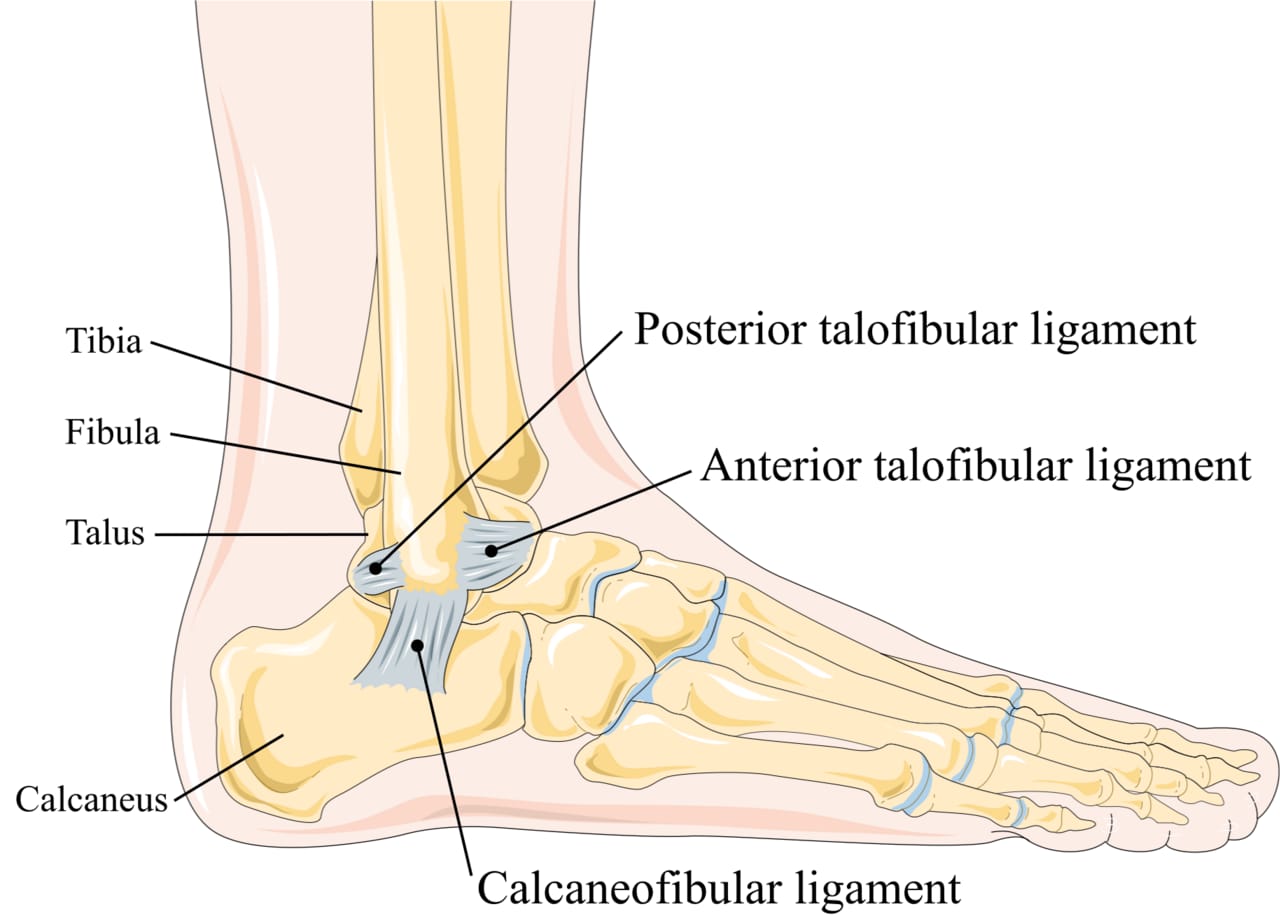
A sprain is a torn or twisted ligament, the tissue that connects one bone to another at a joint. The usual ankle sprain happens when the foot rolls inwards and the ligaments on the outside of the ankle take the strain. The illustration above shows the three of them: the anterior talofibular ligament at the front, which is usually the first to go, the calcaneofibular ligament below it, and the posterior talofibular ligament behind.
A review of 181 prospective studies in Sports Medicine found this outside (lateral) sprain was the most common type by a distance. Indoor and court sports carried the highest rates, and women and children were sprained more often than men and adults. Netball, basketball, five-a-side and squash are the classic settings, along with a pothole on an evening run.
Where "walk it off" is right
Getting moving early is one of the better-supported things in musculoskeletal care. An overview of 46 systematic reviews in the British Journal of Sports Medicine found strong evidence that early mobilisation improves pain, swelling and function after an acute sprain, with moderate evidence for exercise and manual therapy.
The NHS advice fits with this. For the first 2 to 3 days, protect the ankle, ice it, compress it and keep it raised. After that, once you can move it without the pain stopping you, keep moving it so the joint does not stiffen. Most sprains feel better within about 2 weeks, but the same page advises avoiding strenuous exercise such as running for up to 8 weeks.
Anti-inflammatory gels and tablets help some people with the pain. A Dutch evidence-based guideline published in BJSM adds a note of caution, though: they can reduce pain and swelling, but they are not without complications and may dampen the natural healing process.
Where it goes wrong: the bad sprain
Walking it off works less well when the sprain is severe. In the Collaborative Ankle Support Trial in The Lancet, 584 people with severe sprains from eight UK emergency departments were given either a compression bandage, an Aircast brace, a Bledsoe boot or a 10-day below-knee cast. The cast group recovered faster, with ankle function about 9% better than the bandage group at 3 months. By 9 months the groups had largely caught up.
The same Dutch guideline makes a related point: a short period of immobilisation may help with pain and swelling, but after a lateral ligament rupture, tape or a brace combined with an exercise programme works best. It also notes that the severity of the ligament damage is judged most reliably 4 to 5 days after the injury, once the first swelling has settled. A day-one guess at how bad it is can be wrong in either direction.
The bigger problem: stopping when the pain stops
Most people take "it feels fine now" as the end of the injury. The evidence suggests the ankle often disagrees. A 2022 meta-analysis of 15 studies on first-time lateral sprains found residual pain in roughly 49% of people at 3 months and 7% at 12 months. A sense of the ankle giving way fell from about 38% at 3 months to 8% at a year, and around 16% had sprained it again within 12 months. The confidence intervals are wide, so read these as rough sizes, but the pattern is consistent.
The good news is that this part responds to training. In a randomised trial in the BMJ, 522 athletes who had recently sprained an ankle were given either usual care or usual care plus an 8-week home balance programme. Over the following year, 22% of the training group sprained again, against 33% of the control group, a 35% lower risk. The benefit was clearest in people whose original sprain had not been medically treated, which describes most of the people who walk it off.
The BJSM overview above found strong evidence for bracing and moderate evidence for neuromuscular (balance and control) training in preventing repeat sprains. The Dutch guideline prefers supervised exercise to passive treatments, and reserves surgery for ankles that have not responded to a thorough exercise-based programme.
A sensible plan for a typical sprain
This is a general outline for a straightforward sprain. It is not a substitute for being assessed if any of the warning signs in the next section apply.
- For the first 2 to 3 days, protect the ankle, use ice and compression, and keep it raised when you can.
- Walk as soon as the pain allows, aiming for a normal heel-to-toe step rather than a limp. A brace or support can help here.
- Over the next couple of weeks, add ankle circles, calf raises and standing on the injured leg, progressing to eyes closed or a cushion underfoot.
- Before going back to sport, check you can hop, land and change direction on that leg without pain or the ankle feeling unstable.
- For the first months back at sport, a brace or tape is a reasonable extra layer of protection.
If the ankle is slow to settle or keeps giving way, this is the kind of progression our exercise rehabilitation work is built around.
When a sprain needs checking
Not every painful ankle is a sprain. Clinicians use the Ottawa ankle rules, a short set of bone-tenderness and weight-bearing checks, to decide who needs an X-ray. A meta-analysis of 66 studies found the rules picked up about 99% of fractures, so a negative result makes a break very unlikely. They flag plenty of ankles that turn out not to be broken, which is why a positive result means an X-ray rather than a diagnosis.
The NHS advises going to A&E if your ankle is at an odd angle, a bone is sticking out, there is a bad wound, the pain is severe, or your toes look blue or white or feel numb. Do not drive yourself there.
Get help from NHS 111 if the ankle is very painful or getting worse, there is a large or increasing amount of swelling or bruising, you cannot put weight on it or walk more than a few steps, it is very stiff, it is not improving with self-care, or you also have a high temperature or feel hot, cold or shivery.
Outside those situations, an ankle that is still painful, still swelling or still giving way after several weeks is worth having assessed properly rather than walked off for another month.
If this sounds like what you're dealing with, an assessment is the next step. Book online here.
Illustration: Servier Medical Art (Laboratoires Servier), CC BY-SA 3.0, via Wikimedia Commons.